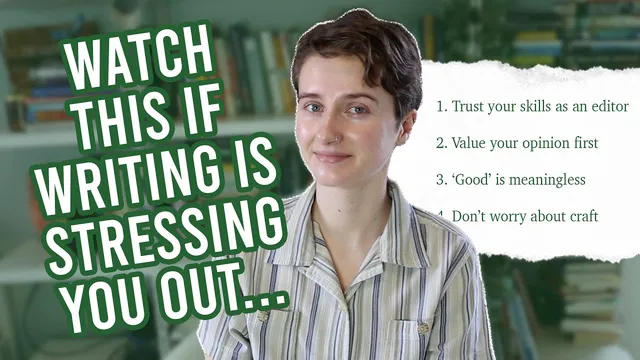
Writing Lessons I Wish I'd Learned Sooner (aka how to stop worrying)
Based on ShaelinWrites's video on YouTube. If you like this content, support the original creators by watching, liking and subscribing to their content.
Trust in editing grows through repeated revision; fear of fixing flaws fades once developmental editing becomes familiar.
Briefing
The central message is that writing gets easier—and better—when a writer stops treating the first draft as a verdict and instead trusts revision, personal taste, and inner motivation. That shift matters because it reduces the anxiety that comes from trying to be perfect immediately, and it reframes editing as a creative process that uncovers depth rather than a punishment for mistakes.
The first lesson centers on trusting editing skills. Stress during drafting often comes from micromanaging and fear that flaws in a draft can’t be fixed later. The remedy is familiarity: trust grows only after someone has actually revised enough to see that large-scale changes are doable. The narrator describes how developmental editing—especially the first time tackling major structural revisions—once felt overwhelming, with past editing habits swinging between light edits and full rewrites. Over time, revision became satisfying: scenes and subplots started to “take shape,” and the writer began looking forward to editing rather than dreading it. With that confidence, imperfections in early drafts no longer trigger panic; instead, they become raw material for later discovery. Editing, in this view, isn’t just about correcting logic or structure—it’s also where nuance, complexity, and hidden emotional layers are uncovered, almost like a scavenger hunt through one’s own manuscript.
The second lesson argues that writers are allowed to have their own philosophy. Progress stalls when someone treats differing craft beliefs as a threat or judges other creators as “wrong.” Since art is personal and shaped by experience, there shouldn’t be a single universal approach to writing. Less friction comes from focusing on one’s own values—why a person writes, what excites them, what kind of stories matter to them—rather than trying to win debates about craft.
Third, the phrase “the reader knows best” is called a trap. With hundreds of readers, opinions will conflict, and catering to shifting feedback turns drafting into endless catch-up—slowing down, speeding up, adding foreshadowing, then being told it’s still wrong. Feedback can be useful, but it should be treated as collaborative input that the writer can adapt to their own vision, not as a mandate to chase consensus. The hierarchy of trust should place the writer first, because the book is a long-term commitment while readers spend only hours with it.
Fourth, being a beginner is not a weakness; it’s a mindset worth maintaining. Writers shouldn’t expect immediate excellence. Continual beginner curiosity keeps learning alive and prevents shame from killing the fun of drafting.
Fifth, “good” is an inadequate goal. Many beloved works can still receive harsh reviews, suggesting that “good” is too vague and subjective to guide the work. Instead, the more durable question is why someone writes—often tied to honesty about human confusion, pain, and messiness, delivered with clarity and compassion.
Sixth, impactful writing depends on what can’t be taught in a lecture: emotional sensitivity, openness to life, and genuine engagement with people and the world. Craft knowledge—structure, technique, rules—can be learned, but it should serve the writer rather than become a source of worry. Over-focusing on technical perfection can crowd out the realness that gives writing its depth. The closing prompt ties everything together: what truly sparks someone’s creativity, and why do they write?
Cornell Notes
The transcript argues that writing anxiety often comes from mistrusting revision and trying to be “good” immediately. Trusting editing grows through experience: developmental revision can feel overwhelming at first, but it becomes satisfying once flaws are seen as fixable material. Writers are also urged to keep their own philosophy, because art has no universal rules and reader opinions conflict. “The reader knows best” is framed as misleading; feedback should be used selectively to strengthen the writer’s intent, not to chase contradictory tastes. Finally, impactful writing depends more on emotional sensitivity and engagement with people than on technical craft alone.
Why does the speaker say drafting stress often comes from a lack of trust in editing?
What changes when developmental editing becomes less scary?
How does the transcript challenge “the reader knows best”?
What does it mean to have a personal writing philosophy?
Why does the transcript say “good” is a misleading end goal?
What makes writing impactful, according to the transcript?
Review Questions
- What specific mechanism turns editing from a source of fear into a source of satisfaction in the transcript’s account?
- How does the transcript justify using feedback without surrendering creative control?
- Which parts of writing are described as teachable versus honable, and why does that distinction matter for reducing rule-based anxiety?
Key Points
- 1
Trust in editing grows through repeated revision; fear of fixing flaws fades once developmental editing becomes familiar.
- 2
Editing is more than structural repair—it also reveals depth, nuance, and complexity that first drafts bury.
- 3
Writers don’t need a universal craft philosophy; personal values and methods are legitimate and reduce community friction.
- 4
“The reader knows best” fails because reader opinions conflict; feedback should strengthen the writer’s intent, not replace it.
- 5
Maintaining a beginner’s mindset protects curiosity and learning, preventing shame from killing the fun of drafting.
- 6
Chasing “good” as an end goal can become a trap; clearer motivation comes from asking why someone writes.
- 7
Impactful writing depends heavily on emotional sensitivity and engagement with people, not just technical rule-following.