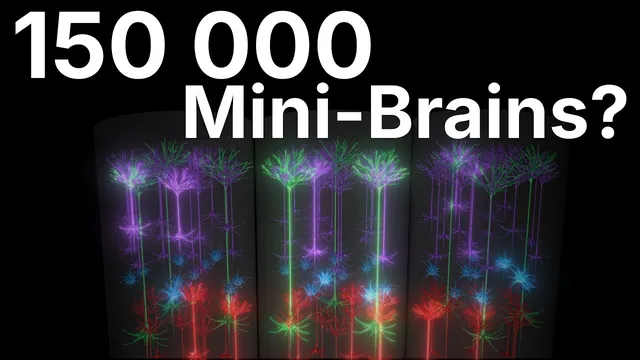
Your Brain Is 150,000 Mini-Brains
Based on Artem Kirsanov's video on YouTube. If you like this content, support the original creators by watching, liking and subscribing to their content.
Neocortex columns show both shared six-layer anatomy and consistent functional tuning, supporting the idea of repeated processing modules.
Briefing
The neocortex may work less like a patchwork of specialized brain regions and more like a single repeating computation: thousands of “mini-brains” (cortical columns) each learn a predictive model by binding sensory inputs to location signals generated through movement. The payoff is a unified explanation for how the same neural machinery can support perception, language, and abstract reasoning—without requiring evolution to invent and wire together hundreds of different algorithms.
For more than a century, researchers have found that the neocortex’s anatomy follows a common blueprint: the same six-layer circuitry and cell types recur across the cortical sheet. Functionally, experiments strengthened the case for a “columnar” principle. When electrodes were lowered through the cortical layers, neurons within a vertical column—roughly half a millimeter wide—responded to the same patch of skin in the somatosensory cortex. A similar pattern emerged in the visual system, where columns were tuned to lines with particular orientations. Taken together, the evidence suggests the cortex is built from repeated processing modules rather than many unrelated structures.
The thousand brains theory (pioneered by Jeff Hawings and the Nenta team) turns that anatomical regularity into a computational claim. If each column shares the same functional hardware, then each column likely runs the same universal algorithm. Instead of the brain constructing one centralized model of the world, each cortical column builds its own complete predictive model. Conscious experience then emerges from rapid cross-column “voting,” where competing hypotheses reinforce one another when they agree and get suppressed when they don’t.
A key mechanism for building a model is sensory–motor coupling. The theory uses a dark-room analogy: touching an unseen statue with only fingertip sensations yields disconnected features (smooth, sharp, rough) but no coherent object. When the brain also tracks movement—updating a mental reference frame via path integration—those features become anchored to locations. With that reference frame, a column can predict what sensations should occur if the sensor moves again.
The theory further proposes that this sensory–motor loop is implemented across the neocortex’s six layers. Layer 4 acts as the primary input port for “what” information, receiving sensory data. Layer 6 is predicted to contain grid cell–like neurons that track “where” by performing path integration using movement-related signals. Layer 5 generates motor outputs and also sends a copy of motor commands upward so layer 6 can update its internal coordinates. Layers 2–3 then bind sensory features with location context to form object-level representations, while layer 1 helps prime dendritic activity to set up predictions.
To explain why this architecture might have appeared so quickly in evolution, the theory offers a simple scaling story: evolution didn’t need to invent many new cognitive components; it could expand intelligence by adding more instances of the same columnar module. Finally, the same algorithm is claimed to scale upward into abstract thought. Higher-level columns can treat the outputs of lower columns as their “sensory input,” and their “motor commands” can correspond to shifts in attention or memory retrieval—turning navigation through physical space into navigation through conceptual space.
Cornell Notes
The thousand brains theory treats the neocortex as a set of repeating “mini-brains” (cortical columns) that all run the same universal algorithm. Each column builds a predictive model by binding sensory features (“what”) to a location-based reference frame (“where”) computed through sensory–motor coupling and path integration. The theory maps this loop onto the neocortex’s six layers: layer 4 supplies sensory input, layer 6 provides grid-like coordinate tracking, layer 5 generates motor output (and sends a copy for updating coordinates), and layers 2–3 bind features with context to form stable object representations. Perception becomes unified through voting: columns exchange sideways signals so mutually consistent hypotheses reinforce and inconsistent ones fade. The same mechanism is proposed to extend from physical perception to abstract reasoning by swapping physical sensors/movements for attention and memory shifts.
What evidence supports the idea that the neocortex is organized into repeating columns rather than many unrelated circuits?
How does the thousand brains theory connect predictive modeling to cortical columns?
Why is movement essential in this framework, and what is “path integration” doing?
How does the theory map “what” and “where” signals onto specific cortical layers?
What does “voting” mean in practice, and how does it resolve ambiguity?
How does the same algorithm scale from physical perception to abstract reasoning?
Review Questions
- What specific role does path integration play in turning raw sensory features into a structured model?
- How do layers 4, 5, 6, and 2–3 each contribute to the sensory–motor loop described by the thousand brains theory?
- Why does the theory predict that adding more cortical columns can increase intelligence without inventing new cognitive modules?
Key Points
- 1
Neocortex columns show both shared six-layer anatomy and consistent functional tuning, supporting the idea of repeated processing modules.
- 2
The thousand brains theory proposes that each cortical column runs the same universal predictive algorithm rather than the cortex acting as one monolithic model-builder.
- 3
Sensory–motor coupling is central: movement updates a reference frame so sensory features can be bound to locations.
- 4
Layer 4 is treated as the main “what” input channel, while layer 6 is predicted to provide grid-like “where” tracking using movement-derived signals.
- 5
Layer 5 generates motor outputs and also provides an internal copy of motor commands that helps layer 6 perform path integration.
- 6
Layers 2–3 bind sensory features with location context to form stable object-level representations, with layer 1 priming predictions.
- 7
Unified perception emerges through voting: hypotheses consistent across columns reinforce each other while inconsistent interpretations fade quickly.