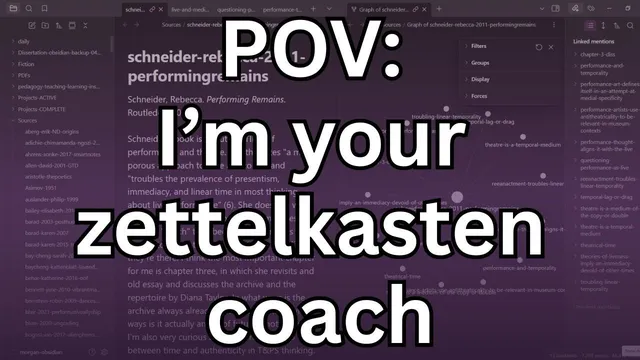
Zettelkasten Coaching Session in Obsidian
Based on morganeua's video on YouTube. If you like this content, support the original creators by watching, liking and subscribing to their content.
Replace opaque note titles with thesis-like filenames that state the core idea so notes are searchable without opening them.
Briefing
A Zettelkasten-style note in Obsidian gets transformed from a vague, hard-to-search title into a set of atomic, linkable ideas—so the note can be rediscovered years later without rereading the whole source. The coaching centers on a practical problem: when note titles don’t communicate meaning, a growing library becomes unusable because finding depends on memory, not retrieval.
The session zooms in on one note originally titled “final take on his mother,” drawn from Barbara Kingsolver’s The Lacuna. As written, the title is too opaque—if it appears in a list, it doesn’t tell the reader what it’s about. With hundreds or thousands of notes, that kind of naming forces a user to open the file and read through it just to understand relevance. The fix starts by treating the note as an atomic unit: each note should express a single solid idea, but still be searchable and richly connected.
The work begins by separating out what belongs to the source commentary versus what belongs to the note’s thesis. A sentence about how relationships in the book are described well is treated as commentary on the book overall, not the specific idea the note is meant to capture. That sentence is moved to the book’s own note, while the mother-related passage is used to derive a tighter set of ideas.
From the mother passage, multiple related ideas emerge. One becomes the note’s core thesis: women are expected to take up less space as they age. Supporting ideas are split into additional atomic notes, including that women’s worth diminishes in society as they age and that women’s worth is tied to their ability to entertain or please men. The coaching emphasizes that these ideas are interconnected, but each deserves its own note so the network can grow cleanly.
The note is then restructured for retrieval. The quote is placed prominently, with context written in the note’s own words immediately before it—framing what’s happening in the novel at the moment the quote appears, and linking back to the source note for the novel. After the quote, the note’s own interpretation is written as a sentence that can stand alone as a thesis, then supported by links to the other atomic ideas (e.g., diminishing worth, worth tied to serving men). The remaining narrative detail—such as the mother not being “a great mother” but loving in her way—stays as relevant connective tissue rather than becoming the main thesis.
Finally, the system is treated as permanent but not frozen. Permanent notes remain in place, yet they can be expanded with new quotes, tags, or clarifying connections as the reader encounters overlapping ideas in later books. Tags and backlinks are used to prevent “orphan” notes: if a note belongs to multiple themes (like women’s worth and aging), it can be cross-referenced so future writing can surface it quickly. The session closes by stressing consistency—regularly working inside the system, using plugins like a random note surfacing tool, and relying on atomic notes plus links to keep knowledge retrievable rather than forgotten.
Cornell Notes
The coaching demonstrates how to repair a Zettelkasten note in Obsidian so it stays findable years later. A vague title (“final take on his mother”) is replaced with a thesis-like filename that states the core idea: women are expected to take up less space as they age. The quote from Barbara Kingsolver’s The Lacuna is kept, but the note is reorganized so the quote has context and the interpretation becomes an atomic, linkable claim. Related ideas—women’s worth diminishing with age and women’s worth tied to pleasing/serving men—are split into separate notes and linked back, building a retrieval-friendly knowledge network. Permanent notes can still evolve through added quotes, tags, and backlinks.
Why does the original title (“final take on his mother”) fail in a Zettelkasten library?
How does the coaching decide what belongs in the note versus what should move elsewhere?
What is the core thesis that becomes the new note title/filename?
How are multiple related ideas handled without breaking the “atomic note” rule?
What does “permanent note” mean here, and how does it affect maintenance?
How do tags and backlinks improve retrieval across overlapping themes?
Review Questions
- What retrieval failure does an uninformative title create in a large Obsidian Zettelkasten, and how does the session’s renaming strategy address it?
- How does the session use linking to keep multiple related ideas atomic rather than stuffing them into one note?
- What practices let a “permanent” note remain useful as new reading adds new evidence or angles?
Key Points
- 1
Replace opaque note titles with thesis-like filenames that state the core idea so notes are searchable without opening them.
- 2
Keep quotes but reorganize notes so the quote has immediate context and the interpretation becomes the note’s own atomic claim.
- 3
Split emerging ideas into separate atomic notes even when they originate from the same passage, then link them to preserve connections.
- 4
Use backlinks and/or tags to prevent notes from becoming orphaned when they belong to multiple themes.
- 5
Treat permanent notes as non-deletable but expandable: add new quotes, tags, and links as later reading refines the idea.
- 6
Move general book commentary to the book’s source note so each atomic note stays focused on one idea.
- 7
Maintain the system through regular use (including retrieval aids like random note surfacing) to reduce forgetting over time.