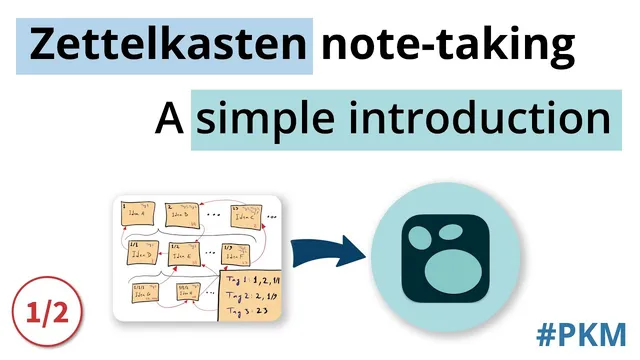
Zettelkasten note-taking with Logseq: A simple introduction (Part 1)
Based on CombiningMinds's video on YouTube. If you like this content, support the original creators by watching, liking and subscribing to their content.
Zettelkasten functions as both storage and processing; notes should be distilled and linked, not merely collected excerpts.
Briefing
A Zettelkasten setup isn’t a plug-and-play note system—it’s a “long-term conversation partner” that rewards heavy thinking, not just storage. The core pitch here is to build a logically linked network of small, processable notes that can be revisited and recombined over time, using Logseq as the digital workspace. The payoff isn’t a tidy, linear document pipeline; it’s an organic web of ideas that can surface serendipitously and grow as attention shifts.
The discussion starts by challenging the common expectation that note-taking should be a solved problem. Zettelkasten is framed as both a storage system and a processing system: notes aren’t just collected excerpts (a “collector’s fallacy”), but atomic units meant to be chewed on, linked, and used to generate new understanding. That emphasis on effort matters because the system is intensive—useful for academic research, but not effortless—and the goal becomes distilling the method into simpler building blocks that can actually be implemented.
To clarify how writing changes under this approach, the transcript compares “just-in-time” writing with “just-in-case” management. Just-in-time is deadline-driven and linear: pick a narrow topic, gather only the needed materials, and draft an essay with predictable structure. Zettelkasten is positioned as less deadline-bound: topics emerge bottom-up from clusters of notes, producing non-linear outcomes. Instead of a single essay assembled from one selected set of sources, the method samples across multiple topics and turns source material into “atomic notes,” then lets connections between those atoms drive what eventually gets written.
The method is then anchored in Nicholas Luhmann’s Zettelkasten. Luhmann—an intensely prolific German sociologist with an online archive of notes—used a branching address scheme so notes could be sequenced and drilled into. The transcript illustrates this with a fairy-tale example: start with separate “entry points,” then continue or branch by incrementing numbers and appending letters in an alternating pattern. The point isn’t the story itself; it’s the mechanism for sequencing (continuation) and expansion (drill-down/branching) so the system can support multiple entry points and organic growth.
From that foundation, the creator distills design principles: atomic notes that stand alone; multiple entry points; clear relationships between notes; a scalable sequencing/branching framework; and a deliberate separation between inputs (sources) and outputs (processed notes). In Logseq, the transcript proposes replacing Luhmann’s numbers/letters with a simpler nomenclature: “tweet” titles for the distilled message, “CF” for continue/flow, “DD” for drill-down or diverging, and “R” for related notes. Sources are linked via block references to avoid cluttering the graph with direct links.
Finally, the system is treated as still evolving. The next missing piece is categorization—using keywords or a “maps of contents” style index—to group notes without losing the graph’s navigability. The transcript ends by signaling future comparisons of note systems and how they appear in graphs, while emphasizing that the real value comes from building a conversation partner: a place to return to, chew on ideas, and link them when energy and attention make sense.
Cornell Notes
Zettelkasten is presented as a “long-term conversation partner,” not a digital filing cabinet. The method treats notes as atomic building blocks that are processed (not merely collected) and then linked so new understanding emerges from combinations. Using Nicholas Luhmann’s branching address logic as inspiration, the approach emphasizes sequencing/branching (continue vs drill-down), multiple entry points, and clear relationships between notes. In Logseq, the transcript proposes a practical substitute for Luhmann’s addresses: tweet-style note titles plus tags like CF (continue/flow), DD (drill-down/diverge), and R (related), while sources are referenced via block references to keep the graph clean. The goal is a scalable system that supports organic growth and serendipitous resurfacing of ideas.
Why does the transcript insist Zettelkasten is more than storing notes?
How does the “just-in-time vs just-in-case” analogy explain the difference between traditional writing and Zettelkasten-style writing?
What is the practical role of Nicholas Luhmann’s branching address scheme?
What Logseq-specific note structure replaces Luhmann’s numbers/letters in this approach?
Why separate inputs from outputs in the note system?
What trade-off does the transcript acknowledge about atomicity and page design?
Review Questions
- How does the transcript’s “just-in-case” framing change what counts as a good writing workflow compared with deadline-driven drafting?
- In the proposed Logseq scheme, what distinguishes CF from DD, and why does that matter for how ideas later combine?
- What problem does block-referencing sources aim to solve, and how does that affect the readability of the note graph?
Key Points
- 1
Zettelkasten functions as both storage and processing; notes should be distilled and linked, not merely collected excerpts.
- 2
The method’s value comes from non-linear idea growth: writing emerges bottom-up from linked atomic notes rather than from a single predefined outline.
- 3
Luhmann’s branching address logic illustrates how sequencing and drill-down can create multiple entry points and navigable expansions.
- 4
A practical Logseq adaptation replaces Luhmann’s address scheme with CF (continue/flow), DD (drill-down/diverge), and R (related), plus “tweet” titles for the core message.
- 5
Keeping sources separate from processed notes helps avoid the collector’s fallacy and keeps the graph focused on meaning-making.
- 6
Block references can link to sources without cluttering the graph with direct edges, improving navigation.
- 7
Categorization (e.g., keywords or a maps-of-contents approach) remains a key missing component to make long-term retrieval easier.