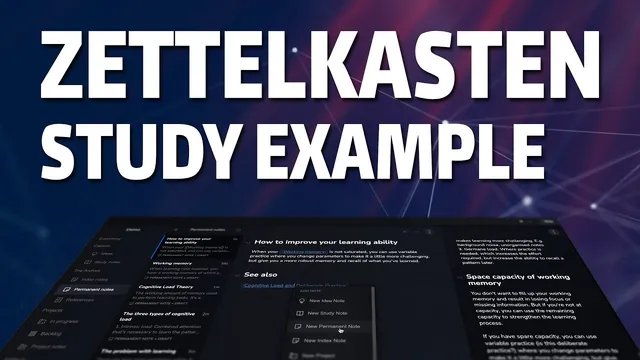
Zettelkasten Study Session: Cognitive Load Theory
Based on Martin Adams's video on YouTube. If you like this content, support the original creators by watching, liking and subscribing to their content.
Cognitive load theory frames learning difficulty as a function of limited working-memory resources consumed by learning tasks.
Briefing
Cognitive load theory is framed as a practical way to understand why learning feels harder in some situations—and how to make it easier by managing working memory. The core idea is that learning tasks draw on limited working-memory resources, and performance drops when that mental “bandwidth” gets overloaded. In the workflow described, those concepts get turned into permanent, linkable notes using a Zettelkasten-style system, so the theory isn’t just read once—it becomes reusable for future study and output.
The study session begins with an article on cognitive load theory and processes it through a “fleeting note” stage into an “archive” of permanent notes. In the notes, cognitive load is defined as the amount of working memory used to perform learning tasks. From there, the material is organized into a set of atomic notes: a high-level “cognitive load theory” note, a “problem with learning” note, and separate notes for the mechanisms that make learning difficult.
A key section breaks cognitive load into three types. Intrinsic load is tied to the inherent difficulty of the material and what the learner already knows; familiarity reduces the mental effort needed. Extraneous load comes from avoidable friction—distractions, background noise, and disorganized or poorly structured materials. Germane load (left less fully understood during note-taking) is associated with effort directed toward learning itself, such as practice that strengthens recall and storage of new information.
The most actionable takeaway links spare working-memory capacity to how practice should be designed. When working memory isn’t saturated, the learner can introduce challenges by changing variables—keeping the underlying skill the same while making the context unfamiliar. The example given is learning to draw by focusing on how the eye works, then drawing eyes from different characters to increase difficulty without changing the core technique. That approach is then compared to deliberate practice: once basic competence exists, increase complexity incrementally (but not so much that learning collapses), so effort remains productive.
Finally, the notes are organized beyond the archive into an index and project structure. An “index note” acts as an entry point for the broader topic of learning, linking down to cognitive load theory and related concepts. A “project” (such as an outline or script for a video on improving learning) is then built by selecting and arranging the relevant notes—problem framing, theory, working memory, deliberate practice, and improvement strategies—so accumulated study becomes a pipeline for creating new work.
Overall, the session treats cognitive load theory as both a learning model and a note-taking blueprint: manage working memory to improve learning, then structure notes so those insights can be retrieved, connected, and reused when building new projects.
Cornell Notes
Cognitive load theory is presented as a way to explain why learning is easy in some contexts and difficult in others: learning tasks consume limited working-memory resources. The notes break cognitive load into intrinsic load (material difficulty and prior knowledge), extraneous load (avoidable distractions and poor organization), and germane load (effort that supports learning and stronger recall). A practical improvement strategy follows from the idea of “spare capacity”: when working memory isn’t saturated, learners can increase challenge by varying practice conditions (e.g., drawing eyes from different characters). That variable practice is compared to deliberate practice, where difficulty is incrementally increased to strengthen mastery. The Zettelkasten workflow then turns these ideas into permanent, linkable notes and organizes them into an index and projects for future creation.
What does cognitive load mean in terms of working memory, and why does that matter for learning?
How do intrinsic load, extraneous load, and germane load differ?
What is the “spare capacity” idea, and how does it lead to a practice strategy?
How is variable practice connected to deliberate practice in the notes?
Why does the workflow emphasize turning study notes into permanent atomic notes?
How do index notes and projects help convert reading into creation?
Review Questions
- How would you distinguish intrinsic load from extraneous load when designing a study session?
- What does “spare capacity” imply about when to increase practice difficulty, and what’s an example of changing variables?
- How does the Zettelkasten-style linking approach (atomic notes, index notes, projects) support turning study into a script or outline?
Key Points
- 1
Cognitive load theory frames learning difficulty as a function of limited working-memory resources consumed by learning tasks.
- 2
Intrinsic load depends on inherent material complexity and the learner’s existing knowledge; prior familiarity reduces mental effort.
- 3
Extraneous load comes from avoidable friction such as distractions and disorganized learning materials.
- 4
When working memory isn’t saturated, learners can increase challenge through variable practice—changing conditions while keeping the core skill constant.
- 5
Variable practice is treated as analogous to deliberate practice: incrementally raise difficulty to strengthen recall and mastery without overwhelming the learner.
- 6
A Zettelkasten workflow turns one-off study into reusable knowledge by converting fleeting notes into permanent, linkable atomic notes.
- 7
Index notes and projects provide retrieval and assembly mechanisms for transforming accumulated reading into outlines, scripts, and other outputs.