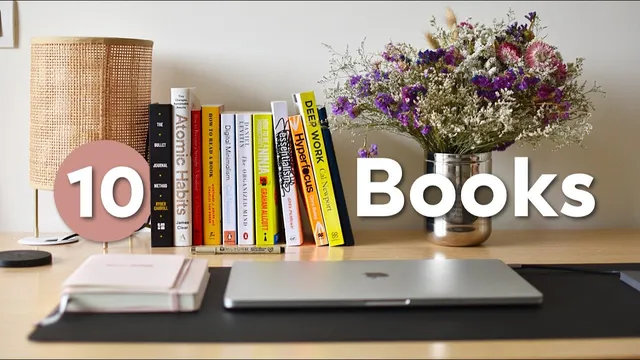
10 Books Every Student Must Read
Based on Mariana Vieira's video on YouTube. If you like this content, support the original creators by watching, liking and subscribing to their content.
Start with “How to Be a Productivity Ninja” if you need a fundamentals refresh on attention, habits, and time management.
Briefing
College productivity advice often drowns students in scattered tips, but a curated reading list offers a cleaner path: ten books aimed at building routines, improving attention, studying more effectively, and reducing digital distraction. The through-line is practical self-management—how to focus, form habits, take notes, and handle academic workload—paired with deeper frameworks for understanding why students struggle in the first place.
The list starts with “How to Be a Productivity Ninja” by Graham Alcott, pitched as a crash course for beginners or anyone who wants to refresh fundamentals. It emphasizes attention management, habit building, and the mechanics of staying organized—capturing ideas, using list-making, and applying time-management techniques that work for both students and people entering work or entrepreneurship.
For students who want a system for organizing daily life, “The Bullet Journal Method” by Ryder Carroll is recommended as the go-to guide. The book’s appeal is its flexibility: it breaks down the workflow clearly while warning against getting stuck in internet aesthetics that can overwhelm newcomers.
Habit formation gets a dedicated spotlight with “Atomic Habits” by James Clear. The core claim is that small habits—implemented one at a time—are the most reliable route to lasting change. The book is framed as especially useful once college schedules start filling up, because morning and evening routines can become “anchors” that stabilize the rest of a student’s day.
Academic performance is handled directly through “How to Become a Straight A Student” by Cal Newport. It blends practical scheduling and to-do-list strategies with guidance on studying: managing time, fighting procrastination, scheduling tasks, taking “smart notes,” and preparing for tests and quizzes. It also extends into research and writing, outlining how to conduct research, create outlines, craft a narrative, and edit papers.
Digital life is treated as both a risk and a tool. “Digital Minimalism,” also by Cal Newport, argues that technology and social media can act like intermittent positive reinforcement—driven by addictive loops and social approval—undermining productivity. The prescription isn’t elimination; it’s reshaping tech use so apps and platforms become allies for study rather than distractions.
Several titles target the student workflow end-to-end: “10 Steps to Earning Awesome Grades” by Thomas Frank (with an ebook available for free on College Info Geek) walks through focus, note-taking, organization, smarter studying, and group projects. “How to Read a Book” by Mortimer J. Adler and Charles Van Doren focuses on analytical reading for textbooks, stressing skimming, outlining, researching the book beforehand, and annotating in the margins.
For students feeling overwhelmed by information overload, “The Organized Mind” by Daniel J. Levitin explains how attention and memory work under cognitive strain, then moves into more actionable guidance on organizing home and social life, time management, and filtering information for decisions. “Essentialism” by Greg McKeown pushes students to remove less important commitments, using tools like the 90% rule, building buffers for the unexpected, and choosing deliberately even when circumstances limit options.
Finally, “Hyperfocus” by Chris Bailey is included for its attention model: a contrast between deep focus and “scatter focus,” where the mind roams to solve problems creatively. The list closes by urging students to back up digital notes and files, recommending Backblaze for unlimited computer backup and easy restoration.
Together, the books form a roadmap: build habits and attention, study and write with structure, manage digital distractions, and protect the information students rely on—so academic life becomes less chaotic and more intentional.
Cornell Notes
The reading list prioritizes practical student skills—productivity, attention, habit building, note-taking, studying, and writing—while also addressing the psychology behind overwhelm. Graham Alcott’s “How to Be a Productivity Ninja” and Ryder Carroll’s “The Bullet Journal Method” focus on organizing daily life and managing attention. James Clear’s “Atomic Habits” argues that small, incremental habits create lasting routines, and Cal Newport’s “How to Become a Straight A Student” turns that into concrete strategies for grades, notes, studying, and papers. Cal Newport’s “Digital Minimalism” reframes technology as a potential ally rather than an enemy, and other titles add analytical reading (“How to Read a Book”), cognitive overload management (“The Organized Mind”), and commitment filtering (“Essentialism”). The list matters because it offers systems students can apply immediately, not just motivation.
What’s the most beginner-friendly entry point for building a productivity system in college?
How does the bullet journal approach avoid turning into an aesthetic trap?
Why does “Atomic Habits” focus on small changes rather than big overhauls?
What does “How to Become a Straight A Student” include beyond studying?
How does “Digital Minimalism” treat technology—as a problem or a tool?
What attention model does “Hyperfocus” add to the list?
Review Questions
- Which book(s) in the list provide step-by-step methods for note-taking and exam preparation, and what specific components do they include?
- How do “Digital Minimalism” and “Essentialism” each recommend reducing distractions or commitments—what’s the mechanism in each case?
- What’s the difference between analytical reading and skimming/previewing, and which book teaches that approach?
Key Points
- 1
Start with “How to Be a Productivity Ninja” if you need a fundamentals refresh on attention, habits, and time management.
- 2
Use “The Bullet Journal Method” to learn a flexible organization system rather than relying on internet aesthetics.
- 3
Adopt “Atomic Habits” by building routines through tiny habit changes that can anchor busy college days.
- 4
For grades and academic writing, apply Cal Newport’s “How to Become a Straight A Student” strategies for scheduling, smart notes, studying, and research-to-edit workflows.
- 5
Treat technology as a controllable input: “Digital Minimalism” recommends reshaping tech use so it supports study instead of exploiting addictive reinforcement loops.
- 6
Improve textbook comprehension with “How to Read a Book” by practicing analytical reading through skimming, outlining, preview research, and margin notes.
- 7
Reduce cognitive and life overload by filtering commitments (“Essentialism”) and managing information strain (“The Organized Mind”), then balance deep and scatter attention (“Hyperfocus”).