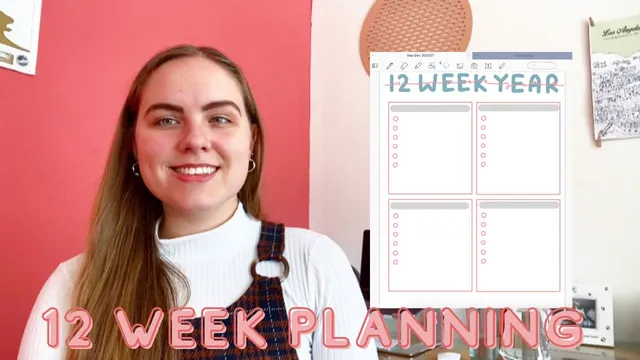
12 Week Goal Setting and Planning | 12 Week Year | iPad Digital Bullet Journal | PhD Student
Based on Ciara Feely's video on YouTube. If you like this content, support the original creators by watching, liking and subscribing to their content.
Use 12-week sprints instead of annual resolutions to maintain urgency and sustain motivation across four cycles per year.
Briefing
A 12-week goal system is presented as a practical alternative to annual resolutions because it forces momentum: four short “sprints” across the year make progress harder to ignore and easier to measure. Instead of setting vague goals for months at a time and then forgetting them, the approach keeps people focused on a finish line that’s close enough to stay motivating. The core requirement is that goals aren’t arbitrary checklists; each 12-week target should connect to a longer-term life direction, so the work done now meaningfully supports where someone wants to be later.
The method also hinges on tracking the right signals. Rather than judging success only by end results (lag indicators like subscriber counts or views), it emphasizes lead indicators—ongoing behaviors that drive those outcomes. For example, aiming for 10,000 YouTube subscribers in a 12-week period is treated as the lag outcome, while posting frequency and promotion effort function as the lead indicators. Weekly review becomes the accountability engine: each week includes a score for adherence to the specific actions tied to the goals, and lack of progress is treated as a clue that key lead behaviors were missed. This turns goal setting into a repeatable weekly operating system instead of a “set it and hope” exercise.
The productivity payoff is also explicit. A 12-week window narrows the calendar and encourages time-bound prioritization—effectively applying an 80/20 mindset by cutting tasks that don’t directly support the goals. With less time available, daily schedules get stripped down to what matters most for the sprint.
To set up the plan, the creator first identifies which life areas need attention. A personal rating exercise ranks categories from best to worst—health, relationships, PhD, YouTube, and a startup plus a part-time job—then selects the areas most in need of improvement. In this case, the main focus areas become the PhD, YouTube, and the startup, while health and relationships are considered relatively stable.
Concrete 12-week goals follow. For the PhD, the targets include completing a stage to transfer by December 15th, finishing a first main chapter and a big bibliography, meeting the research panel, and planning next steps such as career credits and transferable skills. A separate project goal is paired with a measurable lead indicator: working deeply for four hours a day, alongside weekly check-ins with supervisors. For YouTube, the lag target is 10,000 subscribers, supported by a lead behavior of posting at least two videos per week (after a recent slump to one per week or less). Additional engagement efforts include a podcast interview for PhD Live raft scheduled for October 10th.
For the startup (Daisier), the plan centers on weekly partner meetings and mentor check-ins every three weeks, with interim “three-week goals” between meetings. The near-term deliverables include launching a more functional Pomodoro timer on the site (building from a basic version) and developing digital planner templates tailored to the platform’s needs. Templates and planner frameworks are offered to channel members, with viewers encouraged to share their own 12-week goals in the comments.
Cornell Notes
The 12-week year approach replaces annual resolutions with four focused sprints, making goals feel urgent enough to sustain effort. Success is tracked using both lag indicators (outcomes like subscriber counts) and lead indicators (the repeatable behaviors that produce those outcomes). Weekly scoring and review create accountability by revealing which actions were skipped when progress stalls. The planning process starts by ranking life areas to decide where attention is needed most, then translating priorities into specific 12-week goals and measurable tasks. In this example, the PhD, YouTube, and a startup receive the most focus, with clear targets and lead behaviors such as deep work hours, posting frequency, and weekly/three-week meeting cycles.
Why do 12-week goals work better than annual resolutions for many people?
What’s the difference between lag indicators and lead indicators, and how does that change weekly tracking?
How does weekly “grading” function in the 12-week year framework?
How are goals translated into measurable tasks for the PhD sprint?
What lead behaviors support the YouTube subscriber target?
How does the startup plan use meeting cadence to create short-term momentum?
Review Questions
- How would you identify lag and lead indicators for a goal you care about (e.g., fitness, studying, or career progress)?
- What weekly actions would you score to ensure your lead indicators are actually happening, and what would you do if the score drops?
- Which life areas would you rank first, and how would that ranking determine what goes into your next 12-week plan?
Key Points
- 1
Use 12-week sprints instead of annual resolutions to maintain urgency and sustain motivation across four cycles per year.
- 2
Connect each 12-week goal to a longer-term life vision so the work has purpose beyond the sprint.
- 3
Track both lag indicators (outcomes) and lead indicators (behaviors) to diagnose progress realistically.
- 4
Run a weekly review with a score for action adherence; stalled results should trigger changes in lead behaviors.
- 5
Prioritize by time-bounding: narrow daily schedules to the tasks that directly support the 12-week goals.
- 6
Start planning by ranking life areas from best to worst, then choose the categories most in need of improvement.
- 7
Convert goals into measurable tasks (e.g., deep work hours, posting frequency, meeting cadence) so progress can be monitored weekly.