7 To-Do List Hacks That Actually Work (No More Overwhelm!)
Based on Tiago Forte's video on YouTube. If you like this content, support the original creators by watching, liking and subscribing to their content.
Capture tasks immediately when they appear to prevent open loops and reliance on unreliable memory.
Briefing
A to-do list doesn’t need to be longer—it needs to be structured so tasks don’t hijack attention, priorities don’t get buried, and execution stays realistic. The core fix is a seven-rule workflow that turns random “task pops” into captured, actionable items, then limits daily commitments to what can actually be finished. The payoff is less overwhelm and more momentum from small wins, not guilt from an ever-growing list.
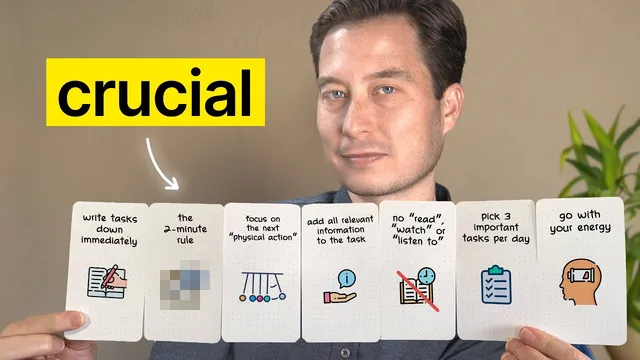
The first rule is immediate capture: when a task surfaces—calling the electrician, fixing a wall plug, walking the dog—writing it down right away prevents the brain from treating it as an open loop. The transcript emphasizes that relying on memory (“I’ll keep it in mind”) fails because attention moves on. Using a mobile device or smartwatch to capture quickly helps; in the example workflow, tasks land in an inbox inside the Things task manager.
Next comes the two-minute rule, attributed to David Allen and popularized in Getting Things Done: if a task takes about two minutes or less, do it immediately instead of adding it to the to-do list. That keeps small items from accumulating, preserves space for bigger priorities, and creates a quick sense of progress.
Clarity and completeness follow. Tasks should be written as the next physical action using strong action verbs—write, schedule, send, call—so the next step is obvious. Vague prompts like “think about” or “figure out” reduce follow-through. Each task should also include all relevant information needed to complete it, such as links, phone numbers, email addresses, or notes, so the person doesn’t have to hunt through inboxes or documents mid-task.
A major source of overwhelm is mixing commitments with content consumption. Read/watch/listen items—articles, newsletters, videos, podcasts—don’t belong on the to-do list because they compete with real priorities. Instead, the transcript recommends routing content to a separate “read later” system (using Readwise’s Reader in the example), treating consumption as optional rather than mandatory.
Daily planning stays bounded: pick a maximum of three important tasks per day. The goal isn’t to “finish everything,” but to choose feasible, realistic outcomes that protect motivation and focus from the psychological weight of an endless list.
Finally, execution should match energy. Deep work goes in the morning when concentration is highest, while lighter tasks fit the afternoon. For extra control, tasks can be tagged by energy level so they can be filtered and scheduled accordingly.
A bonus mindset tip challenges guilt: assume most tasks won’t get done by default. A task becomes “real” only when it reaches the day’s three selected items. That reframes the task manager as a place to consider options—not a contract to complete everything—reducing shame and making the system feel more freeing than burdensome. The transcript closes by positioning this task-capture-and-prioritization approach as part of a broader productivity “pillars” system, offered through a course called Pillars of Productivity.
Cornell Notes
The workflow targets to-do list overwhelm by separating capture from commitment. Tasks are captured immediately in a fast inbox so nothing slips through memory, then small items are handled via the two-minute rule (do them right away if they take ~2 minutes). To make tasks easier to execute, each one should describe the next physical action using clear verbs and include all necessary details. Content consumption (reading/watching/listening) is routed to a separate read-later system so it doesn’t drown out priorities. Daily planning stays realistic by selecting up to three important tasks per day and scheduling them according to energy levels. A final mindset shift treats tasks as optional until they’re chosen for “today,” removing guilt for not finishing an endless list.
Why does immediate task capture matter, and what goes wrong when tasks are only “kept in mind”?
How does the two-minute rule reduce overwhelm in practice?
What makes a to-do list item more likely to get completed: wording or information?
Why shouldn’t read/watch/listen items sit on the same to-do list as tasks?
How does limiting daily tasks to three change motivation?
What does “go with your energy” mean for scheduling tasks?
Review Questions
- What are the specific characteristics of a well-written task (verb choice and required details), and how do they affect follow-through?
- How does separating content consumption into a read-later system change what ends up on the to-do list—and why does that reduce overwhelm?
- What mindset shift reframes the task manager from a guilt system into an option system, and how does it relate to choosing only three tasks for “today”?
Key Points
- 1
Capture tasks immediately when they appear to prevent open loops and reliance on unreliable memory.
- 2
Apply the two-minute rule: complete tasks that take about two minutes right away instead of adding them to the list.
- 3
Write each to-do as the next physical action using clear action verbs, avoiding vague prompts like “think about.”
- 4
Include all relevant execution details inside the task (links, phone numbers, email addresses, notes) to eliminate mid-task searching.
- 5
Keep content consumption (read/watch/listen) out of the to-do list by routing it to a read-later app and treating it as optional.
- 6
Limit daily commitments to a maximum of three important tasks chosen in the morning to prevent overwhelm from an unfinishable list.
- 7
Schedule work by energy—deep work in the morning, lighter tasks later—and optionally tag tasks by energy level for filtering.