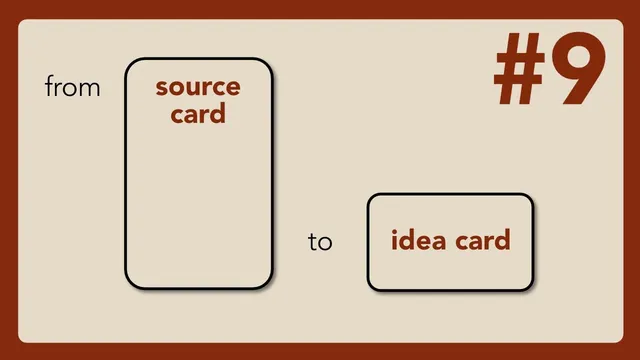
#9 Zettelkasten: from source card to idea card
Based on FP's video on YouTube. If you like this content, support the original creators by watching, liking and subscribing to their content.
Draft idea cards by extracting exact passages from the source text rather than relying on memory.
Briefing
Turning a “reminder” on a Zettelkasten source card into a polished idea card is a slow, text-driven process—one designed to preserve accuracy while still building real connections between thoughts. The workflow starts with a source card packed with notes from Johan Hari’s Stolen Focus. After a power outage cut off internet access for nearly 48 hours, Hari’s book became the main reading material, and the notes taken during that period were later selected for conversion into idea cards.
The key step is not writing from memory. Before drafting, the method requires returning to the original passages on the phone and extracting short, relevant lines. In this case, the creator pulls two core fragments: “Depth takes time and depth takes reflection,” and an interview claim that “slowness nurtures attention.” Those phrases become the raw material for a new idea card, with the card’s content intentionally shaped to reflect the source rather than paraphrase loosely.
Connection-building comes next. The new idea card is placed behind an existing card already in the analog Zettelkasten layout—specifically, a card about pausing to become aware of one’s thinking. That physical placement is meant to signal a relationship between ideas: slowness supports attention and reflection, which in turn helps produce depth. During the drafting attempt, there’s a moment of temptation to create multiple additional cards to capture adjacent ideas, but the process is kept focused on producing a single card that links cleanly to the existing one.
Drafting happens in stages. First, a rough draft is written in a notebook. Then the text is typed into Obsidian, where it effectively goes through two rounds of revision. Only after the digital version is finalized does the final wording get copied onto a blank 4x6 index card. This sequencing matters because typing enables edits and refinement that would be harder to do cleanly on paper.
Finally, the card is assigned a specific address in the Zettelkasten system. The creator notes that addresses like 4b1 and 4b2 have already been used, so the new card becomes 4b3. The card also includes parenthetical citations for the claims it makes, reinforcing that idea cards are grounded in source evidence. Titles are added later; they’re also treated as functional metadata—commas in titles can break Obsidian queries, so punctuation is adjusted (commas replaced with “and”).
The takeaway is practical: the work feels slow because it requires reading, drafting, revising, and careful placement—but the payoff is durable thinking. “Slow is fast” becomes the guiding principle for intellectual work, where depth depends on time, reflection, and deliberate attention rather than speed.
Cornell Notes
A reminder note from a source card becomes an idea card through a careful, staged workflow. The process begins by revisiting the exact passages in Johan Hari’s Stolen Focus and extracting short lines such as “Depth takes time and depth takes reflection” and “slowness nurtures attention.” A rough draft is written first, then the text is typed into Obsidian for revision, and only afterward is the finalized wording transferred to a 4x6 index card with citations. The new card is physically placed behind a related existing card to show conceptual linkage, and it receives a unique Zettelkasten address (e.g., 4b3). The method emphasizes that depth and attention grow through slowness and reflection.
Why does the workflow insist on returning to the original text before drafting an idea card?
How does the creator turn two separate reminders into one coherent idea card?
What role does Obsidian play compared with writing directly on index cards?
How are citations and titles handled on the idea cards?
What does “placing a card behind” an existing card accomplish in this system?
Why does the creator treat card addressing (like 4b3) as important?
Review Questions
- When converting a source-card reminder into an idea card, what are the required steps before the final words appear on the 4x6 index card?
- How do citations and title formatting constraints (like commas) affect the design of an idea card in this workflow?
- What conceptual connection is created by placing the new slowness/attention card behind an existing card, and why does that placement matter?
Key Points
- 1
Draft idea cards by extracting exact passages from the source text rather than relying on memory.
- 2
Use a staged workflow: rough draft in a notebook, then revision in Obsidian, then transfer to a 4x6 index card.
- 3
Build conceptual links by placing a new card behind a related existing card in the analog layout.
- 4
Include parenthetical citations on idea cards to keep claims traceable to source material.
- 5
Assign a unique Zettelkasten address for each new card (e.g., 4b3 when 4b1 and 4b2 are already used).
- 6
Treat titles as functional metadata: avoid commas in titles because they can break Obsidian queries.
- 7
Embrace slowness as a feature of intellectual work—depth and attention grow through deliberate reflection.