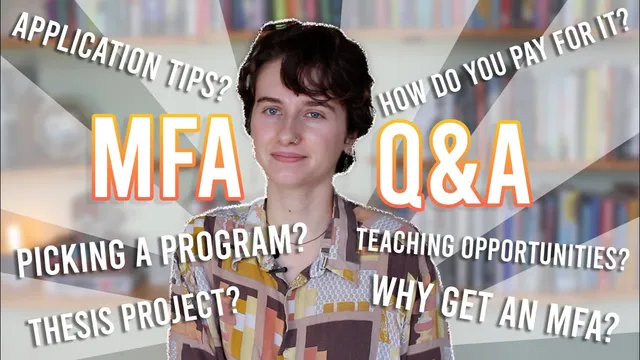
A JUICY MFA Q&A: funding, thesis, application tips, acceptance stats, & more!
Based on ShaelinWrites's video on YouTube. If you like this content, support the original creators by watching, liking and subscribing to their content.
Jaylen frames the MFA as an artistic, thesis-centered degree that offers mentorship and protected time rather than a guaranteed career boost.
Briefing
An MFA in writing is less about learning “new” writing concepts and more about getting paid time, structured mentorship, and an academic environment to push a specific craft focus—especially through a thesis—while also opening doors to teaching. Jaylen, in the first semester of an MFA writing program, frames the degree as an artistic choice rather than a guaranteed career ladder, arguing that the real value comes from immersion, guidance, and the support system that helps writers develop work they may not be able to sustain in the “capitalist grind” of full-time work.
A central theme is motivation: Jaylen wanted the immersive, inspired atmosphere of writing school again, plus the chance to write with deadlines and support. She also wanted a path toward teaching—acknowledging that tenure-track jobs are rare—but emphasizes that an MFA can still function as a finishing degree that helps with instructor opportunities and credibility. Her thesis-driven approach differs from many peers: she already wrote four novels during her time away from undergrad, so she isn’t seeking an MFA solely for motivation or structure to write a first big project. Instead, she’s pursuing deeper academic study and mentorship, including working closely with a supervisor on a novel-length thesis.
On the “MFA vs. real world” debate, she rejects the idea that the real world automatically produces better writers. For many people, “real world” means burnout and lack of time or energy to write. In her view, an MFA is not a permanent fork in the road; it’s a two-year investment that can coexist with future professional life. She also pushes back on the notion that an MFA is required for contemporary literary fiction. There’s correlation—especially because academia is built around a pipeline from writing undergrad to short fiction to an MFA—but she calls it nonessential, noting that writers can emerge without higher education.
Jaylen also offers practical guidance on admissions. She says MFA programs typically require a statement of intent, writing sample/portfolio (often with strict page limits), references, and transcripts or a literary CV. Her strongest application strategy was to submit her best work and tailor the portfolio to each program’s requirements rather than reuse the same set everywhere. A key pattern from her own three-year application cycle: she was accepted to programs that required only a single genre submission (fiction) and not accepted to programs that demanded multiple genres—particularly when her secondary genre (poetry) wasn’t as strong. She advises applicants to choose work that best showcases their strengths, while still balancing stylistic range so committees see a coherent “portrait of a writer.”
Funding is another major thread. She says she would not recommend taking on debt and highlights that her first year was covered by a fellowship that paid tuition and more. For the second year, she’s applying for Canada’s Social Sciences and Humanities Research Council grant (SSHRC), explaining that fine arts theses can be harder to fit into grant categories and may require pitching a creative project as academic research. She also expects teaching-related income later through TA roles and a scholarship tied to designing a course.
Finally, she addresses culture and policy issues around the MFA experience: she notes that AI use is widely treated as unacceptable in writing programs, with course policies that can result in a zero. She also describes the social adjustment of workshop life and suggests concrete ways to build connections, like creating a group chat and organizing work sessions outside class. Across the Q&A, the throughline is pragmatic: an MFA can be a powerful, supportive environment for writers—if the fit, funding, and expectations are handled realistically.
Cornell Notes
Jaylen’s MFA Q&A argues that a writing MFA is primarily an artistic, thesis-driven immersion—less a place to learn entirely new “writing concepts” and more a setting that provides mentorship, structure, and protected time to develop a specific project. She emphasizes that the degree is not required to write contemporary literary fiction, even though academia often creates a common pipeline. Her admissions advice centers on tailoring a portfolio to each program’s genre requirements and submitting the strongest work within page limits; in her own cycle, she was accepted to programs that required only fiction and rejected ones that demanded multiple genres when her secondary genre was weaker. Funding matters: she received tuition coverage via a fellowship and is pursuing SSHRC for the next year, noting that fine arts projects may need to be pitched as academic research. She also reports that generative AI is broadly treated as unacceptable in writing programs, with strict course policies.
What does an MFA add for craft if undergraduate already teaches writing fundamentals?
How should an applicant think about “MFA vs. real world” development?
What admissions strategy did Jaylen find most predictive in her own results?
What does a typical MFA application require, and how does she recommend handling the writing sample?
How did she fund her MFA, and what challenges come with arts grants?
What stance does her program take on generative AI in writing?
Review Questions
- In Jaylen’s view, what specific kind of learning does an MFA provide that differs from undergraduate writing training?
- What portfolio mismatch did Jaylen identify as a likely reason for rejections, and how did she adapt her strategy across applications?
- Why does she believe arts theses can be harder to fund through academic research grants, and how does she plan to frame her work for SSHRC?
Key Points
- 1
Jaylen frames the MFA as an artistic, thesis-centered degree that offers mentorship and protected time rather than a guaranteed career boost.
- 2
She argues that “real world” development often means burnout and lack of energy, so an MFA can be a practical way to sustain writing practice for two years.
- 3
Her admissions experience suggests matching portfolio requirements to strengths—she was accepted when only fiction was required and rejected when multiple genres were demanded and her secondary genre was weaker.
- 4
MFA applications commonly require a statement of intent, a tailored writing sample/portfolio within page limits, references, and a literary CV or transcript.
- 5
She advises applicants to submit their strongest work and to balance stylistic range without diluting their best genre performance.
- 6
Funding is decisive: she received tuition coverage via a fellowship and is pursuing SSHRC, noting that fine arts projects may need to be pitched as academic research.
- 7
Generative AI is treated as unacceptable in her writing programs, with strict policies that can result in zeros for AI-assisted submissions.