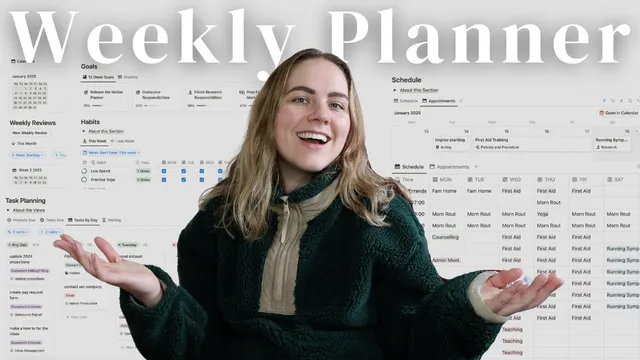
Be 100x More Productive with this Weekly Planner
Based on Ciara Feely's video on YouTube. If you like this content, support the original creators by watching, liking and subscribing to their content.
Use a weekly review page as a structured “look back” to capture wins, failures, and recurring patterns before planning the next week.
Briefing
A weekly planning system built in Notion is helping Ciara Feely turn a chaotic week into a structured cycle of review, prioritization, and scheduling—so key work doesn’t get lost and recurring patterns become visible. The core workflow starts with a “weekly review” page that functions like a bullet-journal-style dashboard: mini calendars, habit tracking, a journal space, and a task/project area organized by day. That setup matters because it forces a deliberate look back at what went well, what derailed, and what should change—before moving into the next week’s commitments.
Feely’s process begins with reflecting on the just-finished week (the current week starting on the 6th). Accomplishments included pushing through difficult exam-result delivery work, completing staff contracts, and managing the task list effectively. The main friction point was procrastination around hard tasks, which she countered by using Notion’s prioritization—marking high-priority items—and by writing down “top priorities for the day” to focus on the biggest “ticket items” rather than everything that could be done. Gratitude and self-care also get logged as part of the weekly review: yoga is framed as a stabilizing routine, along with support for stress (including time with Jack), and caring for her sick dog Lola. She also notes practical maintenance wins, like clearing out and tidying her office space.
The system then shifts into a full “brain dump” for the next weekly cycle. Feely opens the weekly review template as a full page, dumps all tasks, and sorts them into an organized plan. Project review follows: she checks project statuses, adds tasks where needed, and identifies what must roll forward. Her active projects include finishing research responsibilities (a primary focus for the coming week), submitting Cambridge conference expenses for reimbursement, completing handover for research, and continuing longer-running work like March production. She also lists operational and process-building projects—improving business procedures (customer journey enrollment, exams procedure, complaint and incident management, inbox management), updating financial projections, and payroll outsourcing—plus content-related work tied to template releases and documentation.
Next comes habit and goal management. She reviews habits mid-week (Friday with two days left) and plans to carry forward or add new habits for the upcoming week, such as mobility practice with a chosen frequency. Goal tracking is acknowledged as imperfect: she stopped using a weekly goal scorecard because she began the 12W goals partway through the year, but she plans to reintroduce it in February.
Finally, Feely builds the schedule. She blocks known appointments first—family time, first aid training (half 9 to half 4 for three days), and a running symposium—then colors items for readability. She plans on a Friday to give herself the weekend buffer before Monday. The schedule also accounts for constraints like meal prep tied to a “low spend” goal and the reality that she isn’t an early riser, though early starts may be necessary during first aid training. She books yoga classes (Monday evening and Thursday morning) and reserves time for morning and evening routines, transport, and an admin meeting. Content creation time is treated as a tradeoff against research: she regrets signing up for a course that crowds the calendar, and she considers filming on Monday instead of Sunday to protect research time. The resulting week is heavily research-weighted, with limited room for content, admin, and other tasks—an outcome she accepts as long as priorities stay clear and scheduled.
Cornell Notes
Ciara Feely’s Notion weekly planner uses a repeatable loop: weekly review, task/project brain dump, habit check, then schedule building. The review step captures accomplishments, challenges (especially procrastination on difficult tasks), gratitude, and self-care—then turns those lessons into next week’s priorities. Planning starts with blocking fixed commitments (like first aid training and symposium dates) and then layering routines, meal-prep needs, and booked classes (yoga). A key strength is prioritization: high-priority items and “top daily ticket items” keep work from dissolving into endless admin. Content creation is deliberately traded against research time when the calendar is crowded, with filming considered for Monday to protect research focus.
How does the weekly review in Notion prevent important work from getting lost?
What specific tactics does she use to fight procrastination on hard tasks?
How does she handle projects that can’t realistically finish within one week?
What role do habits and habit-carryover play in the planner?
How does she reconcile conflicting goals like low spending and a busy calendar?
Why does content creation get deprioritized, and what compromise does she consider?
Review Questions
- When procrastination shows up, what two concrete mechanisms does Feely use in Notion to re-center the week?
- Describe the order of operations in her system (review → brain dump → projects → habits → scheduling). Why does that sequence matter?
- What scheduling tradeoff does she make between research and content creation, and how does she decide when to film?
Key Points
- 1
Use a weekly review page as a structured “look back” to capture wins, failures, and recurring patterns before planning the next week.
- 2
Counter procrastination by combining Notion high-priority tagging with a short list of the day’s top “ticket items.”
- 3
Run a weekly brain dump for tasks, then sort and update project statuses so ongoing work stays realistic and paused items don’t clutter execution.
- 4
Treat habits as schedulable components: review progress mid-week, then carry forward or add habits with a chosen frequency for the next week.
- 5
Build the schedule by blocking fixed commitments first (training, appointments, symposiums), then layering routines, transport time, and booked classes.
- 6
Plan around goal constraints like low spending by adjusting meal prep timing when training compresses available hours.
- 7
When the calendar is crowded, protect the highest-priority work (research) and choose a content filming day that doesn’t steal from it (e.g., Monday instead of Sunday).