Building a Second Brain: Capturing, Organizing, and Sharing Knowledge Using Digital Notes
Based on Tiago Forte's video on YouTube. If you like this content, support the original creators by watching, liking and subscribing to their content.
Information overload creates daily friction—lost time searching for files and sources erodes focus and increases stress.
Briefing
Digital notes are positioned as the practical antidote to information overload: instead of letting knowledge scatter across files, apps, and devices until it becomes hard to retrieve, people can externalize what they learn into a “second brain” that remembers precisely, connects ideas, and turns insights into shareable artifacts. The payoff is less time hunting for documents and more time using expertise—because the knowledge that matters is searchable, linked, and reusable when decisions and collaboration demand it.
The core problem is framed as a daily friction loop. Even diligent workers lose time searching for misplaced files, struggle to locate correct sources during meetings, and feel a creeping stress from constant device use. That frustration sits on top of a larger mismatch: information keeps multiplying, but the old model of knowledge management—top-down programs, incentives, and centralized capture—doesn’t stick. Knowledge is described as inherently personal and contextual; when it’s separated from the person who holds it, it loses meaning, timing, and relevance.
Personal knowledge management shifts the center of gravity to the individual. The goal isn’t to extract tacit know-how into a corporate database. It’s to give each person tools and methods to get maximum value from what they already know while they’re still in the role. The approach is deliberately “small scale and local,” treated as a human training problem rather than something solved by Big Data or AI. The emphasis is on changing how people relate to their knowledge—through mental models, workflows, and habits that preserve context.
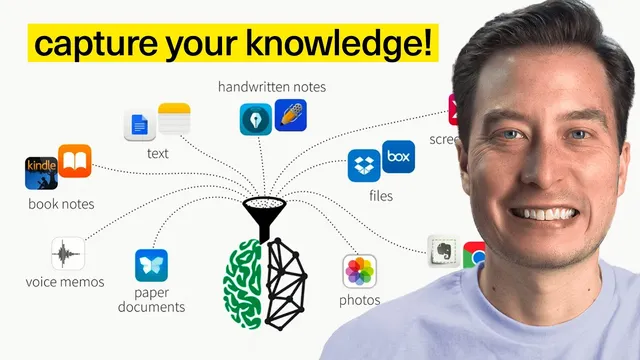
Three value streams define the second brain. First is “remember”: capture ideas and specifics in durable digital notes so the biological brain doesn’t have to store everything. Notes become a cloud-backed, searchable archive for artifacts such as scanned documents, voice memos, ebook highlights, web clippings, PDFs with annotations, and handwritten text converted into searchable form. The recommended software category is digital notes apps optimized for quick, messy creative capture—specifically Evernote and OneNote—because they support fast input, centralized retrieval, and attachments.
Second is “connect”: organize knowledge so patterns emerge. This happens through explicit links between notes, tags and metadata for retrieval, image views that make relationships visible, and inbound/outbound linking that turns scattered references into reusable knowledge chunks. The result is a more tangible form of creativity—less mystical inspiration and more recognition of relationships.
Third is “create”: knowledge becomes valuable when it turns into artifacts that others can use—reports, diagrams, slides, recorded talks, videos, summaries, translations into new formats, and even sales pitches or teaching. The process is portrayed as iterative: interpretations strengthen as evidence accumulates through examples, screenshots, statistics, and notes. A feedback loop follows—created artifacts return to the second brain, get reviewed, and generate further refinement.
Zooming out, the second brain is described as revealing a “personal knowledge landscape,” clarifying what someone knows deeply, what’s partially understood, and what’s missing. That self-awareness supports “situational awareness”—knowing what’s worth acquiring and where to find expertise on demand. Ultimately, the promise is labor-saving in the original sense: technology should free people from low-value information drudgery so their time goes toward strategic thinking and producing results that outlive the workday.
Cornell Notes
The second brain concept treats knowledge management as a personal workflow problem: externalize what matters into digital notes so it’s durable, searchable, and reusable. Instead of top-down capture programs that fail because knowledge is contextual and personal, the approach centers the individual and trains better relationships with their own knowledge. Value comes in three stages: remember (capture specifics like highlights, PDFs, voice memos), connect (link notes with tags, metadata, and visual views to reveal patterns), and create (turn interpretations into evidence-backed artifacts such as slides, videos, diagrams, and teaching materials). This enables situational awareness—knowing what to learn next and where to find it—freeing time for higher-value work and producing knowledge that can generate returns beyond the moment.
Why do centralized knowledge-capture programs often fail, and what replaces them?
What does “remember” mean in a second brain workflow, and what kinds of artifacts get captured?
How does “connect” turn scattered notes into insight?
What counts as “creating knowledge” beyond writing documents?
How does a second brain support situational awareness?
Review Questions
- What specific failure mode occurs when knowledge is separated from the person who holds it, and how does personal knowledge management address that?
- Describe the three value streams of a second brain (remember, connect, create) and give one concrete example for each.
- How do tags, metadata, and linking work together to make knowledge retrieval faster and more meaningful?
Key Points
- 1
Information overload creates daily friction—lost time searching for files and sources erodes focus and increases stress.
- 2
Top-down knowledge management often fails because knowledge is contextual and personal, not a commodity that can be extracted without losing meaning.
- 3
Personal knowledge management centers the individual and treats knowledge workflows as a training and mindset problem, not a Big Data automation problem.
- 4
A second brain delivers value through three stages: remember (durable capture and search), connect (links, tags, metadata, visuals), and create (evidence-backed artifacts).
- 5
Digital notes apps optimized for quick capture—specifically Evernote and OneNote—are favored over heavier tools like word processors for in-the-moment ideas.
- 6
Capturing highlights, annotations, and excerpts from ebooks and PDFs turns reading into a searchable research database that reduces re-reading.
- 7
Organized knowledge enables situational awareness: knowing what’s worth learning and where to find expertise, freeing time for higher-value work.