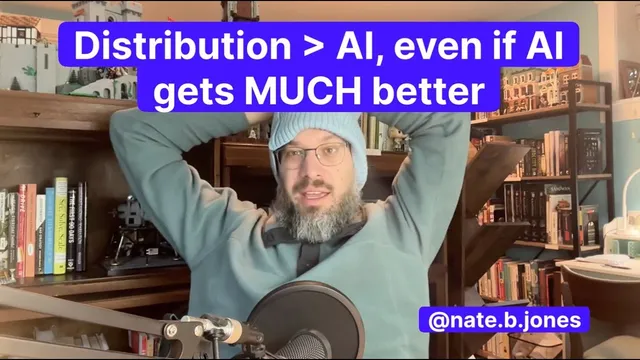
Distribution beats AI, even if AI gets MUCH better
Based on AI News & Strategy Daily | Nate B Jones's video on YouTube. If you like this content, support the original creators by watching, liking and subscribing to their content.
AI makes software cheaper to build, but distribution remains difficult and may get harder as competition increases.
Briefing
Distribution is becoming the decisive advantage in software and AI—while AI makes it cheaper and easier to build, it does not make it easier to reach customers, and in some cases it makes distribution harder as the number of competing products explodes. That imbalance is why “distribution beats AI, even if AI gets MUCH better” lands as a practical bet: models may improve quickly, but customer acquisition still determines which companies survive.
A key example comes from Sam Altman’s reported preference for a “1 billion user site” over having the most advanced AI model when thinking five years out. The point isn’t that AI won’t matter; it’s that owning a massive, reliable stream of traffic and already having acquired users can be more economically powerful than chasing the frontier model. The same logic applies to enterprise software. Salesforce’s staying power isn’t attributed to product features alone, but to distribution advantages baked into where businesses already operate—its software presence across industries, network effects, and the practical inertia of organizations that have Salesforce embedded in their workflows. Even when competitors generate headlines (such as Clarna signaling an exit from Salesforce), the distribution moat is portrayed as difficult to dislodge because it requires sustained organizational focus that many companies can’t spare.
The transcript also reframes “product-market fit” as essentially a shorthand for distribution advantage: startups either secure customers and the channels that bring them, or they don’t. Investors reinforce this emphasis with a blunt question after pitches—where are the customers?—because no amount of technical brilliance can substitute for the ability to consistently reach buyers.
That distribution challenge is set to intensify. AI tooling has lowered the barrier to creating software, shifting supply upward dramatically. The result is a likely “creataceous-level crisis” for AI startups: tens of thousands of AI tools already exist, and the number could climb into the six figures. With so many new products chasing attention, many teams without distribution will struggle to pay for compute and tokens, increasing the odds that weaker companies “go to the wall.”
Meanwhile, the funnel itself is being disrupted. Traditional playbooks from the 2010s (including well-worn growth strategies) don’t map cleanly onto a world where discovery may happen through LLMs. ChatGPT visibility is described as becoming a new form of SEO, and Claude’s web search is cited as producing surprising results when searching for oneself. That raises a new distribution problem: how to make content and documentation legible to models so they can recommend or retrieve it. Stripe is mentioned as an example of distribution engineering via LLM-friendly documentation formatting (LLMs.ext), suggesting more efforts will follow.
The bottom line: the next model won’t solve customer acquisition. Winning founders are expected to be less technical and more sales- and funnel-oriented, with sharper segmentation to identify where buyers are and how they research—whether in B2B (G2 versus chat-based research) or consumer contexts (TikTok, TikTok Shop, Meta, paid search, organic, X, Reddit). In a rapidly expanding “100,000 AI app” landscape, distribution—especially audience segmentation and channel strategy—is portrayed as the core differentiator.
Cornell Notes
AI is making software easier and cheaper to build, but it isn’t making distribution easier. In fact, customer acquisition may get harder as the number of AI tools grows into the tens of thousands and possibly the six figures. Sam Altman’s reported preference for a massive “1 billion user site” highlights the economic power of existing distribution compared with chasing the best model. Salesforce is used as an enterprise example of a distribution moat created by being embedded across workflows and benefiting from network effects. With the discovery funnel shifting toward LLMs (chat-based “visibility” resembling SEO), the winners are expected to be founders who can segment audiences precisely and engineer discoverability for how buyers now search and evaluate products.
Why does the transcript claim distribution beats AI improvements?
How does Sam Altman’s “1 billion user site” preference illustrate the distribution thesis?
What makes Salesforce hard to beat, according to the transcript?
Why does the transcript predict many AI startups will fail?
How does LLM-based discovery change the distribution problem?
What traits does the transcript suggest will correlate with winning in the next distribution era?
Review Questions
- What economic advantage does the transcript attribute to owning large-scale distribution (e.g., a billion-user site) compared with model leadership?
- How does increasing the number of AI tools change the relationship between building and acquiring customers?
- What does “LLM visibility” imply for how companies should structure content and documentation?
Key Points
- 1
AI makes software cheaper to build, but distribution remains difficult and may get harder as competition increases.
- 2
Existing customer access (traffic, users, embedded workflows) can outweigh having the most advanced AI model.
- 3
Enterprise moats like Salesforce are framed as distribution advantages reinforced by network effects and organizational inertia.
- 4
Product-market fit is treated as a proxy for distribution advantage: startups either secure customers or they don’t.
- 5
A surge in AI tooling (potentially into the six figures) raises the odds that many teams without distribution will fail.
- 6
LLM-based discovery is emerging as a new “SEO,” requiring discoverability engineering for how models retrieve and recommend information.
- 7
Winning strategies likely depend on precise audience segmentation and sales/funnel execution across B2B and consumer channels.