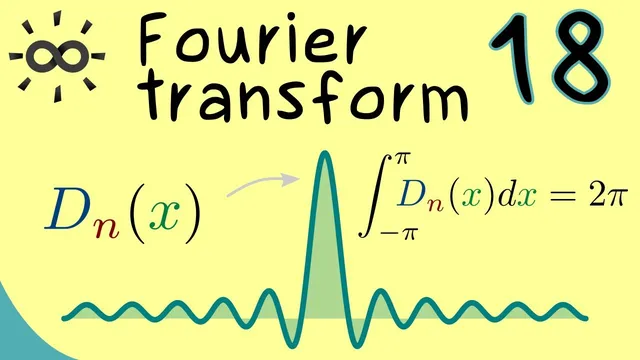
Fourier Transform 18 | Dirichlet Kernel
Based on The Bright Side of Mathematics's video on YouTube. If you like this content, support the original creators by watching, liking and subscribing to their content.
Dirichlet kernel DN(n, x) is defined as the symmetric exponential sum ∑_{k=−n}^{n} e^{ikx}, yielding a real-valued, 2π-periodic continuous function.
Briefing
Dirichlet kernel DN sits at the heart of Fourier series: it turns a Fourier partial sum into an integral (or convolution/inner product) against DN, making the kernel the main mechanism behind how Fourier series approximate functions. DN is defined for each natural number n as a finite symmetric sum of complex exponentials from k = −n to n, and it can be rewritten in equivalent real forms—either as 1 + 2 times a cosine sum or as a closed expression involving a sine ratio. Even where the sine-ratio formula has removable “exception points” (zeros in the denominator), continuity lets the kernel be uniquely extended, so DN remains a well-defined continuous, 2π-periodic function.
The kernel’s behavior explains both what Fourier partial sums do well and why they can fail pointwise. As n grows, DN develops more oscillations and a sharper central peak; despite this, the sequence DN does not converge pointwise as n → ∞. That lack of pointwise convergence is not a dead end—it’s exactly why Fourier series analysis needs more careful tools than simply taking limits term-by-term.
The transcript then connects DN directly to Fourier series. For a fixed function f and truncation level n, the partial Fourier sum at a point x can be written using Fourier coefficients CK computed by integrating f against complex exponentials. By algebraically combining the finite exponential sum with the coefficient integral, the partial sum becomes an integral of f(y) times DN(x − y) over y from −π to π. A change of variables shows equivalent formulations: the same expression can be viewed as an L2 inner product between DN and the shifted function f, or as a convolution DN * f evaluated at x. These identities clarify why the kernel is “inside” the approximation process: DN is the weighting function that mixes values of f across one period.
Three key properties of DN are then developed to set up later convergence results. First, the zeros of DN can be counted using the sine-based representation: within [−π, π], DN has exactly 2n zeros after accounting for a removable mismatch at the origin caused by the numerator and denominator sharing a zero there. Second, DN is normalized in a strong sense: integrating DN over a full period (equivalently, taking DN against the constant function 1 in the L2 inner product) always yields 1 for every n. Third, the kernel’s absolute mass grows without bound. When integrating |DN(x)| over [−π, π], the result increases with n and diverges as n → ∞. The argument uses a comparison estimate based on the sine numerator, symmetry to reduce to x ≥ 0, and a decomposition across intervals between zeros; the bound ultimately reduces to a constant multiple of the harmonic series ∑(1/k), which diverges.
Together, these facts explain why Fourier series convergence is subtle: DN’s peak sharpens while its oscillatory structure carries increasing total variation. The transcript closes by noting that these kernel properties will be used to prove pointwise convergence in the next installment, but that proof requires additional work beyond the kernel identities themselves.
Cornell Notes
Dirichlet kernel DN is defined as a finite symmetric sum of complex exponentials (k = −n to n) and can be rewritten using cosines or a sine-ratio formula with removable singularities. DN is the core tool behind Fourier partial sums: the nth partial Fourier sum of f at x equals the integral from −π to π of f(y)·DN(x − y) dy, which can also be expressed as an L2 inner product or a convolution. DN has exactly 2n zeros in [−π, π] after handling the removable issue at the origin. Its normalization is constant: integrating DN against the constant function 1 always gives 1. But the total absolute area ∫|DN(x)| dx grows with n and diverges, reflecting why Fourier series convergence cannot rely on simple pointwise limits of DN.
How is the Dirichlet kernel DN defined, and why does it end up real-valued?
What integral identity links DN to the nth partial Fourier sum of a function f?
Why do “exception points” appear in the sine-ratio formula for DN, and why aren’t they a problem?
What are the zeros of DN on [−π, π], and how does the origin affect the count?
Why does ∫_{−π}^{π} |DN(x)| dx diverge as n → ∞?
Review Questions
- How do the exponential-sum, cosine-sum, and sine-ratio forms of DN relate, and what role does continuity play at points where the sine-ratio denominator vanishes?
- Write the nth Fourier partial sum of f at x in three equivalent ways: as an integral against DN(x − y), as an L2 inner product, and as a convolution.
- What three properties of DN are established: zero count on [−π, π], normalization against the constant function, and divergence of the L1 norm ∫|DN|? Explain the intuition behind each.
Key Points
- 1
Dirichlet kernel DN(n, x) is defined as the symmetric exponential sum ∑_{k=−n}^{n} e^{ikx}, yielding a real-valued, 2π-periodic continuous function.
- 2
DN admits equivalent representations: a cosine-sum form and a sine-ratio closed form with removable singularities at x = 2πM.
- 3
The nth Fourier partial sum of f at x can be written as an integral (or convolution/inner product) of f(y) against DN(x − y) over y ∈ [−π, π].
- 4
DN has exactly 2n zeros in the interval [−π, π] once the removable behavior at the origin is accounted for.
- 5
DN is normalized so that pairing it with the constant function 1 in the L2 inner product always returns 1, independent of n.
- 6
The total absolute mass ∫_{−π}^{π} |DN(x)| dx grows with n and diverges as n → ∞, linked to a harmonic-series-type bound.
- 7
Because DN does not converge pointwise as n → ∞, Fourier series convergence requires more than naive pointwise limiting arguments.