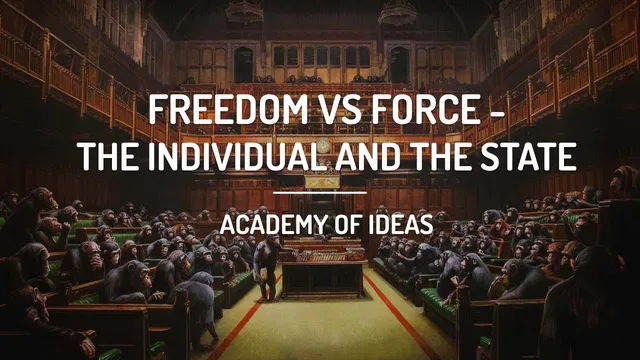
Freedom vs. Force - The Individual and the State
Based on Academy of Ideas's video on YouTube. If you like this content, support the original creators by watching, liking and subscribing to their content.
Freedom is framed as essential for prosperity because wealth creation, creativity, and voluntary cooperation depend on individuals acting without coercive management.
Briefing
Freedom is treated as a life-sustaining condition for individuals and a productive engine for societies—but modern life increasingly trades it away for “safety,” comfort, and material ease. The central claim is that this bargain is Faustian: people do not flourish inside coercive cages, and societies lose wealth, creativity, and voluntary cooperation when freedom retreats. The argument frames freedom as the foundation for prosperity and peace, not a luxury, and contrasts the old demand for liberty with a newer appetite for distraction and managed security.
From there, the discussion pivots to a stark dichotomy: a society either rests on freedom or on coercive force. Defensive force—used to ward off aggression against person or property—is described as broadly accepted and morally justified. The controversy begins with coercive force wielded by centralized governments to impose top-down control. Critics cited in the argument contend that large centralized states function like parasites: they drain the societies they govern and eventually undermine the very order they claim to protect.
Oberon Herbert, a 19th-century British philosopher and former high-ranking member of the British Parliament, is presented as a key opponent of unchecked governmental force. His position is that if government force exists at all, it should be decentralized and limited to protecting individuals from attacks on person and property. The reasoning is that once a government is granted authority beyond defense—authority to shape society—limits become both unclear and politically manipulable. The argument warns that power naturally expands: if taking “one tenth” of property is permissible, the next step toward taking “one half” or “the whole” becomes a matter of shifting justification rather than principle.
The transcript also argues that political systems attract the wrong kind of people. Elections do not reliably prevent authoritarian or narcissistic personalities from gaining influence; instead, centralized politics rewards those willing to deceive, lie, and use force with little remorse. It adds that constitutional limits become difficult to enforce when governments oversee tens or hundreds of millions of people, since those in power can breach constraints through “devious strategies” and propaganda—often wrapped in appeals to public safety and the “greater good.”
Most ominously, the argument claims that granting unchecked coercive power sets in motion a long-term drift toward a Leviathan state. Drawing on historical reflections attributed to Arnold Toynbee and Kirkpatrick Sale, it suggests that unified, centralized civilizations decay over time. Herbert’s mechanism for this decay is psychological and social: masses are turned into “ciphers,” people lacking moral autonomy and critical thinking who regurgitate slogans and obey orders. A Leviathan state then requires bureaucratic minions and a political elite that tightens control, suffocating free enterprise, voluntary exchange, innovation, and hope until the system collapses under its own dead weight.
The closing challenge is binary and direct: choose between the “perfection of force” and the “perfection of liberty,” because the trajectory of centralized power is portrayed as self-reinforcing and increasingly difficult to escape.
Cornell Notes
The argument treats freedom as essential to human flourishing and social prosperity, not an optional preference. It claims that societies built on coercive force—especially centralized government coercion—tend to expand power, evade constitutional limits, and attract power-hungry leaders. Oberon Herbert’s view is that government force, if it exists, should be decentralized and limited to defending individuals against aggression, because any broader mandate turns right into wrong through shifting justifications. Over time, unchecked centralized power is portrayed as producing “ciphers”: people with weakened moral autonomy who obey slogans and orders. The stakes are civilizational: the drift toward a Leviathan state is described as a slow process that ends in decay and collapse.
Why does the transcript treat freedom as necessary for prosperity rather than merely a moral ideal?
What is the key distinction between defensive force and coercive force?
How does Oberon Herbert’s framework limit government power?
Why does the transcript say constitutional limits often fail under centralized rule?
What mechanism does the transcript use to explain how Leviathan states grow?
What is the final choice presented, and what does it imply about political trajectories?
Review Questions
- What reasons are given for treating freedom as a driver of wealth, creativity, and peaceful cooperation?
- How does the transcript connect the expansion of government coercion to the difficulty of defining limits and enforcing constitutional checks?
- According to the argument, what social and psychological changes turn a population into “ciphers,” and why does that matter for state power?
Key Points
- 1
Freedom is framed as essential for prosperity because wealth creation, creativity, and voluntary cooperation depend on individuals acting without coercive management.
- 2
Defensive force against aggression is treated as broadly justified, while coercive force used for top-down control is treated as the central threat.
- 3
Oberon Herbert’s core prescription is decentralized government with a narrow mandate: protect individuals from attacks on person and property, not to remake society.
- 4
Granting government power beyond defense is portrayed as a slippery slope where “right” becomes “wrong” through shifting justifications and expanding authority.
- 5
Constitutional limits are described as vulnerable under centralized rule because propaganda and appeals to safety can normalize power grabs.
- 6
Unchecked centralized power is portrayed as self-reinforcing: it attracts power-hungry leaders, requires bureaucratic minions, and grows into a Leviathan state that suffocates free enterprise and innovation.
- 7
The argument concludes with a binary political choice between the perfection of force and the perfection of liberty, warning that the trajectory of centralized authority is hard to reverse.