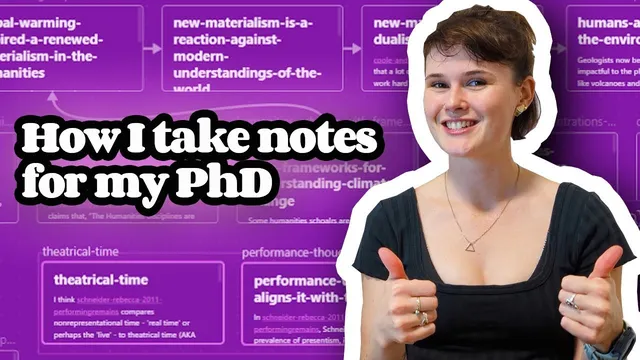
FULL note-taking session for my PhD with DETAILED commentary!
Based on morganeua's video on YouTube. If you like this content, support the original creators by watching, liking and subscribing to their content.
Move from highlights trapped in Zotero/PDFs or illegible handwritten notes into Obsidian so ideas remain searchable, linkable, and reusable.
Briefing
A structured note-taking workflow is helping an Arts and Humanities PhD writer turn dense readings into reusable, citation-safe “atomic” ideas—so dissertation writing becomes less like starting over from scratch and more like assembling arguments from a growing knowledge base. The core shift is moving from scattered, hard-to-reuse highlights (highlights trapped in the PDF viewer or illegible handwritten notes) into a system built around Obsidian, where quotes and interpretations are captured as modular notes that can be linked, retrieved, and recombined later.
The process starts after reading a key text—Rebecca Schneider’s Performing Remains—using Zotero to highlight passages. Those highlights and notes are then imported into Obsidian. Immediately after the reading, the writer creates a brief synopsis in their own words, anchored to the book’s introduction and research questions. That synopsis acts as a memory scaffold for future years when the details of the book have faded.
From there, the workflow moves into “atomic” TtTle Casten-style notes: short, self-contained ideas extracted from specific quotes. The writer scans the imported highlights for lines worth turning into standalone knowledge units. One example is the idea that performance aligns with the live/present. Even if the concept feels obvious within performance studies, it still gets its own note because it is meant to be modular—something that can be pulled into different projects without rewriting from scratch.
When creating a new atomic note, the writer uses the Obsidian community plugin Note Refactor (James Lynch) to cut the selected quote into a new note automatically. The new note begins with the original wording and a link to the author, then shifts into the writer’s own explanation to ensure understanding and future usefulness in essay writing. Next comes linking: the note is connected to relevant topics, related notes, and theorists—so retrieval happens through relationships, not just keyword search. In this case, the note links to performance studies, performance/liveness, a source that popularized the “performance is live” framing, and also to theorists who complicate or contest it.
The same method is applied to follow-up and adjacent claims. Another atomic note addresses challenges to the “performance is live” idea, linking back to the earlier note to show conceptual continuity. Additional notes capture foundational theater-studies claims such as theater being live and temporal, and theater being representational—an idea that often fuels anti-theatrical arguments about theater being “fake” or “pretend.”
A notable emphasis is accuracy and academic integrity in the linking chain. The writer flags a mistake where “Schneider” was mistyped as “Schechner,” then corrects it, explaining why misattribution can cascade into serious citation problems—especially when a quote is actually Schneider citing someone else. The workflow also includes a fallback: if linking is incomplete, the writer uses tags and a list of related links to preserve the conceptual map.
Finally, the writer demonstrates how these notes feed directly into dissertation outlining. Using Obsidian Canvas, they insert relevant notes into an outline, rearrange them to fit the developing narrative, and connect ideas with arrows to clarify the order of argument—turning note networks into a writing plan.
Cornell Notes
The workflow turns Zotero highlights from key readings (like Rebecca Schneider’s Performing Remains) into modular “atomic” notes inside Obsidian. After reading, the writer first drafts a brief synopsis in their own words to preserve the book’s core argument and research questions for future reference. Then they extract specific quotes into standalone notes, starting with the original wording and author link, followed by an explanation in their own language. Each note is strengthened through linking to related concepts, sources, and contested perspectives, creating a retrievable web useful for literature reviews and argument building. Accuracy matters: mis-typed author links are corrected because citation errors can compound, especially when one theorist is citing another.
What is the purpose of writing a short synopsis right after importing highlights into Obsidian?
How does an “atomic” note get created from a quote, and what goes into it?
Why create notes for ideas that feel “obvious” in a field like performance studies?
How does linking improve the usefulness of notes for dissertation work?
What academic-integrity risks does the writer highlight in note linking, and how are they handled?
How do these notes translate into an outline for writing?
Review Questions
- When should a synopsis be written in this workflow, and what information must it include to be useful later?
- What steps turn a highlighted quote into an atomic note, and why does the note include both the original wording and the writer’s own explanation?
- How can a small linking error (like a mistyped author name) create downstream citation problems in academic writing?
Key Points
- 1
Move from highlights trapped in Zotero/PDFs or illegible handwritten notes into Obsidian so ideas remain searchable, linkable, and reusable.
- 2
Write a brief post-reading synopsis in your own words immediately after importing highlights to preserve the book’s core argument and research questions for future use.
- 3
Convert selected quotes into atomic notes: include the original quote with an author link, then add your own explanation to ensure understanding and writing readiness.
- 4
Strengthen each atomic note by linking it to related concepts, sources, and contested perspectives so retrieval happens through a network, not just keywords.
- 5
Use Obsidian tools like Note Refactor to streamline quote-to-note creation and reduce manual copying errors.
- 6
Treat accuracy in citation links as part of the workflow—mistyped author links and misattributed quotation chains can create serious academic-integrity risks.
- 7
Build dissertation outlines directly from the note network using Obsidian Canvas, inserting notes and connecting them with arrows to map argument flow.