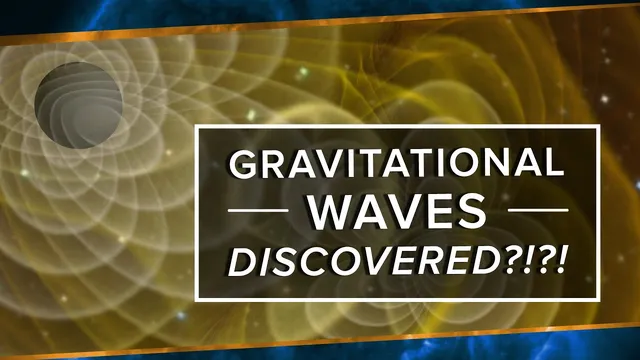
Have Gravitational Waves Been Discovered?!?
Based on PBS Space Time's video on YouTube. If you like this content, support the original creators by watching, liking and subscribing to their content.
General Relativity predicts gravitational waves as ripples in warped spacetime, not as a traditional force.
Briefing
Gravitational waves—Einstein’s last major, direct prediction from General Relativity—are still waiting for a confirmed first detection, but the search is now in a decisive phase. General Relativity reframes gravity not as a force but as warped four-dimensional spacetime: mass and energy reshape the geometry, and that geometry dictates motion. In that framework, certain kinds of accelerating or changing mass distributions should generate ripples in spacetime itself—outward fluctuations of expanding and contracting space—moving at the speed of light.
Those ripples are hard to see because the effect on Earth is unimaginably tiny. Only systems that change their mass distribution in a way that isn’t spherically or cylindrically symmetric—described as changing the quadrupole moment—produce gravitational waves. Rotating spheres or cylinders don’t generate them, but orbiting pairs, asymmetric spinning bodies, or explosive events do. The most promising sources are extreme astrophysical catastrophes: in-spiraling black holes or neutron stars near merger, supernovae, and giant black-hole collisions. Even then, the strain from likely events would stretch and squeeze space by about 10^-21 (or less), translating to height changes smaller than a millionth of a proton’s width for the strongest waves that might pass through.
The detection strategy relies on measuring an absurdly small change in distance using interference. LIGO uses a giant Michelson interferometer: a laser beam is split into two paths running down perpendicular four-kilometer vacuum tubes, reflected hundreds of times, and recombined. Under normal conditions, the electromagnetic waves cancel out through destructive interference. A passing gravitational wave would alternately shorten one arm and lengthen the other, breaking the perfect cancellation and producing brief “blips” with a characteristic oscillating pattern. Because many disturbances can mimic tiny path-length changes—seismic noise, distant vehicles, even quantum fluctuations—confidence comes from the specific time-varying signature and from coincidence across multiple detectors.
Earlier LIGO runs (2002–2010) found zero events, largely because sensitivity was only just sufficient for relatively nearby mergers, which are rare. The experiment then upgraded into advanced LIGO, improving sensitivity by about a factor of ten and expanding the observable volume by roughly 1,000 times, which should translate into many more detections if the universe is behaving as expected. Yet the early advanced-LIGO period has produced no public announcement. The caution is deliberate: candidate signals undergo extensive verification, including the injection of false signals (“drills”) so that only a small subset of team members know whether a given trigger is real or fake.
Rumors have circulated—one tied to a possible signal of two black holes in-spiraling—but official confirmation is withheld until rigorous checks are complete. If a real detection emerges, it would finally provide direct evidence for gravitational waves and open new observational windows on black holes, neutron stars, and even the early universe. If not, advanced LIGO still represents a substantial leap in capability, keeping the odds of a first confirmed signal firmly in play.
Cornell Notes
General Relativity predicts that accelerating, non-spherically symmetric mass distributions generate ripples in spacetime called gravitational waves. These waves travel at the speed of light and have a distinctive quadrupole pattern: they alternately stretch and squeeze space in perpendicular directions. The strongest likely sources—black hole and neutron star mergers, supernovae, and other extreme events—produce strains around 10^-21, far too small to measure directly. LIGO detects them indirectly by using a Michelson interferometer: a gravitational wave changes the relative lengths of two perpendicular arms, spoiling destructive interference and creating brief signals. Earlier LIGO runs found no detections, but advanced LIGO’s higher sensitivity should make detections far more likely, with announcements delayed until extensive verification rules out noise and injected “drill” signals.
What physical condition determines whether a system produces gravitational waves?
Why do gravitational waves propagate at the speed of light?
How would a gravitational wave affect matter passing through it?
How does LIGO turn a passing gravitational wave into a measurable signal?
Why did earlier LIGO runs find zero events, and what changed with advanced LIGO?
Review Questions
- What does “changing the quadrupole moment” mean in practical terms, and which kinds of motion fail to produce gravitational waves?
- Describe the interference principle behind LIGO and explain how a gravitational wave disrupts it.
- Why is coincidence across multiple detectors (LIGO sites plus Virgo) important for distinguishing gravitational-wave signals from noise?
Key Points
- 1
General Relativity predicts gravitational waves as ripples in warped spacetime, not as a traditional force.
- 2
Only mass motions that change the quadrupole moment—non-spherically and non-cylindrically symmetric changes—produce gravitational waves.
- 3
Gravitational waves propagate at the speed of light, framed as the speed of causality in spacetime.
- 4
The expected strain from likely sources is around 10^-21, making direct measurement of length changes extraordinarily difficult.
- 5
LIGO detects gravitational waves by using a Michelson interferometer whose destructive interference is disrupted when one arm effectively shortens while the other lengthens.
- 6
Earlier LIGO runs (2002–2010) found no detections, consistent with low event rates at its then-limited sensitivity.
- 7
Advanced LIGO’s higher sensitivity increases the observable volume by about 1,000 times, but public confirmation is delayed until extensive verification rules out noise and injected “drill” signals.