How I Plan My Week as a PhD Student - Deep Work Time Blocking Template in Notion
Based on Ciara Feely's video on YouTube. If you like this content, support the original creators by watching, liking and subscribing to their content.
Translate each monthly goal into trackable weekly actions (counts, frequency, or days achieved) rather than leaving goals abstract.
Briefing
Weekly planning for a PhD student becomes manageable when goals are translated into trackable actions and then enforced through time blocking. The core setup uses Notion to connect monthly goal-setting (health, well-being, fun, recreation, and social) to a weekly tracker that measures progress with simple metrics—how often habits happen, plus a star rating and percentage score that later feed into end-of-month reflection. That reflection is tied to a 12-week-year style review, though the creator currently runs it on a four-week cycle to keep goals smaller, iterate gradually, and decide whether to keep or adjust targets.
The weekly tracker is built around turning vague intentions into measurable inputs and outputs. For example, “hit 10,000 steps” becomes a daily target that can be counted as “days achieved” across the week; gym time becomes a “three times per week” target that can be scored against actual attendance. The system also adds output-style measures—especially mood—so progress isn’t judged only by activity counts. Mood tracking and reflection are positioned as the output side of the equation, supported by planned mental health and journaling templates in Notion.
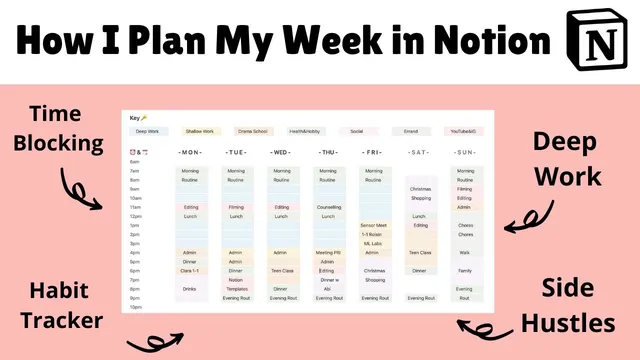
Once the goals are converted into trackable actions, the schedule itself follows a structured time-blocking method. The calendar is filled first with fixed, non-negotiable commitments like teaching classes and meetings. Then the remaining open time is carved into deep work windows—specifically aiming for three to four hour blocks for PhD methodology work. Because teaching is finishing for the term and the focus is largely on methodology, the deep work plan stays relatively clean: the creator doesn’t need to juggle many competing PhD tasks right now.
After deep work, the plan deliberately protects routines and recovery: morning routine, evening routine, and lunch breaks are scheduled as blocks rather than left to chance. Shallow work is then slotted in where it fits, including a consistent admin hour each day (set around 4 p.m. or 5 p.m.) to build habit through repetition.
Task planning also adapts to the creator’s menstrual-cycle-based “in the flow” approach, using the follicular/ovulatory phase as a guide for what kinds of tasks feel most natural. During this window, the week’s “fun” priorities take center stage—like Christmas shopping, research and development for gifts, and building a Christmas list—alongside lighter creative or planning work such as improving a filming space at home and finishing Notion templates (mental health bullet journal and finances). The plan also accounts for context changes: time at the family home on Tuesday and Wednesday is used to handle at-home tasks, while office work is deprioritized in favor of staying home for most of the week.
The result is a weekly system that combines measurable goal tracking, protected deep work, routine anchors, and flexible task placement—then relies on daily check-ins to keep the schedule intact while still leaving room for life, content creation, and business responsibilities.
Cornell Notes
The weekly planning system turns broad PhD and life goals into measurable weekly actions inside Notion, then enforces those actions through a time-blocked calendar. Health and fun goals are broken into trackable inputs (e.g., gym frequency, 10,000 steps) that generate star ratings and percentage scores. Mood and reflection act as output metrics, helping connect behavior to how the week actually felt. Progress then rolls into a four-week review cycle aligned with a 12-week-year style approach, keeping goals smaller and easier to adjust. Scheduling follows a deep-work-first structure: fixed commitments first, then 3–4 hour methodology blocks, routine blocks, and a consistent daily admin hour.
How does the weekly tracker convert goals into something measurable?
What’s the difference between “input” and “output” metrics in this planning system?
Why are deep work blocks scheduled before shallow work?
How does the planner handle routines and habit-building?
How does menstrual-cycle “in the flow” planning affect what goes on the calendar?
How does context (home vs. office) change task placement?
Review Questions
- What specific weekly metrics would you track for one of your goals, and what would you use as the corresponding output metric (how you want to feel)?
- How would you restructure your calendar if you currently mix deep work and admin in the same blocks?
- Which tasks in your life depend on location or context, and how could you time-block them to reduce friction?
Key Points
- 1
Translate each monthly goal into trackable weekly actions (counts, frequency, or days achieved) rather than leaving goals abstract.
- 2
Use both input metrics (behavior frequency) and output metrics (mood/reflection) to evaluate whether progress is actually landing.
- 3
Time-block fixed commitments first, then reserve 3–4 hour windows for deep work on PhD methodology.
- 4
Protect routines by scheduling morning/evening routines and breaks as non-negotiable calendar blocks.
- 5
Add shallow work through dedicated slots, including a consistent daily admin hour around 4 p.m. or 5 p.m.
- 6
Place tasks based on menstrual-cycle “in the flow” preferences so the week’s workload matches motivation and energy.
- 7
Adjust task placement for real-life context changes (e.g., family-home days) so location-dependent tasks get handled when you’re there.