How Luminiferous Aether Led to Relativity
Based on PBS Space Time's video on YouTube. If you like this content, support the original creators by watching, liking and subscribing to their content.
The Michelson–Morley interferometer searched for an ether wind by checking whether rotating the apparatus changed the interference fringe pattern.
Briefing
By the end of the 19th century, physics looked nearly finished—until the Michelson–Morley experiment failed to detect the luminiferous ether, undermining the assumption that light needs a material medium and breaking the Newtonian framework that relied on Galilean relativity. The null result forced a rethink of how space and time work, setting the stage for Lorentz’s transformation updates and, eight years later, Einstein’s special relativity, where the speed of light stays constant for all observers.
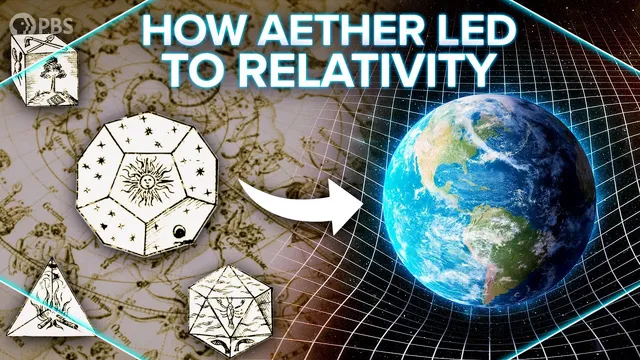
The ether idea had deep roots long before it became an experimental target. Ancient Greek thought treated ether as a primordial, divine element; Aristotle placed it as an immutable substance filling space; and medieval alchemists associated it with quintessence. By the 1600s, René Descartes argued against empty space, while Christian Huygens developed a wave-based theory of light that required an all-pervading medium—luminiferous ether—to explain how light propagates, refracts, and interferes. Isaac Newton pushed back with a particle view of light and argued that any medium filling space should create detectable drag on planetary motion, making the ether idea implausible.
The 19th century revived the ether’s credibility. Thomas Young’s double-slit experiment produced an interference pattern consistent with waves, and Maxwell’s equations predicted electromagnetic waves traveling at the speed of light. With light behaving like a wave, the ether seemed not just plausible but necessary—so Michelson and Edward Morley designed a test to measure how Earth’s motion through the ether would change the apparent speed of light. Their interferometer split a beam into two perpendicular arms, recombined them after multiple reflections, and read the outcome through interference fringes. If the “ether wind” altered light’s speed differently along the two arms, rotating the apparatus by 90 degrees should shift the fringe pattern.
Instead, the fringes didn’t move. The experiment was repeated across seasons to rule out the possibility that the ether happened to match Earth’s motion, and the result remained null—one of physics’ most famous failures to find what everyone expected. That outcome contradicted Galilean relativity’s velocity-addition logic and implied that light’s speed is direction-independent. Hendrik Lorentz responded by building the Lorentz transformation to preserve the constancy of light, and Einstein later elevated that principle into special relativity, motivated partly by the way Maxwell’s equations fit poorly with Galilean transformations.
The ether didn’t vanish entirely as a concept. Einstein reframed it as a “new ether” tied to the gravitational field, and later thinking treated space-time itself as a kind of medium—an idea that resonates with modern physics’ view of quantum fields and the structure of space-time. Even Albert Michelson reportedly struggled to accept his own result, clinging to the ether until late in life. In the end, the death of the classical luminiferous ether didn’t just close a chapter—it cracked open the foundations that enabled relativity and, eventually, quantum theory.
The transcript then pivots to a separate discussion about cosmology and the universe’s age, including questions about how an infinite universe can have a finite age, what happens near the Planck time, and how the cosmic microwave background maps to a specific size and distance scale.
Cornell Notes
The luminiferous ether was a once-central medium concept meant to explain how light travels as a wave. Michelson and Edward Morley built an interferometer to detect an “ether wind” by looking for fringe shifts when the apparatus rotated; no shifts appeared, even when Earth’s motion changed over the year. That null result contradicted Galilean relativity and implied the speed of light does not depend on an observer’s motion. Hendrik Lorentz developed the Lorentz transformation to keep light’s speed constant, and Einstein later used that constancy as a cornerstone of special relativity. The classical ether died, but related “ether-like” ideas reappeared in gravitational and space-time interpretations.
Why did the ether become such a strong expectation by the late 1800s?
What specific prediction did Michelson and Morley test?
How does an interferometer translate tiny speed differences into visible fringe shifts?
What did the null result imply about Galilean relativity?
How did the ether’s failure connect to Lorentz transformations and Einstein’s relativity?
Did “ether” disappear completely after Michelson–Morley?
Review Questions
- What experimental signature would have appeared if an ether wind affected light’s speed differently along the interferometer arms?
- How did the Michelson–Morley null result force a change in the relationship between observer motion and measured light speed?
- In what ways did wave evidence (Young) and electromagnetic theory (Maxwell) make the ether seem necessary before the experiment?
Key Points
- 1
The Michelson–Morley interferometer searched for an ether wind by checking whether rotating the apparatus changed the interference fringe pattern.
- 2
Young’s double-slit interference and Maxwell’s electromagnetic-wave prediction made light’s wave nature—and thus the need for a medium—seem compelling.
- 3
Newton’s objections included the idea that a medium filling space should create drag on planetary motion, conflicting with observed near-perfect motions.
- 4
The null result contradicted Galilean relativity’s velocity-addition logic and implied light’s speed is effectively independent of observer motion.
- 5
Hendrik Lorentz’s Lorentz transformation was developed to keep the speed of light constant across inertial frames.
- 6
Einstein used light-speed constancy and the Lorentz transformation as foundations for special relativity, later reshaping gravity through general relativity.
- 7
Although the classical luminiferous ether for light was rejected, ether-like concepts reappeared in discussions of gravitational fields and space-time structure.