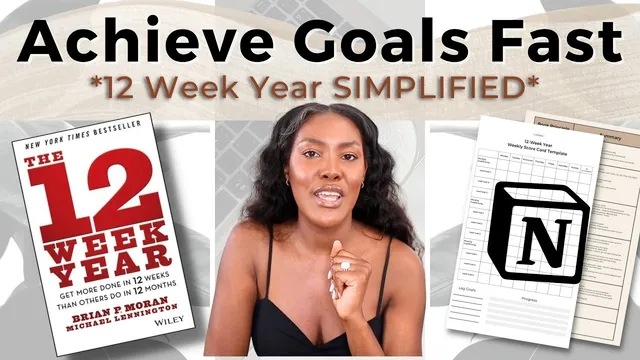
HOW TO ACHIEVE YOUR GOALS IN ONLY 12 WEEKS l 12 Week Year Guide
Based on Dr. Tiffany Shelton's video on YouTube. If you like this content, support the original creators by watching, liking and subscribing to their content.
Treat goal progress as a 12-week sprint system rather than an annual plan, with four cycles per year to maintain urgency and focus.
Briefing
Missing your goals mid-year usually isn’t a motivation problem—it’s a planning problem. The core fix is the “12-week year” mindset shift: replace annual thinking with period thinking. Instead of treating goals as something to revisit in December, the year gets broken into four 12-week sprints, creating urgency, focus, and momentum. That shorter time horizon also makes goals easier to adjust when reality changes, rather than forcing a single, rigid plan to carry you for months.
Support for the approach comes from research cited around 90-day cycles versus yearly goals. Companies using quarterly goals reportedly saw 31% higher returns on investment than those sticking to annual goal setting. In volatile environments, annual plans often become irrelevant by mid-year, while quarterly reviews support faster pivots. Regular feedback loops over 90 days are also linked to stronger persistence, less procrastination, and better refinement of day-to-day actions. The practical takeaway is straightforward: shorter planning cycles don’t just increase urgency—they improve learning and course correction.
But urgency alone doesn’t solve the deeper issue. When effort isn’t guided by direction, people burn out without progress. A business example illustrates the pattern: Jess had plenty of ideas but ran out of time, sprinted hard for weeks, then hit burnout with tasks everywhere and little movement. The diagnosis wasn’t discipline; it was clarity. The “hustle as water, clarity as the funnel” metaphor frames the solution: energy needs a funnel—values and a defined why—so it can flow into the right actions instead of leaking into random work.
To build that funnel, the 12-week year framework starts with vision work: clarify values, define a why, and filter goals through that purpose. It then organizes long-term ambition into “sun goals” (5–10 year goals) and “moon goals” (1–3 year goals) so daily effort serves a larger trajectory. From there, execution becomes more concrete by shifting from outcome-only targets to controllable actions. The method uses lag goals (the outcomes, like losing 10 lbs or gaining 10,000 followers) and lead goals (the behaviors that drive results, like working out three times a week or posting five times weekly).
Planning then turns into a weekly operating system. Monthly priority goals act as milestones (“star goals”), and weekly lead actions become a checklist (“earth goals”). Progress depends on recurring review and reset: weekly planning to check the scorecard and monthly priorities, plus a structured weekly plan that includes non-negotiables, batched tasks, and time blocking. Time blocking is reinforced with buffer blocks, breakout blocks (at least three hours away from work-related activities and thoughts), and strategic blocks (three hours of uninterrupted deep work with no calls, emails, or visitors).
Finally, consistency is treated as a system, not a personality trait. Accountability is presented as the decisive lever, with a cited study showing success rates rising from about 25% with goal-setting alone to as high as 95% when a specific accountability appointment is set. When energy dips, the framework also normalizes an emotional roller coaster—uninformed optimism, informed pessimism, a valley of despair, informed optimism, and eventual success—and recommends self-compassion, mindfulness, and committed action over perfect feelings. The overall message: build clarity, plan in 12-week sprints, execute through lead goals, review weekly, and lock in accountability so momentum survives real life.
Cornell Notes
The 12-week year approach reframes goal progress by replacing annual planning with four focused 12-week sprints. Shorter cycles create urgency and make it easier to pivot through regular reviews, which research links to better persistence and less procrastination. The method also insists that effort needs direction: clarify values and define a “why,” then set “sun goals” (5–10 years) and “moon goals” (1–3 years) so daily work serves a larger purpose. Execution is built around lag goals (outcomes) and lead goals (actions), then organized into monthly milestones and weekly checklists. Weekly review, time blocking (including buffers and deep-work blocks), and accountability are presented as the system that sustains consistency through burnout and doubt.
Why does the 12-week year emphasize “period thinking” instead of annual goal setting?
What’s the difference between lag goals and lead goals, and why does it matter?
How do “sun goals” and “moon goals” connect long-term vision to weekly action?
What role do weekly reviews and resets play in the system?
How does time blocking support execution beyond just scheduling tasks?
What accountability mechanism is described as most likely to drive follow-through?
Review Questions
- How does shifting from annual thinking to 12-week sprints change both urgency and the ability to adjust plans?
- Create an example lag goal and at least three lead goals that would realistically drive it within a 12-week cycle.
- What weekly review questions would you ask to determine whether your actions still match your sun and moon goals?
Key Points
- 1
Treat goal progress as a 12-week sprint system rather than an annual plan, with four cycles per year to maintain urgency and focus.
- 2
Clarify values and define a clear “why,” because effort without direction leads to burnout and scattered tasks.
- 3
Set “sun goals” (5–10 years) and “moon goals” (1–3 years) so weekly work serves a larger trajectory.
- 4
Use lag goals for outcomes and lead goals for controllable actions, then translate monthly milestones into weekly checklists.
- 5
Run a weekly review and reset using a scorecard to course-correct before misalignment compounds.
- 6
Time block with buffers, breakout blocks (minimum three hours away from work), and strategic blocks (three hours of uninterrupted deep work).
- 7
Lock in accountability through scheduled check-ins, since follow-through rises sharply when someone expects updates.