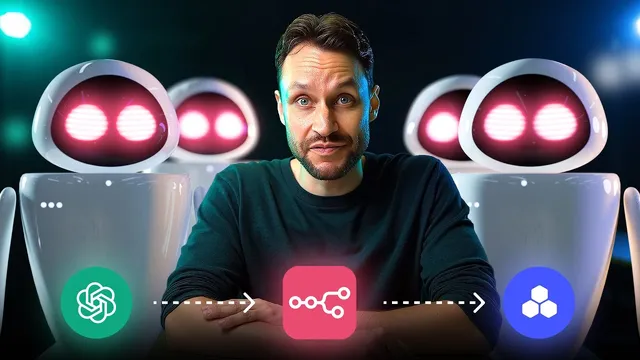
How To Build a Startup Team of AI Agents (n8n, OpenAI, FeedHive)
Based on Simon Høiberg's video on YouTube. If you like this content, support the original creators by watching, liking and subscribing to their content.
Fine-tune a model on 20–50 high-quality examples to lock in a consistent writing style, rather than relying on generic prompts.
Briefing
A founder can replace a large share of a startup’s day-to-day team work with a small “startup team” of AI agents—built around a fine-tuned writing model, a brand brief, and an automation workflow that lets multiple agents collaborate and then publish results automatically. The practical payoff is clear: instead of manually prompting and copy-pasting drafts, the system can generate on-brand social posts end-to-end, push them into FeedHive drafts, and iterate via internal quality checks.
The approach starts with content creation, but the underlying pattern is meant to generalize to many startup tasks. Early attempts to generate posts by simply prompting ChatGPT tend to produce generic, off-brand output. The fix is to specialize the model. Rather than relying on a system prompt with examples, the workflow uses fine-tuning: collect 20–50 high-quality examples (including the founder’s own posts or preferred creators’ work), reverse-engineer the likely prompts that produced each example, and train a custom model on those input-output pairs. OpenAI’s fine-tuning pipeline is used with a JSONL dataset (one training example per line), and the base model recommended is gpt-4o.
Fine-tuning handles “how to write,” but not “what to believe.” To make the model adopt the founder’s actual positioning—core values, themes, objectives, dislikes, opponents, and related products/services—the system adds a separate brand layer. A plain-English brand brief is created (in a text file, Notion page, or Google Doc). If building it from scratch is too slow, ChatGPT can draft it from the same training examples, then the founder edits it. In the playground, the fine-tuned model is prompted with this brand brief so outputs match both style and stance.
The next step turns a specialized model into a true agentic workflow. The setup uses n8n to orchestrate multiple AI agents that collaborate: one agent generates topic ideas from the brand brief, a second agent drafts a post in the desired tone, and a third agent scores and critiques the draft against quality criteria (with a numeric score returned in JSON). The drafting agent then revises based on feedback until the post meets the brand and quality requirements. n8n’s automation nodes call these sub-workflows, pass structured data between them, and loop over multiple content ideas.
Finally, the system publishes. An HTTP request node sends the approved post text into FeedHive, where it appears under drafts for scheduling. The result is a semi-closed loop: generate → draft → evaluate → refine → publish, with minimal human intervention beyond maintaining the brand brief and training data.
The workflow also includes a “lighter” alternative: FeedHive’s built-in AI grading and suggestions, which is easier to use but not trained on the founder’s specific content. For founders who want automation without building everything from scratch, the message is that the custom setup is best for fidelity, while the built-in option is a faster on-ramp.
Cornell Notes
The core method replaces manual team work with a small set of AI agents that collaborate through automation. It starts by fine-tuning a model (using 20–50 examples) so outputs match a specific writing style, then adds a separate “brand brief” so the model knows the founder’s values, themes, and hot takes. n8n orchestrates multiple agents: one generates topic ideas, another drafts posts, and a third scores/criticizes them using JSON outputs, feeding feedback back into revisions. When the post meets criteria, an n8n step pushes it into FeedHive drafts for scheduling. This matters because it turns AI from a one-off chatbot into an end-to-end production pipeline that can run with less ongoing human effort.
Why does prompting ChatGPT directly often produce low-quality startup content, and what replaces that approach?
What does fine-tuning contribute versus what the brand brief contributes?
How is the training dataset structured for fine-tuning in this workflow?
What makes the system an “AI agent team” rather than a single chatbot call?
How does the workflow move from generated text to scheduled social posts?
What’s the tradeoff between the custom fine-tuned setup and FeedHive’s built-in AI grading?
Review Questions
- What specific shortcomings of generic prompting does fine-tuning address, and what does the brand brief address that fine-tuning doesn’t?
- Describe the collaboration loop among the three n8n-driven agents (ideas → draft → feedback) and how JSON outputs are used.
- What steps in the workflow ensure the final post is pushed into FeedHive drafts rather than staying as a chat result?
Key Points
- 1
Fine-tune a model on 20–50 high-quality examples to lock in a consistent writing style, rather than relying on generic prompts.
- 2
Create a plain-English brand brief that defines values, themes, objectives, dislikes/opponents, and product context so outputs match positioning.
- 3
Use n8n to orchestrate multiple agent workflows: idea generation, drafting, and quality scoring with structured JSON feedback.
- 4
Implement an internal revise-and-approve loop where the feedback agent critiques drafts and the drafting agent revises until criteria are met.
- 5
Push approved post text into FeedHive via n8n so content lands in drafts for scheduling, enabling near end-to-end automation.
- 6
Use FeedHive’s built-in AI grading as a faster alternative when custom fine-tuning and orchestration are too heavy.
- 7
Plan for ongoing maintenance: keep training examples and the brand brief current so the system doesn’t drift off-brand.