How to Plan Your Best Year Yet in 4 Easy Steps
Based on Ciara Feely's video on YouTube. If you like this content, support the original creators by watching, liking and subscribing to their content.
Run a yearly review that includes completions, challenges, learning, relationships, well-being, finances, habits, community contribution, and explicit values/vision alignment.
Briefing
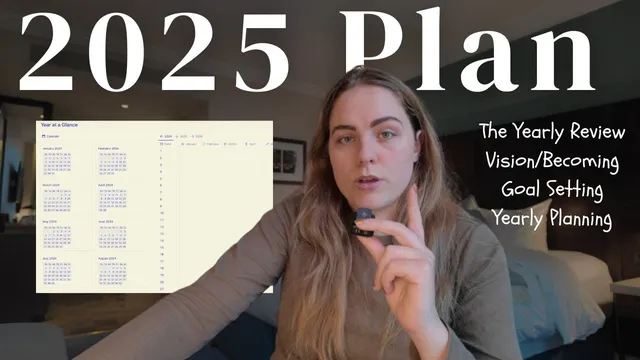
Planning a “best year yet” starts with a hard look back—then turns that clarity into a values-driven vision and only then into goals and a workable calendar plan. The core move is to stop treating New Year’s goals like isolated targets and instead run a full yearly review that captures what was completed, what was hard, what changed, and whether the year matched long-term values. That review matters because it reveals both wins you may have forgotten and patterns you can’t see in the moment; one example given is completing 23 items in 2023—many of them unexpected—once a completion list was tracked.
The process begins with a yearly review that combines a “completion list” mindset with structured reflection. A planner template can help by listing completed projects and archived areas of focus, plus goals set during the year. From there, the review expands beyond achievements: it includes calendar-based recall of highlights and low points, and a set of prompts that cover accomplishments, challenges and how they were overcome, learning and personal growth, relationship shifts, and well-being priorities. The prompts also reach into gratitude, finances, habits and routines, community contribution, and alignment with vision and values. The review doesn’t end at retrospection; it explicitly asks what to carry forward, what to leave behind, what unexpected events shaped the year, whether happiness and fulfillment were present, and what top goals should be pursued next.
A key question ties the review to future decisions: “Is the life being led aligned with values and long-term vision?” If the answer is no, the guidance is blunt—continuing the same path is still a choice. The next step is building a vision that feels emotionally reachable. Instead of a traditional vision board, the transcript highlights a “becoming board”: filling it with small, daily-life details that represent the person someone wants to become (morning drink, exercise routine, commute, evening rhythm). The goal is to replace aspirational images with lived reality over time, so the board becomes a reflection of actual daily life rather than distant milestones like “a million dollars” or “a million subscribers.”
Another vision technique uses AI: describe an ideal life and ask ChatGPT to generate a “day in the life” for that person, or even a comparison life for someone who embodies the same values. The point isn’t novelty—it’s alignment checking. Only after review and vision does the transcript move to goal setting, warning against copying goals from other people without first grounding them in values and vision. Goals should be refined into SMART form for clarity and measurability, then audited for value alignment.
Finally, planning turns goals into reality by mapping them onto an already-booked year. The approach is calendar-first: list existing commitments, then decide how to break the year into seasons or planning blocks. Goals may run in parallel or in sequence depending on whether they’re lifestyle routines, skill-building projects, or learning goals (like composing piano lessons and improv, handled in different seasons). The transcript also endorses a “12-week year” style structure—four 12-week sections—while allowing other frameworks (monthly, two six-month blocks). Even start dates can shift to match seasonal rhythms, such as beginning the next goal-setting section on February 1st using the Celtic calendar. The result is a system where goals are scheduled, habits and tasks are tracked within each block, and the year’s constraints are treated as part of the plan—not an afterthought.
Cornell Notes
A “best year yet” plan starts with a detailed yearly review that captures completions, challenges, learning, relationships, well-being, finances, habits, and alignment with long-term vision and values. The review is paired with calendar reflection to identify what the year actually looked like and what should change next. Vision comes next, using tools like a “becoming board” (small daily-life details that represent the person someone wants to become) and AI-generated “day in the life” prompts via ChatGPT to test emotional and values alignment. Only then should goals be set—refined into SMART form and checked against values—before being scheduled into a realistic calendar using seasonal blocks or a 12-week year approach. This sequence prevents goal-setting from becoming disconnected wishlists.
Why does the process start with a yearly review instead of jumping straight to goals?
What does a “becoming board” do differently from a traditional vision board?
How can ChatGPT be used to strengthen vision and values alignment?
What’s the transcript’s rule for setting goals after review and vision?
How does planning make goals realistic instead of aspirational?
Review Questions
- Which parts of the yearly review are most likely to reveal misalignment with values—and what specific prompt would you use to surface that?
- How would you translate your “ideal life” into a becoming board with daily-life details rather than end-state achievements?
- What planning block structure (12-week year, monthly, seasonal) best matches your goals, and what existing commitments would you map first?
Key Points
- 1
Run a yearly review that includes completions, challenges, learning, relationships, well-being, finances, habits, community contribution, and explicit values/vision alignment.
- 2
Use calendar reflection to identify highlights and low points, then decide what should change rather than repeating the same year by default.
- 3
Build vision through “becoming” details—small daily routines and behaviors—so the future feels actionable and emotionally rewarding.
- 4
Use ChatGPT to generate a “day in the life” for an ideal, values-aligned person, then compare it to current reality to spot gaps.
- 5
Set goals only after review and vision, then refine them into SMART form so progress is measurable and achievement is clear.
- 6
Audit every goal for values alignment; a goal can be financially or professionally successful yet still feel off if it conflicts with what matters.
- 7
Schedule goals into a realistic calendar by mapping existing commitments first and then using seasonal blocks or a 12-week year approach to sequence habits and projects.