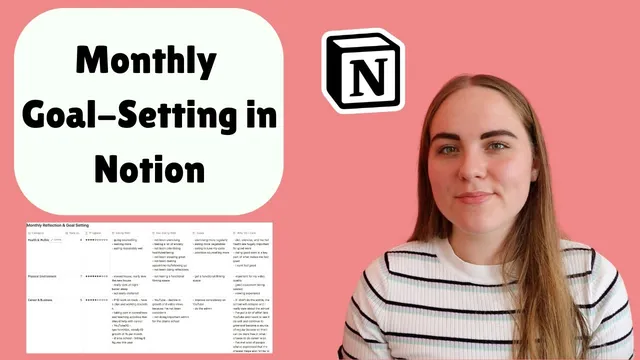
How to Set Effective Goals - Monthly Reflection and Goal Setting in Notion
Based on Ciara Feely's video on YouTube. If you like this content, support the original creators by watching, liking and subscribing to their content.
Use a monthly (or quarterly/yearly) reflection to review multiple life areas instead of relying on once-a-year resolutions.
Briefing
Monthly goal-setting becomes effective when it starts with a structured reflection across life areas—then turns each insight into specific actions tied to a clear “why.” The core workflow centers on using a Notion database built around the Wheel of Life categories, rating what’s going well versus what’s not, and only then drafting goals and next steps. The emphasis is practical: goals fail when they’re copied from other people’s resolutions or when they’re written without checking what actually needs attention.
The process begins with normalizing goal check-ins beyond January. Instead of treating goals as an annual event, the approach calls for monthly (or quarterly/yearly) reviews so progress doesn’t quietly stall. The reflection is designed to surface both gaps and strengths—what’s already working and what’s dragging—across categories like health and well-being, career and business, finances, friends and family, romance and relationships, personal growth, and fun and recreation. Categories are customizable, including splitting broad areas into more specific subcategories when there’s a lot going on (for example, separating different career tracks).
A key step is assigning a “why” to each goal. The reflection warns that people often set goals they don’t truly care about, which undermines follow-through. The “why” doesn’t need to be poetic, but it must be specific enough to connect habits to motivation. In this example, health goals are framed as fuel for doing good work and feeling good overall, while finances are tied to reducing uncertainty and avoiding tension from not knowing where money stands.
From there, goals are translated into measurable actions. In health and well-being, the reflection identifies weak habits—insufficient exercise, inconsistent appointment follow-through, poor sleep quality (including nightmares), and not eating in sync with the menstrual cycle. The resulting goals include exercising more regularly, meal prepping, eating in tune with the cycle, and adding tracking—such as a mental health tracker in Notion to monitor thoughts, feelings, sleep, and mood. Personal growth goals focus on building a daily habit for reflection and mindfulness (about 30 minutes per day), rather than relying on occasional sessions.
Career and business is treated differently: when performance feels on track, the plan avoids forcing unnecessary changes. The focus shifts to areas showing friction—especially YouTube consistency, admin work, and declining views—paired with concrete steps like one hour of admin daily and a process to delegate responsibilities. Finances are rated as moderately strong but flagged for budgeting gaps after moving and enjoying reopened life; the action is to create and follow a budget.
Finally, fun and recreation is treated as a serious category, not a reward for later. With canceled trips and a “work hard, play hard” rhythm disrupted, the reflection sets specific hobby actions—reading fiction, trying new recipes and food venues, and hiking—then schedules them so they become real rather than aspirational. The overall message: reflection produces better goals, but only tracking and scheduling turn those goals into consistent progress.
Cornell Notes
Effective goals start with a monthly reflection that rates each life area (using Wheel of Life-style categories) on what’s going well and what isn’t. After that assessment, each goal gets a specific “why,” because motivation drives follow-through; goals that don’t matter to the person tend to fail. The reflection then converts goals into concrete actions—often daily, weekly, or monthly—so progress can be tracked in Notion. The approach also treats “fun and recreation” as essential, not optional, and emphasizes scheduling hobbies to prevent them from disappearing during busy periods.
Why does the reflection insist on writing a “why” for every goal?
What comes first: rating life areas or drafting goals?
How are goals turned into actions that can be tracked?
How does the approach handle categories that are already “on track”?
Why is “fun and recreation” treated as a goal category, not a luxury?
What role does Notion play in the system?
Review Questions
- When you rate “what’s going well” versus “what’s not,” how would you prevent yourself from skipping that step and jumping straight to goals?
- Pick one life category you care about. What would your specific “why” be, and how would that “why” change the actions you choose?
- What cadence would you assign to each action you set (daily, weekly, monthly), and what would you track to know whether it’s working?
Key Points
- 1
Use a monthly (or quarterly/yearly) reflection to review multiple life areas instead of relying on once-a-year resolutions.
- 2
Start by rating what’s going well and what’s not in each category before writing goals.
- 3
Attach a specific personal “why” to every goal to ensure motivation and follow-through.
- 4
Convert goals into concrete actions with a clear schedule (daily, weekly, monthly) so progress can be tracked.
- 5
Customize Wheel of Life-style categories to match real life complexity, splitting broad areas when needed.
- 6
Treat “fun and recreation” as essential by scheduling hobbies and setting specific, repeatable actions.
- 7
Track actions in Notion so one-time intentions become measurable habits over time.