How to Write High Quality Paragraphs: Unity, Order, Cohesion, Completeness | PhD Thesis Writing Tips
Based on Ciara Feely's video on YouTube. If you like this content, support the original creators by watching, liking and subscribing to their content.
Use a topic sentence that matches the paragraph’s single main idea, then ensure every supporting sentence links back to it.
Briefing
High-quality paragraphs in a PhD thesis aren’t built by piling in information—they’re built by locking the writing to one clear idea and then arranging supporting evidence so it reads logically. A strong paragraph typically starts with a topic sentence, follows with a few supporting sentences (often more than three), and ends with a concluding sentence that either restates the main point or smoothly sets up the next paragraph. For thesis writing—especially introductions and literature reviews where structure is less “automatic” than methods/results—this discipline matters because it prevents sections from turning into confusing collections of claims.
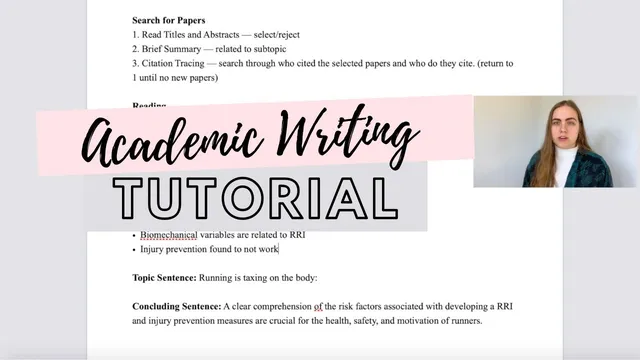
The framework used to keep paragraphs on track centers on four elements: unity, order, coherence, and completeness. Unity means every sentence in the paragraph must connect back to one key idea introduced in the topic sentence. In the example about running-related injury occurrence, the topic sentence is chosen to match the paragraph’s purpose: running is taxing on the body, and the incidence of running-related injuries is high across runners of all distances. Once that focus is set, the supporting sentences must stay within that lane. Claims that belong to other themes—like biomechanical variables (more suited to injury risk) or injury prevention techniques (more suited to prevention)—should be removed rather than “shoehorned” into the wrong paragraph.
Order is the next constraint: supporting points should be arranged in a way that makes the relationships between ideas easy to follow. The example shows how mixing injury categories can break flow—jumping between time-loss injuries and injuries requiring medical attention makes the paragraph feel like it’s zigzagging. Grouping similar categories together (medical-attention injuries together, time-loss injuries together) creates a clearer structure. The paragraph then moves from general prevalence to more specific patterns, such as a U-shaped relationship between time-loss injuries and running distance, and higher injury incidence among novice runners.
Coherence is about the transitions and sentence-to-sentence logic that make the paragraph feel like one continuous argument rather than separate facts. The example highlights a common problem: even when each sentence is individually sensible, the paragraph can still read incoherently if it lacks connecting language. Adding transition words and restructuring sentences helps the reader move from one claim to the next—such as shifting from medical-care injury rates to the U-shaped pattern for time-loss injuries, and then to the novice-runner peak.
Completeness ensures the paragraph is sufficiently developed. A complete paragraph doesn’t just introduce a topic; it also provides enough supporting evidence to give the reader a clear understanding and then closes the loop. In the injury-occurrence example, the concluding sentence ties back to why the prevalence of injuries matters—setting up the next section on risk factors and injury prevention. The result is a paragraph that stands alone: one main idea, logically ordered evidence, smooth transitions, and a conclusion that prepares the reader for what comes next.
Cornell Notes
Strong thesis paragraphs are built around one main idea, not a bundle of unrelated findings. A typical structure uses a topic sentence, several supporting sentences (often more than three), and a concluding sentence that either summarizes or leads into the next paragraph. The four-part checklist—unity, order, coherence, and completeness—helps writers keep paragraphs focused and readable. Unity requires every supporting sentence to connect directly to the topic sentence; order groups related evidence (e.g., medical-care injuries together, time-loss injuries together). Coherence depends on transitions and logical flow between sentences, while completeness means the paragraph has enough evidence to fully develop the idea and then links to the next section (such as moving from injury occurrence to risk factors).
What does “unity” mean in paragraph writing, and how does it affect what gets included or removed?
How should “order” be handled when a paragraph includes multiple related categories of evidence?
Why can a paragraph still feel incoherent even if every sentence is factually correct?
What does “completeness” require, especially for literature review paragraphs?
How does the concluding sentence function in a well-structured thesis paragraph?
Review Questions
- When you revise a paragraph, what specific test would you use to check unity (and how would you decide what to cut)?
- How would you reorganize a paragraph if it alternates between two categories of evidence (e.g., time-loss vs medical-care injuries)?
- What kinds of transition words or sentence reshaping would you add to improve coherence without changing the underlying facts?
Key Points
- 1
Use a topic sentence that matches the paragraph’s single main idea, then ensure every supporting sentence links back to it.
- 2
Aim for a paragraph that has enough supporting sentences to develop the idea (often more than three), but avoid adding multiple unrelated key ideas.
- 3
Group related evidence together to create a clear order; don’t zigzag between categories that belong in separate parts of the argument.
- 4
Improve coherence by adding transitions and restructuring so the reader can follow why each sentence follows the previous one.
- 5
Write a concluding sentence that either summarizes the evidence or sets up the next paragraph’s purpose (e.g., moving from injury occurrence to risk factors).
- 6
Treat completeness as development plus closure: the paragraph should fully address its key idea and then stop, rather than previewing the next topic too early.