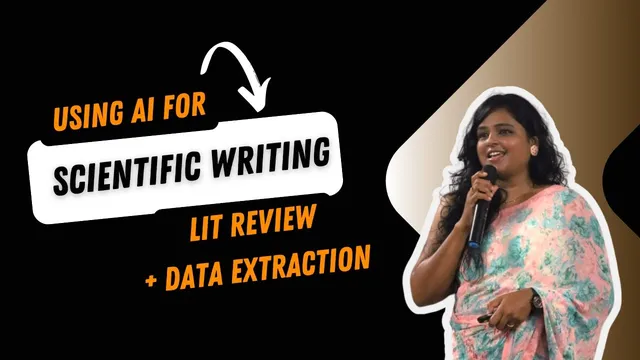
How To Write Scientific Papers Using AI
Based on SciSpace's video on YouTube. If you like this content, support the original creators by watching, liking and subscribing to their content.
General-purpose AI can hallucinate and may cite mixed-quality sources, so scientific use requires verification and citation discipline.
Briefing
Artificial intelligence has moved from niche computer-science circles into everyday academic work—yet the real value for scientific writing comes from using AI as a co-writer and research assistant, not as a replacement for the researcher’s judgment. The central message is that general-purpose chatbots can help draft and rephrase, but they often struggle with academic needs like reliable citations, source quality, and structured extraction across papers. Tools built for academic workflows—especially SciSpace—aim to bridge that gap by turning literature search, reading, note-taking, and drafting into a more connected pipeline.
The transcript starts by contrasting today’s AI boom with earlier AI history, then explains how modern “general purpose” systems work: they predict likely next text based on context, which makes them fast but also prone to hallucinations when pushed beyond what the data supports. That risk matters in academia, where citations and verifiable claims are non-negotiable. Even when tools provide references, the sources may be mixed (journal articles plus blogs or news), which can be unacceptable for many scientific writing standards.
From there, the focus shifts to practical academic tasks where AI can reduce time without sacrificing rigor. Literature search and review are framed as a semantic problem: simple keyword searches can explode into irrelevant results because terms like “Apple” can refer to unrelated entities. AI tools can filter using semantics—connections, frequencies, and how terms co-occur across documents—so researchers can start with fewer, more relevant papers. Semantic Scholar is presented as a straightforward way to shrink the initial paper set before deeper screening.
The transcript also emphasizes that literature isn’t just a timeline of independent papers; it’s a network. Citations and reference lists create backward and forward links, while co-author networks and semantic similarity add more structure. This “citation mining” approach can be automated via tools like Litmaps, which generate literature maps showing how papers overlap and connect, helping researchers find clusters and gaps.
Reading and comprehension are treated as another bottleneck, especially for researchers who learned scientific English later or who face papers that assume prior domain knowledge. SciSpace Copilot is described as a way to upload a PDF, then request explanations in simpler language, summaries for quick scanning, and related-paper suggestions tied to specific sections. The workflow extends to multi-paper extraction: researchers can select several PDFs and ask Copilot to synthesize answers (e.g., limitations across studies) while seeing which papers contributed.
Once information is extracted, the transcript argues that good scientific writing is not a list of isolated paper summaries. Instead, it should center the “story” of the argument—what the reader should believe, why it matters, and how sections connect. SciSpace’s notebook and AI writing features are positioned as tools to generate outlines, bridge gaps between paragraphs, and draft sections with citations and formatting options. Paraphrasing is presented as useful for rewriting and tone adjustment, but the transcript repeatedly warns against copy-pasting AI-generated text into final submissions.
Finally, ethics and compliance are addressed directly. AI content detectors and plagiarism checks are discussed as imperfect signals; the safer approach is to use AI for literature search, extraction, and drafting in early drafts, then apply human rewriting, verification, and responsibility. Journals generally disallow AI as a co-author and expect disclosure when AI use goes beyond minor assistance. The transcript concludes that AI is not the villain—how researchers use it, verify it, and integrate it into their own reasoning is what determines whether the work holds up.
Cornell Notes
AI’s biggest academic payoff comes from workflow tools that support literature search, paper reading, and structured extraction with citations—rather than from general chatbots that may hallucinate or mix unreliable sources. The transcript explains how semantic search and citation mining reduce the paper overload by using meaning, reference networks, and forward/backward citations to build a focused literature map. SciSpace Copilot is presented as a practical “PDF-to-notes” assistant: upload a paper, ask for explanations or summaries, find related papers by section, and extract synthesized information across multiple PDFs into table-like columns. Those extracted notes can feed SciSpace notebooks and drafting tools to build outlines, bridge gaps, and format text with references. The ethical throughline: use AI as a co-writer for drafts and verification, but keep final authorship, paraphrase responsibly, and avoid copy-paste submissions.
Why do general-purpose AI tools often fall short for scientific writing, even when they provide “references”?
How does semantic search reduce the “keyword explosion” problem in literature reviews?
What is “citation mining,” and how does it help build a literature map?
What does SciSpace Copilot add beyond asking a chatbot questions?
Why does the transcript warn against summarizing papers as independent “ABC said this” blocks?
What ethical boundary is emphasized for AI use in final manuscripts?
Review Questions
- When a search term has multiple meanings (like “Apple”), what semantic approach helps prevent irrelevant results from dominating the initial literature set?
- Describe backward vs forward citations and explain how following both can reveal research clusters and gaps.
- What workflow steps does the transcript recommend for using AI outputs in early drafts without turning them into final copy-paste text?
Key Points
- 1
General-purpose AI can hallucinate and may cite mixed-quality sources, so scientific use requires verification and citation discipline.
- 2
Semantic search helps literature reviews by filtering using meaning and document-level connections rather than isolated keywords.
- 3
Citation mining treats literature as a network: reference lists enable backward citation discovery, while later citing papers enable forward citation mapping.
- 4
SciSpace Copilot supports PDF-based explanation, section-level summaries, related-paper suggestions, and multi-PDF extraction into structured columns for faster synthesis.
- 5
Good scientific writing synthesizes evidence into a coherent argument; it avoids “paper-by-paper” listing that leaves the reader without a clear conceptual story.
- 6
AI should be used as a co-writer for drafts and extraction, while final responsibility remains with the human author; AI cannot be listed as a co-author.
- 7
Ethical compliance depends on journal/institution rules: disclosure may be required for heavier AI use, and final text should be human-verified and properly cited.