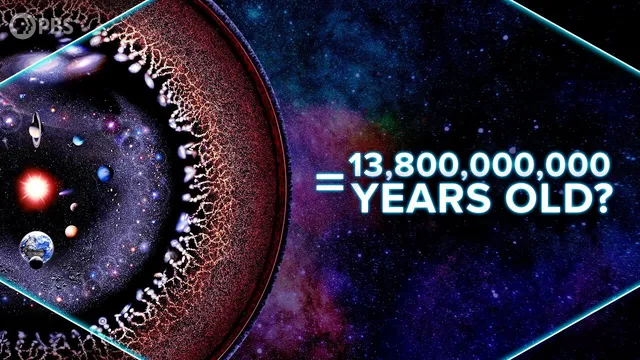
How We Know The Universe is Ancient
Based on PBS Space Time's video on YouTube. If you like this content, support the original creators by watching, liking and subscribing to their content.
The universe’s age is inferred by rewinding the expansion history using the Big Bang model, not by observing the earliest moments directly.
Briefing
Astronomers can assign a precise “birthday” to the universe—about 13.8 billion years ago—even though no direct relic from the first moments survives. The core trick is to treat the universe’s expansion like a clock: measure how fast galaxies are receding today, then use the physics of cosmic expansion to rewind the timeline to when the universe was hot, dense, and small enough to match the Big Bang model.
The modern story begins with the realization that the faint spiral nebulae are not local clouds inside the Milky Way but entire galaxies far beyond it. In the 1920s, Vesto Slipher measured redshifts showing those galaxies were moving away at enormous speeds. Edwin Hubble then used Cepheid variable stars—whose pulsation period tracks intrinsic brightness—to determine distances. Put together, redshifts and distances implied a simple pattern: the farther a galaxy is, the faster it recedes. That discovery shattered the earlier assumption of a static cosmos and made an expanding universe the natural interpretation.
Once expansion was on the table, the next step was to connect “how fast” to “how long ago.” The Hubble constant, which links a galaxy’s recession speed to its distance, provides a first estimate of the universe’s age if the expansion rate had stayed fixed. Early calculations in the 1930s produced an age under 2 billion years—smaller than Earth’s oldest rocks—so the problem had to be observational. The culprit was distance calibration: Hubble relied on Cepheid period–luminosity relations that didn’t match the Cepheids he observed in distant galaxies. Walter Baade corrected the Cepheid calibration in 1943 after distinguishing two Cepheid types with different period–luminosity relations, doubling the inferred distances and raising the estimated age to about 3.6 billion years.
Further revisions came from other distance indicators. Alan Sandage identified that astronomers had mistakenly counted bright hydrogen gas regions (H II regions) as if they were stars, biasing distance estimates. With corrected methods, the inferred Hubble constant rose to roughly 75 kilometers per second per megaparsec, pushing the age toward ~13 billion years. Gravity complicates the simple “rewind” because it slows expansion over time, meaning the universe must have expanded faster in the past; that adjustment yields an age range roughly between 7 and 13 billion years. Later, stellar-evolution updates resolved a brief tension with claims of globular clusters older than the universe.
The final precision—13.8 billion years—requires both slowing from matter’s gravity and speeding from dark energy. These effects enter the Friedmann equations, and the remaining challenge is determining the universe’s contents: how much matter (including dark matter) and how much dark energy exist, plus the expansion history. The gold-standard constraint comes from the cosmic microwave background, the oldest light visible, released when the universe was about 400,000 years old. Measurements from the Planck satellite’s CMB maps pin down the matter and dark-energy fractions and, through the expansion equations, converge on the same age from multiple approaches. The result is a consistent cosmic timeline: the universe’s “fiery beginning” occurred 13.8 billion years ago.
Cornell Notes
The universe’s age is inferred by rewinding cosmic expansion, not by finding a surviving “first moment” artifact. After redshift and distance measurements showed galaxies are receding faster when they are farther away, the Hubble constant provided an initial age estimate. Early ages came out too small because Cepheid distance calibrations were wrong—Cepheid variables come in two types with different period–luminosity relations—an error corrected by Walter Baade. Alan Sandage improved distance estimates by removing biases from confusing H II regions with stars, raising the inferred expansion rate. The modern 13.8 billion-year value comes from solving the Friedmann equations with both matter (gravity slows expansion) and dark energy (accelerates it), with the cosmic microwave background—measured by Planck—providing the key constraints on the universe’s contents.
How did astronomers move from “spiral nebulae” to a universe-wide expansion measurement?
Why did early calculations give an age of the universe that conflicted with Earth’s geology?
What changed when Walter Baade corrected the Cepheid method?
How did Alan Sandage’s work refine distance measurements beyond Cepheids?
Why can’t the universe’s age be found by simply dividing 1 by the Hubble constant?
Why does the cosmic microwave background matter for the “13.8 billion years” number?
Review Questions
- What observational chain links galaxy redshifts and Cepheid variables to the idea of an expanding universe?
- How did distinguishing two Cepheid types change inferred distances and the estimated age of the universe?
- What roles do matter gravity and dark energy play in the Friedmann-equation calculation of the universe’s age?
Key Points
- 1
The universe’s age is inferred by rewinding the expansion history using the Big Bang model, not by observing the earliest moments directly.
- 2
Redshift measurements (Vesto Slipher) plus Cepheid distances (Edwin Hubble) established that recession speed increases with distance, implying expansion.
- 3
Early age estimates were too low because Cepheid period–luminosity calibrations were mismatched; Walter Baade’s correction raised the inferred age.
- 4
Distance estimates also improved when Alan Sandage removed biases from confusing H II regions with stars.
- 5
A simple 1/Hubble-constant estimate fails because the expansion rate evolves due to gravity and dark energy.
- 6
The Friedmann equations require the universe’s matter and dark-energy fractions; the cosmic microwave background provides the tightest constraints.
- 7
Multiple independent approaches converge on an age of about 13.8 billion years.