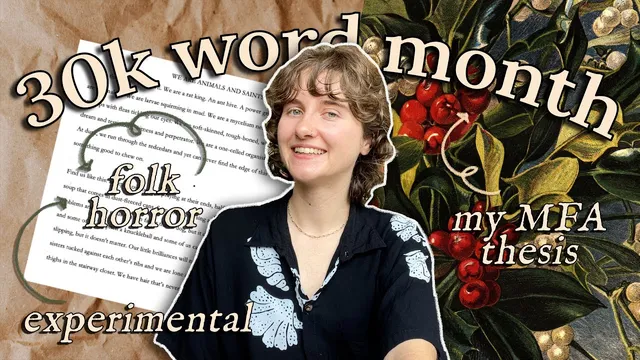
It's my MFA summer semester and I'm locked in 🍃 | WRITING VLOG
Based on ShaelinWrites's video on YouTube. If you like this content, support the original creators by watching, liking and subscribing to their content.
The MFA summer semester is treated as a funded window to draft a thesis close to a complete manuscript by September, with defense timing driving the pace.
Briefing
A summer MFA sprint is colliding with a looming debut-novel revision, and the result is a tightly managed writing schedule built around finishing a thesis draft fast enough to defend on time. In the summer semester between year one and year two, Jaylen is funded to do self-directed thesis work, aiming to complete as much of the manuscript as possible before September. After restarting in early May and getting momentum, she wrote all of Part Two out of six and is now pushing through Part Three with a clear chapter-by-chapter pace—seven chapters per part—using that symmetry as scaffolding to keep the draft moving.
The thesis itself is described as literary fiction with folk horror elements, loosely outlined at the “major beats” level rather than scene-by-scene. That approach is paying off: by the midpoint, she reports being unusually confident that plot and structure are essentially where they need to be. She’s already logged just over 43,000 words at the halfway point, projecting a roughly 90,000-word manuscript, with the expectation that revision will focus more on fleshing out scenes and layering in detail than on rewriting large plot mechanics. She also credits speed with keeping her connected to the story—she’s been able to draft quickly because the plot feels solid, even if the prose sometimes needs richer scene-level work.
But the schedule is complicated by “The Animal Sense,” a separate manuscript she’s edited heavily before and now must revisit after an agent call. That call triggered a major priority shift: the agent believes the book needs significant work, including a second round of feedback from another reader. Jaylen says she has little memory of her earlier “fugue state” revisions, aside from cutting roughly 15,000 words, and she’s bracing for a large, time-consuming edit. The emotional pressure is real—she’s “hungry for the sale”—yet she’s also trying to protect thesis momentum by delaying immediate revisions on The Animal Sense for the rest of June.
Her plan becomes a balancing act: finish Part Three and Part Four before a cluster of back-to-back camping trips in July, then take a natural rest point at the end of Part Four before shifting to later revisions. After hitting a wall at the start of Part Four—partly due to time pressure and the looming Animal Sense edit—she took about ten days off the manuscript, re-entered by reworking early pacing (including splitting Part One material into two chapters), and then regained a stride. She’s now down to two chapters left in Part Four, targeting completion before July 8 so she can rest without leaving the thesis mid-scene.
Across the draft, she’s also refining craft choices: she notes that her scenes can come out underbaked, especially in third person, and she wants to add complexity and richer detail during revision. She’s particularly attentive to structure devices, including a rare “same scene from two POVs” technique used only twice in the whole book. By the end of the vlog, she’s wrapping Part Four with confidence, projecting that Parts Five and Six could be written quickly once she returns—while acknowledging that The Animal Sense revisions will likely consume one to three months after late July, pushing some thesis-related work into fall. The throughline is clear: finish the thesis draft strongly enough for committee feedback and defense, then tackle the debut-novel overhaul with a renewed, more informed plan.
Cornell Notes
The writer is in the middle of an MFA summer semester, using self-directed funding to push a thesis draft toward a September defense. After early-May momentum, she completed Part Two and is driving through Part Three and Part Four with a seven-chapter-per-part structure. Midway through the manuscript, she reports unusually strong confidence in plot and structure, expecting revisions to focus more on scene-level richness and layered context than on major plot changes. A separate priority—her agented debut manuscript, The Animal Sense—requires significant revisions, and an agent call plus additional feedback means a large edit will likely start after June and run into fall. The schedule is further constrained by back-to-back camping trips in July, so finishing Part Four before leaving is treated as a key milestone and a “natural rest point.”
What is the thesis drafting strategy for the summer semester, and why does it matter for the defense timeline?
How does the writer’s outlining method shape what she believes needs revision later?
What changed after the agent call about The Animal Sense, and how does that affect the thesis schedule?
Why does the writer take a break and then rework early pacing in Part Four?
What milestone does she treat as essential before July travel, and what does she expect after Part Four?
What craft device does she use sparingly, and what problem does it create while drafting?
Review Questions
- How does the writer’s “major beats” discovery outlining approach influence her confidence about plot versus her expectations for revision?
- What scheduling constraints force tradeoffs between thesis drafting and The Animal Sense revisions, and how does she decide what to prioritize when?
- Why does the writer believe finishing Part Four before July travel is more than just a productivity goal?
Key Points
- 1
The MFA summer semester is treated as a funded window to draft a thesis close to a complete manuscript by September, with defense timing driving the pace.
- 2
The thesis is structured with seven chapters per part, and progress is tracked by chapter-level targets (e.g., finishing Part Three, then pushing through Part Four).
- 3
Midway through the draft, the writer reports unusually strong confidence in plot and structure, expecting revisions to focus on scene-level richness and layered context rather than major plot rewrites.
- 4
An agent call about The Animal Sense triggers a priority shift: the debut manuscript needs significant revision and will likely require a large edit starting after June, extending into fall.
- 5
Time pressure increases when both MFA deadlines and the looming debut revision collide, leading to a brief writing break and reworking of early pacing in Part Four.
- 6
Back-to-back camping trips in July create a hard deadline to finish Part Four before leaving, framed as a “natural rest point” rather than stopping mid-scene.
- 7
Craft adjustments during revision are expected to address underbaked scenes—especially in third person—by adding detail, complexity, and stronger scene execution.