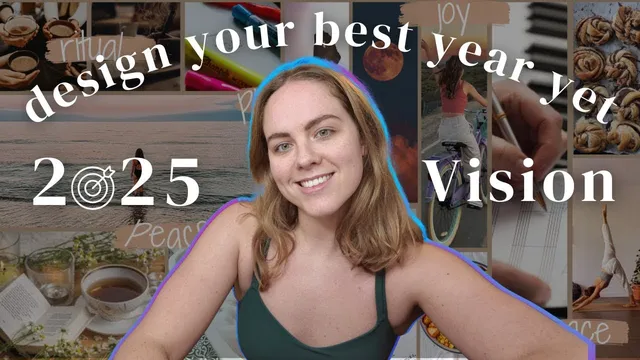
Make 2025 Your Year | A Vision Board That Works
Based on Ciara Feely's video on YouTube. If you like this content, support the original creators by watching, liking and subscribing to their content.
Shift from outcome metrics to identity and daily-life behaviors by building a “becoming board.”
Briefing
A “becoming board” can make goal-setting feel more grounded by shifting from achievement checklists to daily-life cues—then pairing that identity focus with sensory, value-based imagery. Instead of treating a vision board as a place for outcomes that may be out of reach (income targets, subscriber counts, awards, or distant milestones), Ciara Feely frames the board as a tool for rehearsing the person someone wants to become. The practical payoff: it’s meant to increase fulfillment by aligning goals with values, and by encouraging small, repeatable behaviors that move life in the right direction.
Feely contrasts traditional vision boards—often packed with measurable aspirations like earnings, follower numbers, fitness metrics, or plaques—with a becoming board that centers routines and character traits. Her “Kira 2.0” list describes a calmer, present version of herself: someone “not busy,” peaceful, connected, vintage-minded, able to keep a plant alive, creative in the kitchen, story-driven, spiritually alternative, and comfortable exploring her city in outrageous outfits. She doesn’t try to include everything; she narrows to a few themes so the board doesn’t become overwhelming.
To build the board without the usual friction of printing and sticking, she uses a digital workflow. She starts by collecting images tied to the chosen identity traits, but she also adds a method for making the imagery feel vivid and personal: search with “aesthetic” and build a sensory mix—images that represent what she wants to see, taste, smell, touch, and listen to. She also maps images to values such as creativity (piano, art, dance, acting) and growth (reflection, journaling, mindfulness, learning, reading, and language study). All saved images go into a desktop folder, and she recommends picking a color scheme early to prevent a mismatched collage.
Design choices matter, too. Feely experiments in Canva with a minimal layout, discovering that a crowded board can look worse on-screen than it would on a wall. Her solution: a single-color background and separated sections with varied image sizes and spacing, so the board feels organized even when it’s still personal and imperfect.
The final becoming board condenses her “2.0” into a few anchor words: ritual, peace, and purpose. “Ritual” includes seasonal and nature connection, monthly moon cycles, journaling, and a community vibe she calls “coven” (not literal witchcraft, but shared gatherings with cacao and planning). “Peace” shows up through bath time, sea swims, tea and reading, and the idea that her evening routine is a barometer for how she’s doing emotionally. “Purpose” points to acting and scripting, yoga and handstand skill-building, cycling joy, piano composition, and learning new kitchen skills—paired with reminders to nourish herself with foods that won’t make her feel sick.
Over time, she plans to replace the curated images with photos taken from real life, using the board as an evolving mirror of an aligned life rather than a static checklist. The core message is simple: make the board about who you’re practicing becoming, then let the visuals guide daily choices toward that identity.
Cornell Notes
The transcript argues for replacing outcome-heavy vision boards with “becoming boards” that focus on identity and daily behaviors. Instead of chasing metrics that may feel out of control, the board uses values and routines to make progress feel more fulfilling. Feely builds her “Kira 2.0” board by narrowing a long identity list into a few themes, then collecting images that match those themes through sensory searches (what she wants to see, taste, smell, touch, and hear) and value-based keywords like creativity and growth. She recommends saving images digitally (e.g., in Canva), using “aesthetic” in searches, and choosing a color scheme to avoid visual chaos. The board ultimately centers ritual, peace, and purpose—and is meant to evolve as real-life photos replace curated images.
What’s the practical difference between a vision board and a becoming board in Feely’s framework?
How does she make the image-collecting process less overwhelming?
What sensory and values-based method does she use to choose images?
Why does she recommend digital design first, and what layout choice does she land on?
What are the anchor themes on her final board, and what real-life behaviors do they represent?
How is the board supposed to change over time?
Review Questions
- How would you rewrite your own vision board goals into a “becoming board” focused on identity traits and daily routines?
- Which of your values (e.g., creativity, growth, peace) could be translated into specific sensory cues and repeatable habits?
- What design constraints—like a color scheme or minimal layout—would help you avoid an overwhelming, mismatched collage?
Key Points
- 1
Shift from outcome metrics to identity and daily-life behaviors by building a “becoming board.”
- 2
Use values as a filter: connect images to what you want to practice (e.g., creativity, growth) rather than only what you want to achieve.
- 3
Reduce overwhelm by narrowing a long identity list into a few anchor themes and building the board digitally first.
- 4
Collect imagery through sensory prompts (see, taste, smell, touch, listen) and search with “aesthetic” to keep results cohesive.
- 5
Pick a color scheme before collecting everything to prevent visual mismatch and wasted time.
- 6
Design for coherence: a minimal layout with separated sections can look better than a crowded collage, especially on-screen.
- 7
Treat the board as a living project by replacing curated images with photos from real life over time.