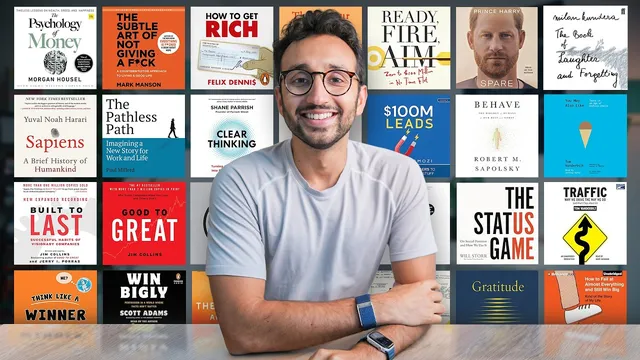
My ONE Piece of Advice for Someone in Their 20s
Based on Ali Abdaal's video on YouTube. If you like this content, support the original creators by watching, liking and subscribing to their content.
Commit to a concrete learning habit: listen to one audiobook per week for a year to build compounding knowledge.
Briefing
A single, concrete habit—listening to one audiobook every week for a year—can be a high-leverage upgrade for people in their 20s because it replaces low-effort, high-volume content consumption with deeper, structured learning that compounds over time. The advice is framed as a “magic bullet” alternative to vague motivation: instead of “find your passion” or “enjoy your work,” the prescription is measurable, repeatable, and easy to track.
At an event Q&A, a newly turned 20-year-old asked for one broad piece of guidance. The response was blunt: commit to one audiobook weekly for the next 12 months, and life will change “for the better.” The reasoning is tied to a broader critique of modern attention: many people spend hours scrolling social feeds or watching short and long-form clips, while the effort required to produce that content is often far lower than the effort embedded in books. Short-form posts can take creators only minutes to hours to make; educational YouTube videos are estimated at roughly 4–20 hours per video; podcasts are typically conversational and quicker to assemble. By contrast, audiobooks are downstream from books that can involve years of research, editing, and production—plus professional recording and engineering. The payoff, the argument goes, is “bang for your buck” per unit of time.
That “more listening” message comes with a constraint: it’s not a call to consume more passively. Action remains the foundation—learning should feed execution. The practical benefit is that audiobooks fit into real life: they can be played while commuting, doing laundry, or handling other mechanical tasks. For people who worry about focus or multitasking, the claim is that attention can be trained; listeners can start at normal speed and gradually increase playback speed (e.g., 1.1x up to 1.5x) to build the ability to track words while doing other tasks. The result is faster “context building,” not just entertainment.
The advice also expands into a framework for turning knowledge into outcomes: GPS—Goal, Plan, System. First define the goal. Then identify the plan, often requiring a knowledge gap to be filled through learning. Finally, build a system that makes the plan stick. Books and audiobooks are positioned as the fastest route to both the “plan” and the “system,” because they package years of expertise into repeatable steps.
To reinforce the point, the talk includes a pattern from business conversations: when people ask for help starting or scaling companies, the most useful answer often becomes recommending specific books by recognized experts—examples named include $100 million offers, Traction, Deep Work, and others. The closing emphasis is that almost any struggle has a book about it; audiobooks reduce the friction of getting started, enabling “exploration reading” (sampling multiple titles quickly) before deeper “exploitation reading” (using a chosen book as a reference while building something). A long personal Audible library walkthrough—hundreds of titles—serves as proof of the habit’s breadth, spanning productivity, psychology, business, relationships, and fiction.
Cornell Notes
The core recommendation is to listen to one audiobook every week for a year, using audiobooks as a practical substitute for time spent on social media and other low-effort content. The argument is that books (and therefore audiobooks) embed far more research and production effort than typical online content, so the learning-to-time ratio is higher. Audiobooks also fit into daily routines, allowing “background” learning while doing mechanical tasks, and listeners can build focus by gradually increasing playback speed. To turn learning into results, the GPS framework—Goal, Plan, System—connects knowledge acquisition to execution and follow-through.
Why does “one audiobook a week” count as a high-leverage habit for people in their 20s?
How does the advice avoid becoming “just consume more content”?
What is the GPS framework, and how does it connect to audiobooks?
What’s the practical strategy for listening without losing focus?
How does “exploration reading” differ from “exploitation reading”?
What role do books play in business advice conversations?
Review Questions
- If someone already has a goal but no plan, what does the GPS framework suggest they should do next?
- How would you design a one-week schedule that includes one audiobook while still ensuring you take action on what you learn?
- Give an example of when exploration reading would be more useful than exploitation reading.
Key Points
- 1
Commit to a concrete learning habit: listen to one audiobook per week for a year to build compounding knowledge.
- 2
Replace some time spent on social media, short-form clips, and podcasts with audiobooks to improve the learning-to-time ratio.
- 3
Treat audiobooks as input for action, not a substitute for execution—results still require doing the work.
- 4
Use GPS—Goal, Plan, System—to translate knowledge into outcomes and avoid getting stuck in vague motivation.
- 5
Build listening skill by starting at normal speed and gradually increasing playback speed, especially during mechanical tasks.
- 6
Use “exploration reading” to scan a topic quickly, then switch to “exploitation reading” by applying a chosen book as a reference while building something.