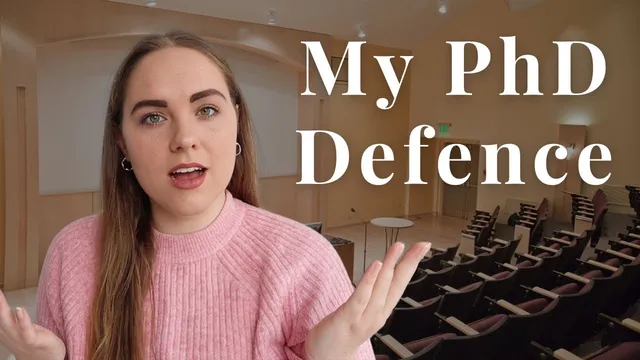
My PhD Viva Experience - What They Won't Tell You
Based on Ciara Feely's video on YouTube. If you like this content, support the original creators by watching, liking and subscribing to their content.
Expect emotional turbulence after thesis submission; relief may arrive later because stress and identity shifts can override rational milestones.
Briefing
A PhD viva can deliver closure and a sense of achievement—but it often doesn’t feel like relief right after the thesis submission. Ciara Feely describes a months-long buildup of stress that spiked into panic over minor issues, even while the thesis itself had already been submitted and approval steps were underway. In her account, the emotional mismatch is the key problem: many people expect to feel “amazing” after finishing the work, yet she felt anxious and unsettled because the shift from “PhD student” to “doctor” changes identity, routine, and self-image all at once. That disconnect can make post-submission emotions feel irrational, but it’s also common enough to plan for.
Her viva preparation began in the final weeks with a more grounded confidence. She says fears about examiners dismissing the research faded once she returned to the substance of her work and could defend key decisions. Still, she identified specific weak points she expected to face—especially around the “related work” section, where much of the literature base came from her supervisor’s earlier review paper, leaving her less personally connected to parts of the search process. She also worried about justifying applied machine learning research as a meaningful contribution, and about whether methods and modeling choices would be challenged.
On the day, nerves arrived despite confidence. She describes a morning that included physical anxiety sensations, a personal training session that helped reset her, and support from her PhD peer Courtney, who joined her for breakfast and helped her stay focused. She kept the viva private on social media to avoid additional emotional pressure if the outcome were negative. Even with the expectation that failure was “virtually impossible” at her stage, fear persisted—she frames it as an emotional reflex rather than a rational assessment.
The viva itself lasted about three hours, longer than her peers typically experience in her department, but it “flew by.” After a presentation, the Q&A centered on defense and justification: why the thesis was titled as it was, how generalizable the marathon-focused physical exercise work might be to other sports, and why certain features—like age—appeared in some chapters but not others. She found early questions more difficult, especially when she couldn’t instantly recall authors from a large reference list or when data limitations made her worry she sounded like she was undermining her own work. She also took questions personally, interpreting them as potential attacks rather than curiosity.
As the exam progressed into later technical chapters, she felt more relaxed and confident, particularly when summarizing results and discussing explainability and future work. A recurring theme was the lack of labels in the runner data—she emphasized how valuable it would be to know what happened and why. By the end, deliberation was brief, and she received a pass with minor corrections. Feedback highlighted that she had mastered two areas—sport science and machine learning—well enough to conduct applied research effectively.
Feely’s bottom line is that the viva should be hard, because that difficulty is part of earning closure. She contrasts the lack of relief after thesis submission with the achievement she felt after the viva, and she encourages others to prepare thoroughly while also accepting that emotions may not match expectations immediately after the final milestone.
Cornell Notes
Ciara Feely recounts how her viva experience produced closure and a sense of achievement, but also how anxiety and panic spiked even after thesis submission. She argues that the emotional “disconnect” after submitting work—when people expect instant relief—can be driven by identity change and accumulated stress. In preparation, she regained confidence by revisiting her research and anticipating likely weaknesses, especially around related work, applied contribution, and methodological justification. During the viva, early Q&A felt personally challenging and frustrating, but confidence grew in later technical chapters where she could summarize results and discuss limitations and future work. She passed with minor corrections and credits the difficulty of the exam for the lasting sense of accomplishment.
Why did anxiety intensify after thesis submission, even though the end was near?
What preparation strategy helped her move from fear to confidence?
How did she handle the problem of “everyone says you’ll pass”?
What kinds of viva questions did she find most challenging, and why?
What shifted the tone of the viva for her?
What was the outcome and what feedback stood out?
Review Questions
- What emotional factors did Feely link to anxiety after thesis submission, and how did identity change play a role?
- Which specific preparation concerns did she name (related work, applied contribution, methods/data/modeling), and how did she address them?
- During the viva, what made the second half feel easier than the first, and how did her approach to limitations and future work help?
Key Points
- 1
Expect emotional turbulence after thesis submission; relief may arrive later because stress and identity shifts can override rational milestones.
- 2
Use preparation to rebuild defense confidence: revisit your research decisions and practice answering likely “why” questions.
- 3
Treat reassurance carefully—if it increases fear of embarrassment, rely more on preparation and realistic scenario planning than on others’ certainty.
- 4
Anticipate early viva pressure around framing (title, generalizability) and dataset/feature decisions, especially when experiments were conducted independently.
- 5
Prepare for limitations questions without letting them sound like self-criticism; connect limitations to future work and the value of what the data still enables.
- 6
Confidence often improves once the exam reaches chapters where you feel strongest; plan to carry momentum from technical mastery into Q&A.
- 7
A pass with minor corrections can still come with rigorous questioning; the core purpose is justification and defense, not humiliation.