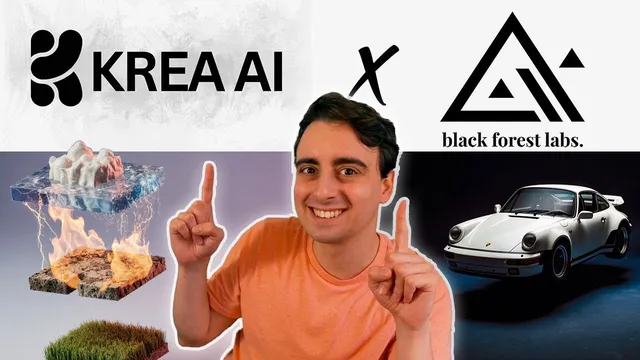
NEW Krea-1 Model Compared to Open AI & Ideogram! Head to head!
Based on MattVidPro's video on YouTube. If you like this content, support the original creators by watching, liking and subscribing to their content.
Creo 1 is a free image generation model from Korea AI, trained in collaboration with Black Forest Labs (Flux/Flux Context), and it shows strong realism cues in beta tests.
Briefing
Korea AI’s free image generator, Creo 1, is drawing attention because it delivers unusually strong “photo-like” texture and prompt-following for a first public beta—especially compared with other leading image models on the same surreal, detail-heavy prompts. The model is trained in collaboration with Black Forest Labs, a company behind Flux and Flux Context, and the results in hands-on tests repeatedly show crisp surfaces, convincing lighting, and fewer of the “AI mush” artifacts common in image generation.
Creo 1’s standout strength is aesthetic control: the model is marketed as avoiding the typical synthetic look and producing better skin textures, dramatic camera angles, cinematic lighting, and hundreds of expressive styles. In practice, the generated examples include fine detail such as individual fur hairs on a fox and visible grain and dust-like specks—small cues that make images feel more like real photography. Even when the scene includes complex objects (like a drum set), the model holds together reasonably well from a distance, though it still struggles with the ultra-fine structure of intricate items.
A key test involves a highly specific prompt: a desolate backyard at night with violently sideways rain sucked toward a glowing crater, steam rising, rusted tools scattered, and gravitational lens warping distorting the raindrops. Creo 1 generally follows the prompt’s mood and composition, and—crucially—produces distinct, backlit raindrops. That detail becomes a deciding factor in side-by-side comparisons. Ideogram 3.0 generates a similar scene but tends to lose the “horizontal vs. sideways” nuance (it keeps rain more vertical), and it doesn’t show the same crisp individual rain blobs. OpenAI’s GPT-4 Omni multimodal image generation, while it experiments with diagonal rain, often shifts away from a photographic look into more stylized digital art.
The comparisons extend beyond surreal scenes into graphic design and character work. Creo 1 performs decently with light text and layout, but it struggles with complex thumbnail-style typography and exact wording—sometimes substituting near-misses (“neat”/wrong phrasing) or mangling text-related elements. Ideogram 3.0, by contrast, proves far more reliable for precise text placement and multi-element thumbnail compositions, including a vending machine, fast-flipping calendar, FBI logo stamping, and a robot face morph concept.
Style adherence tests show Creo 1 can nail voxel-like aesthetics better than some alternatives, though it may still introduce odd anthropomorphic body parts when prompts demand “anthropomorphic” characters. In a tougher prompt—an old Italian mafia-style turtle—Creo 1 and Ideogram 3.0 repeatedly default to a mafia boss without the turtle. OpenAI’s GPT-4 Omni is the exception, producing the turtle more faithfully, suggesting architectural differences and training-data coverage matter when prompts require rare or highly specific entities.
Overall, Creo 1 earns praise for realism cues, prompt adherence in texture-heavy scenarios, speed, and being free. The model remains in beta, with the clearest improvement area being nuanced prompt understanding for graphic design and text-heavy layouts. The transcript also flags additional AI news: a WAN 2.1 14B Fusion video model available on Civit AI (with claims about running on 12 GB VRAM), an open-source “Titans” memory-as-context project, and newly announced Gemini 2.5 Pro and 2.5 Flash models.
Cornell Notes
Creo 1, a free image generation model from Korea AI, is trained with Black Forest Labs and is showing strong results in prompt-following and “photo-like” texture. In side-by-side tests using a surreal prompt about sideways rain sucked into a glowing crater, Creo 1 stands out for producing distinct, backlit raindrops and a more realistic look than Ideogram 3.0 or OpenAI’s GPT-4 Omni. The model’s weaknesses show up in graphic design tasks: complex thumbnail text and exact wording often come out wrong or garbled, where Ideogram 3.0 is more reliable. For entity-specific prompts like “mafia turtle,” diffusion-based models (Creo 1 and Ideogram 3.0) can miss the turtle, while GPT-4 Omni handles it better. The model remains in beta, with text/layout precision as the main improvement target.
What makes Creo 1 feel more “photographic” than many competitors in these tests?
How did Creo 1 perform on the highly nuanced “sideways rain” prompt compared with Ideogram 3.0 and GPT-4 Omni?
Why did the “graphic design / thumbnail text” test favor Ideogram 3.0 over Creo 1?
What does the “mafia turtle” prompt reveal about model behavior?
How did the models handle voxel/pixel-style character prompts?
Review Questions
- In the crater-and-rain comparison, which specific visual cue did Creo 1 produce that the transcript treats as a major advantage?
- What kinds of prompt elements most often caused Creo 1 to miss—complex typography, rare entities, or both?
- Why might diffusion-based models repeatedly fail on a prompt like “mafia turtle” even when the entity is explicitly named?
Key Points
- 1
Creo 1 is a free image generation model from Korea AI, trained in collaboration with Black Forest Labs (Flux/Flux Context), and it shows strong realism cues in beta tests.
- 2
Creo 1’s best results come from texture-heavy, lighting-driven prompts where individual details (like raindrops or fur hairs) matter.
- 3
On a surreal “sideways rain into a glowing crater” prompt, Creo 1 outperformed Ideogram 3.0 and GPT-4 Omni mainly by producing distinct, backlit rain droplets.
- 4
Complex thumbnail-style graphic design with exact text and multi-element layout is a weak spot for Creo 1, while Ideogram 3.0 is more reliable.
- 5
For entity-specific prompts (e.g., “mafia turtle”), diffusion models (Creo 1 and Ideogram 3.0) can default to more common concepts, while GPT-4 Omni handled the turtle more accurately.
- 6
Creo 1 can match voxel-like aesthetics reasonably well, though “anthropomorphic” wording can trigger odd human-like body-part artifacts.
- 7
Additional AI updates mentioned include WAN 2.1 14B Fusion video generation on Civit AI, an open-source “Titans” memory-as-context project, and new Gemini 2.5 Pro/2.5 Flash models.