Parallel Worlds Probably Exist. Here’s Why
Based on Veritasium's video on YouTube. If you like this content, support the original creators by watching, liking and subscribing to their content.
Quantum states evolve deterministically under the Schrödinger equation, but measurements appear random because early interpretations added a separate collapse/probability rule.
Briefing
Quantum mechanics can be made fully deterministic by treating the wave function as the complete description of reality and replacing “wavefunction collapse” with continuous evolution plus branching. That shift matters because it turns Schrödinger’s cat—from a paradox about contradictory outcomes—into a consequence of how quantum systems entangle with their surroundings, without adding an extra, non-dynamical rule for measurement.
In classical mechanics, knowing a system’s state (like position and velocity) lets Newton’s laws predict its future. Quantum mechanics parallels this: knowing a particle’s wave function lets the Schrödinger equation evolve that state smoothly over time, typically spreading out in space. The tension arises because measurements don’t reveal a spread-out wave; they produce a single detected outcome. Early quantum theory leaned on measurement as more “real” than the wave function, and Max Born’s interpretation provided the missing link: the wave function’s complex amplitude squared gives the probability of finding a particle at a point. That “Born rule” effectively introduces randomness into the core picture.
Schrödinger’s cat dramatizes the problem. A radioactive atom can be in a superposition of decayed and not decayed. When coupled to a detector and then to a macroscopic cat, the combined system becomes entangled so that, before anyone looks, the cat is described by a superposition of alive and dead. Traditional Copenhagen-style accounts say the wave function collapses when the box is opened, selecting one outcome.
A different approach keeps only the Schrödinger evolution rule and treats measurement as just another quantum interaction. Superposition is supported by experiments like the double-slit setup: individual electrons produce an interference pattern that can’t be explained as a simple “either slit A or slit B” story. Entanglement is supported by momentum-correlation experiments: after two particles interact, they are described by a single shared wave function, so measuring one immediately determines the other’s correlated property—without needing separate wave functions for each particle.
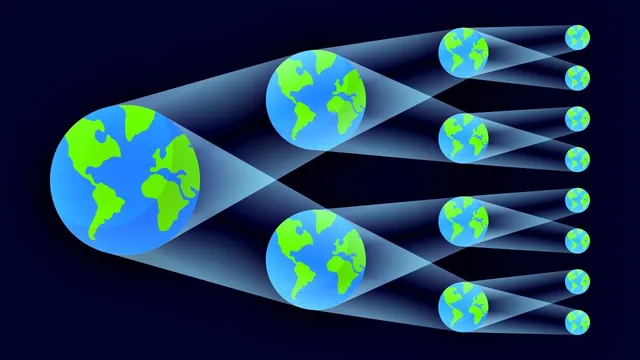
In the many-worlds interpretation, the cat paradox resolves through environmental decoherence. As the atom’s superposition entangles with the detector, the detector then entangles with countless uncontrolled degrees of freedom—air molecules, photons, and other environmental particles. That entanglement “branches” the universe into effectively non-interacting copies corresponding to different outcomes. When the box is opened, an observer finds either alive or dead, but the other outcome has already occurred in a separate branch associated with a different “copy” of the observer.
Caltech physicist Sean Carroll addresses common objections. Energy conservation is handled at the level of the total wave function; branches correspond to different internal configurations that together fit within conserved quantities. The number and rate of branching are unknown, though branching happens extremely often—for instance, radioactive decays in the body occur thousands of times per second. Many-worlds does not mean every logically possible event occurs; the Schrödinger equation assigns zero probability to outcomes that violate conservation laws. Finally, whether branching is instantaneous or spread out across space can be described in multiple equivalent ways that make the same predictions, making “branches” more like a useful bookkeeping framework than a fundamental feature carved into reality.
The bottom line: many-worlds replaces collapse with continuous quantum evolution, making all outcomes occur with probabilities encoded in the structure of the wave function—while decoherence explains why observers experience only one result.
Cornell Notes
Quantum mechanics evolves wave functions smoothly via the Schrödinger equation, but measurements yield single outcomes. Many-worlds keeps only the evolution rule by treating measurement as an ordinary quantum interaction: a superposed system becomes entangled with a detector and then with the environment. Environmental decoherence effectively splits the universe into branches, so an observer inside the box finds either alive or dead without invoking a special collapse step. Experiments like the double slit support superposition, and entanglement experiments support the idea of a shared wave function. The interpretation aims to restore determinism: the wave function is complete, and “collapse” is replaced by branching that makes different outcomes appear separate to different observers.
Why does the wave function’s smooth evolution clash with what detectors record as single outcomes?
What experimental evidence supports superposition rather than “either/or” behavior?
How does entanglement differ from having two separate wave functions?
How does many-worlds reinterpret Schrödinger’s cat without collapse?
What does Sean Carroll say about how many worlds exist and how often branching happens?
Does many-worlds mean every conceivable event happens?
Review Questions
- How does Born’s rule connect the squared amplitude of a wave function to measurement probabilities, and why does that matter for determinism?
- In many-worlds, what role does environmental decoherence play in turning a superposition into effectively separate observed outcomes?
- Why do conservation laws constrain what kinds of “branches” can occur in the many-worlds picture?
Key Points
- 1
Quantum states evolve deterministically under the Schrödinger equation, but measurements appear random because early interpretations added a separate collapse/probability rule.
- 2
Born’s rule links the probability of an outcome to the squared magnitude of the wave function’s complex amplitude.
- 3
Schrödinger’s cat becomes less paradoxical when measurement is treated as entanglement with the detector and environment rather than a special collapse event.
- 4
Superposition is supported by interference patterns in experiments like the double slit, which require alternatives to combine rather than add incoherently.
- 5
Entanglement means interacting particles are described by a single shared wave function, producing strong correlations upon measurement.
- 6
Many-worlds replaces collapse with environmental decoherence, branching the universe into effectively non-interacting copies corresponding to different outcomes.
- 7
Key open questions remain about the total number of branches and the exact branching rate, even though branching is expected to occur extremely often in everyday systems.