Software Engineer gets Private Coaching
Based on Justin Sung's video on YouTube. If you like this content, support the original creators by watching, liking and subscribing to their content.
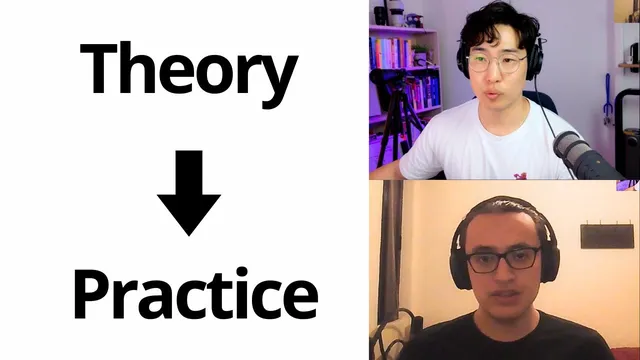
Mastery depends on practice far more than theory; theoretical understanding alone often supports only a small fraction of accurate execution.
Briefing
Mastery in software and other technical skills comes from tightly managing the tradeoff between theory and practice—then deliberately mixing skills through interleaving—rather than bingeing lectures and “learning” in bulk. A 1-to-5 ratio is offered as a practical rule of thumb: even when someone understands a technique perfectly in theory, real-world competence usually requires far more practice than theory alone would suggest. The risk of going too fast is not just slower improvement; it can create “learning debt,” where later attempts to apply knowledge fail because retrieval and integration weren’t trained early.
The coaching centers on a pacing question: should practice happen immediately after each lecture, or can it be postponed and done in batches? The guidance is conservative: practice should follow learning soon enough to prevent overload and to ensure the theory-to-practice relationship stays intact. The amount of theory that can be absorbed without practice depends on how difficult the technique is and how much of it is truly understood—but theoretical understanding alone is often capped at roughly a quarter of what’s needed for accurate execution. That gap widens when multiple techniques must work together under real constraints like assessments, deadlines, and shifting contexts.
As new techniques are added, the difficulty doesn’t rise linearly. Each additional skill increases the cognitive load of running the whole system at once, even if each technique individually feels easy. The recommended checkpoint is twofold: first, measure how much mental effort it takes to perform the technique at all; second, verify whether the results match the expected effect. If a technique is easy and produces the intended improvement, it’s a signal to move on. If it demands high concentration or fails to produce the expected outcome, adding more techniques will compound the problem—often because the technique isn’t being executed correctly.
A second pillar is interleaving: practicing not only the “simple direct method” but also mixing skills and testing them in new contexts. Coding is used as the example—following step-by-step tutorials can make functions seem easy to use, yet competence collapses when those pieces must be combined in unfamiliar situations. Interleaving forces retrieval and strengthens the ability to manipulate knowledge beyond the original lesson framing.
The conversation also turns to note-taking and memory. Research is cited as leaning toward handwritten notes over typed ones, largely because typing encourages longer output with less cognitive processing. Freehand note-taking is defended as better for primary encoding: it makes prioritization harder to avoid, supports iterative “scratch pad” rewriting and deletion, and enables richer visual anchoring. Digital tools like Obsidian are treated as valuable for second-brain reference work, but not as a replacement for the cognitive work of building and revising mental structures.
Overall, the throughline is efficiency with less stress: build mastery early through small, repeated practice loops, then mix and challenge skills so they remain usable under pressure—rather than trying to compress learning into a fast, lecture-heavy sprint that later forces relearning.
Cornell Notes
The core message is that mastery requires more practice than theory alone can provide, and that practice should be scheduled to preserve a healthy theory–practice balance. A rule of thumb is a 1-to-5 ratio: even deep theoretical understanding may translate to only about 25% (or less) of the competence needed for accurate execution. As techniques accumulate, cognitive load rises sharply because the whole system must run together, so new techniques should be added only when effort and results match expectations. Interleaving—mixing skills and testing them in new contexts—is presented as the way to build retrieval and real-world transfer. For notes, freehand is favored for primary encoding, while tools like Obsidian are positioned as second-brain reference systems.
Why does theory-heavy studying often fail when someone tries to apply it later?
What pacing rule helps prevent overload when learning a course or skill stack?
How should someone decide whether to add another technique?
What makes interleaving different from simple “I can do it once” practice?
Why is freehand note-taking argued to outperform digital for learning?
How can Obsidian fit into a learning workflow without replacing primary encoding?
Review Questions
- What does the 1-to-5 theory–practice ratio imply about how much practice is needed after learning a technique?
- How do cognitive load and “system functioning” change when multiple techniques are used at the same time?
- What does interleaving require beyond practicing the direct method used in instruction?
Key Points
- 1
Mastery depends on practice far more than theory; theoretical understanding alone often supports only a small fraction of accurate execution.
- 2
Keep a tight theory–practice balance to avoid overload and prevent “learning debt” where later application fails due to weak retrieval.
- 3
Add new techniques only after verifying both effort level and expected effectiveness; high effort or wrong results are signals to slow down.
- 4
As more techniques accumulate, difficulty rises because the entire system must operate together, not because each technique is individually hard.
- 5
Interleaving strengthens real-world transfer by mixing skills and testing them in new contexts rather than repeating the original step-by-step method.
- 6
Freehand note-taking is argued to support primary encoding through prioritization, iterative rewriting, and visual anchoring, while digital tools like Obsidian are best used as second-brain reference systems.