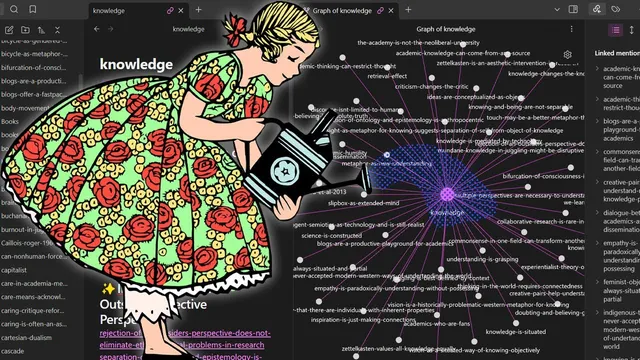
Take RANDOMIZED zettelkasten notes with me!
Based on morganeua's video on YouTube. If you like this content, support the original creators by watching, liking and subscribing to their content.
Atomic notes (one idea per note) make knowledge modular so it can connect to many future topics without rewriting.
Briefing
Atomic notes plus constant, connection-driven “random note” sessions keep a Zettelkasten system usable long after the original project ends. The core advantage over traditional note-taking isn’t just having lots of notes—it’s ensuring every small idea remains findable later through backlinks and dense interlinking, even when the note seems irrelevant at the moment it’s created.
The workflow centers on two rules: keep notes atomic (one idea per note) and interconnect them as much as possible. Instead of worrying about tags, plugins, or whether notes are “fleeting” versus “permanent,” the system makes a simpler distinction: literature notes versus atomic notes. Literature notes act as containers for what’s learned from reading; atomic notes then break those ideas into small, linkable units. In practice, the atomic notes live in the main Obsidian folder, while a separate “sources” folder stores the underlying references.
A problem emerges during dissertation writing: once research and drafting are done, note growth slows. That creates a future risk—when the next project arrives, the system may not contain the fresh, cross-domain brainstorming material needed to skip the slow “start from scratch” phase. The dissertation becomes a temporary center of gravity, even though the system’s long-term value depends on continuous, varied input.
To prevent the note system from becoming a storehouse only for PhD-related material, the approach is to keep taking notes on random ideas every day. The method uses Obsidian’s Random Note core plugin to surface an existing note at random, then forces new notes to grow outward from that starting point. The constraint matters: new notes can’t be written in isolation. They must connect to the randomly surfaced note (and, by extension, to the notes connected to it). The session is time-boxed—10 minutes per random note—so the practice stays lightweight and frequent rather than perfect.
Three 10-minute examples show how the system evolves under that constraint. One random note about juggling leads to linked notes about running, focus and endurance, and the idea that juggling teaches life skills through simplicity. Another random note surfaces a literature-based article by Amelia Jones on material traces and performativity; because it had few backlinks, the session repairs the isolation by creating new notes tied to specific examples (like the juggling performance “mandala” by The Institute of Jugi), plus conceptual bridges such as “hybrid art” and “relational ontology,” referencing Karen Barad’s work through Jones. A final session starts from Susan Orlene’s Skillshare class notes and branches into writing-focused atomic notes—good writing regardless of genre, choosing writing topics, and the reporting principle of “unpreparedness,” including an alias that reframes it as “research requires not knowing.”
Across all examples, the real payoff is cognitive freshness: repeatedly surfacing a random anchor note keeps prior ideas active, making it easier to form new links quickly. The system stays “seamless” only when the practice happens often—ideally daily for short bursts—so connections remain low-friction when the next project demands them.
Cornell Notes
The Zettelkasten approach described here relies on atomic notes (one idea each) and heavy interconnection so knowledge stays findable later via backlinks and nearby links. Instead of managing tags or “fleeting vs permanent” status, the system separates literature notes from atomic notes: reading goes into literature notes, then ideas get split into atomic notes. A key challenge appears when dissertation work slows new note creation, risking a future system that’s too focused on one project. The fix is to take time-boxed “random note” sessions using Obsidian’s Random Note plugin: surface a note at random, then create new notes only if they connect outward from that anchor. Frequent short sessions keep ideas fresh and make linking feel effortless.
Why does the system emphasize atomic notes and backlinks instead of traditional notebooks or documents?
How does the system handle “literature notes” versus “atomic notes,” and why does that matter?
What problem arises during dissertation writing, and what risk does it create for future projects?
How does the Random Note plugin change the note-taking session structure?
What does the juggling example demonstrate about building connections quickly?
How does the Amelia Jones article example fix an “orphan” note with few backlinks?
Review Questions
- How does the requirement that new notes “must grow from connections” change the quality and retrievability of notes compared with writing standalone thoughts?
- What tradeoff does the system make by downplaying tags and plugin management, and how does it compensate through structure (atomic notes, literature notes, dense linking)?
- In the Random Note workflow, why does time-boxing (10 minutes) matter for maintaining “freshness” and low-friction linking?
Key Points
- 1
Atomic notes (one idea per note) make knowledge modular so it can connect to many future topics without rewriting.
- 2
Dense interlinking enables retrieval through “neighborhood” browsing, not just keyword search.
- 3
Separate literature notes from atomic notes: reading goes into literature notes, then ideas get split into atomic, linkable units.
- 4
When project work slows note creation (e.g., during dissertation drafting), the system risks becoming too narrow for future projects.
- 5
Use Obsidian’s Random Note core plugin to surface an anchor note and run short, 10-minute sessions that force new notes to connect outward from that anchor.
- 6
Time-boxed random sessions keep ideas cognitively fresh, making new connections faster and less energy-intensive.
- 7
Repairing low-backlink “orphan” notes by adding connected examples and conceptual bridges increases long-term findability.