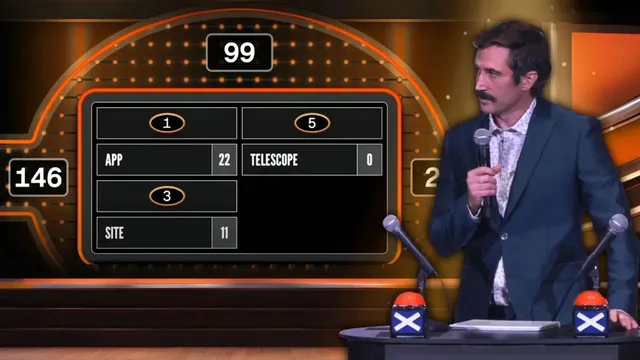
Terminal Family Feud
Based on The PrimeTime's video on YouTube. If you like this content, support the original creators by watching, liking and subscribing to their content.
Terminal Feud uses Twitch chat voting plus AI categorization to generate the answer board during live rounds.
Briefing
“Terminal Feud” turns software culture into a live, Family Feud-style competition—then layers in audience voting and AI-assisted categorization to decide the answers. The night’s headline moment comes in the final Fast Money round: Madison and lowlevel Academy hit the exact target to reach 200 points, winning 20,000 story points after a spread of answers that matched the audience’s expectations for what programmers love, hate, and joke about.
The format runs in three games, each split into four rounds plus a fast-money/fast-story-points finale. Teams face off with buzzer rounds and fill-in-the-blank prompts, while Twitch chat can vote on answers in real time. Instead of pre-made surveys, the show uses AI to summarize and categorize audience responses, then displays the results on the game board. Contestants also play under strict constraints—no special characters in chat voting, limited time for audience submissions, and rules that treat duplicates and “wrong” categories as immediate setbacks.
Early rounds set the tone with programmer-flavored answers and recurring themes: startup failure signs (“triple the price,” “pivot,” “everybody starts to quit”), the scariest message from a boss (“you’re fired,” “production is down,” “overtime”), and what belongs on a programmer’s desk beyond the usual keyboard and mouse (rubber ducky, tissues, cheat sheets, lotion, soda, artwork). The show repeatedly rewards answers that map cleanly onto the most common crowd categories, while also punishing answers that miss the expected phrasing—even when they sound plausible.
A key twist is how the scoring and “steal” mechanics work: teams can lose a round, then regain points if the opposing team’s answer doesn’t land in the top categories. In one notable moment, a fill-in-the-blank sequence around “web” versions (Web 1.0, Web 2.0, Web 3.0, etc.) produces a mix of correct and off-by-one responses, showing how tightly the game expects canonical labels. Another standout is the “worst website to get coding advice from” question, where Twitch chat’s influence is explicit—answers like OnlyFans, Stack Overflow, ChatGPT, and Twitch itself appear as top contenders.
The final Fast Money round compresses everything into five rapid prompts. lowlevel Academy and Madison answer questions about Git merge conflicts, what to commit to a repo (binary files), recurring meetings (sprint reviews/standups), and the most expensive programmer setup item (a keyboard/chair category). When Madison’s turn comes, the board confirms a wide spread from the earlier contestant’s answers, and the final tally lands exactly at the threshold needed to win.
Beyond the competition, the night functions as a showcase for the ecosystem behind the scenes—sponsors and tooling are credited, and the event’s AI-powered audience pipeline is treated as part of the entertainment. By the end, the show’s mix of live audience participation, rapid-fire questions, and software-jargon humor delivers a clear takeaway: programmers may disagree on tech, but they converge quickly on what feels familiar, frustrating, and funny.
Cornell Notes
Terminal Feud is a Family Feud-style game built around programmer culture, with teams answering buzzer questions, fill-in-the-blank prompts, and “fast money” rounds. Audience members on Twitch vote on answers, and AI categorizes those responses to populate the game board in real time. Across multiple rounds, common themes emerge—startup failure signs (“pivot,” “triple the price”), boss messages (“you’re fired,” “production is down”), and desk items beyond keyboards/mice (rubber ducky, cheat sheets, tissues, lotion). The climax is the Fast Money finale: lowlevel Academy and Madison reach the 200-point threshold and win 20,000 story points, demonstrating how tightly the game rewards answers that match the crowd’s top categories.
How does audience participation affect what ends up on the game board?
What kinds of questions show up repeatedly, and what do they test?
Why do small phrasing differences matter (for example, in Web version questions)?
How do “steal” and strikes influence strategy?
What made the final Fast Money win decisive?
Review Questions
- In Terminal Feud, what role does AI play between Twitch voting and the game board, and why does that matter for contestants’ success?
- Pick one category (e.g., boss messages or programmer desk items). What are two examples of answers that appeared, and what do they suggest about what programmers commonly agree on?
- During Fast Money, why is reaching 200 points more about matching crowd categories than about giving “clever” or highly specific answers?
Key Points
- 1
Terminal Feud uses Twitch chat voting plus AI categorization to generate the answer board during live rounds.
- 2
The game structure repeats: four rounds per game, then a Fast Money/fast story points finale with five rapid questions.
- 3
Scoring rewards answers that match the crowd’s top categories; plausible but mismatched phrasing can still lose points.
- 4
Strike limits and steal mechanics create comeback opportunities even after a team’s early miss.
- 5
Programmer-culture questions repeatedly cluster around shared frustrations (merge conflicts, recurring meetings, flaky tests) and shared humor (desk items, worst advice sources).
- 6
The final Fast Money win required hitting the 200-point threshold, which lowlevel Academy and Madison achieved to earn 20,000 story points.