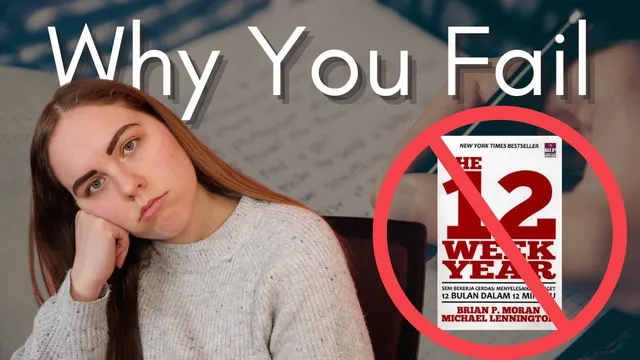
The 12 Week Year Doesn't Work | 5 Reasons Why
Based on Ciara Feely's video on YouTube. If you like this content, support the original creators by watching, liking and subscribing to their content.
Treat goals as dependent on current “given circumstances,” not just on the goal’s numeric feasibility.
Briefing
The 12 Week Year fails for many people not because the planning framework is inherently flawed, but because real life repeatedly breaks the assumptions behind it—especially around time, responsibilities, and human biology. The core problem is that goals are often set as if circumstances are stable and energy is consistent, yet most schedules are shaped by constraints already in place, unpredictable events, and fluctuating motivation and capacity.
A first major failure point is unrealistic goal-setting that ignores “given circumstances”—the actual conditions a person is living in right now. Even when a goal sounds modest on paper (like producing one YouTube video per week), it can be unrealistic if the environment makes execution difficult. One example involves trying to film content while a kitchen renovation created constant noise at home, with filming only possible in a bedroom when others were away or in early-morning campus sessions. The plan wasn’t too ambitious; the setting made it impractical.
A second issue is failing to account for “areas of responsibility,” meaning the commitments already occupying time and mental bandwidth. Goals often compete with work, family obligations, or other duties that take priority. In the creator’s case, running a company outweighed producing content, even though the content felt enjoyable and potentially valuable later. The result was self-blame for inconsistency that wasn’t really a scheduling problem—it was a prioritization problem. The proposed fix is to inventory existing responsibilities and then decide whether there is truly capacity for a new goal; if not, something must be reduced, delegated, or dropped.
Third, consistency-based goal systems collide with life’s inconsistency. The 12 Week Year was attempted multiple times, but each cycle ran into major disruptions: a global pandemic that changed daily life and anxiety levels, and later a life-altering loss that forced a full takeover of business operations. Those events made the original 12-week plans obsolete, illustrating that “follow-through” depends on stability that people can’t reliably predict.
Fourth, the framework often underestimates biological variability, particularly for people with menstrual cycles. Hormonal changes across a roughly 28-day cycle influence daily energy, appetite, preferred work, and exercise capacity. Plans that assume a steady routine—like waking early at the same time every day—can become demoralizing when sleep needs and energy shift. The alternative offered is to build routines that work across fluctuating conditions, with consistency in what matters most rather than in rigid timing.
Finally, the method’s emphasis on future-focused achievement can create a mismatch between goals and the feelings people actually want. After reaching milestones—such as earning a PhD or hitting an income target—happiness may not arrive as expected. The suggested pivot is to seek the desired emotional state in the present (relief, relaxation, happiness) rather than treating goals as the sole route to those feelings. That shift reframes productivity: growth can still happen, but constant “pushing” every quarter can keep people perpetually craving something they don’t yet have.
Overall, the takeaway is a call for self-kindness and realism: setbacks aren’t proof of personal failure when circumstances, responsibilities, and biology change. The better question becomes how to align goals with current life capacity—and how to build satisfaction now, not only after the next milestone.
Cornell Notes
The 12 Week Year often breaks down when its assumptions don’t match real life. Goals fail when people ignore their current “given circumstances,” overcommit beyond their “areas of responsibility,” and treat consistency as guaranteed despite disruptions like pandemics or major personal losses. Biological variability—especially for people with menstrual cycles—also makes rigid routines hard to sustain because energy and capacity shift across a roughly 28-day hormonal cycle. Finally, future-focused achievement can disappoint: reaching milestones like a PhD or income target may not deliver the emotional payoff people expected. The alternative is to plan with present constraints in mind and to pursue desired feelings now, not only after the next quarter.
Why can a goal that sounds realistic still be unrealistic in practice?
What does “areas of responsibility” add to goal-setting that SMART goals often miss?
How do unexpected events undermine 12-week planning?
Why might rigid routines be especially difficult for people with menstrual cycles?
What emotional problem can future-focused achievement create?
Review Questions
- Which part of the goal-setting process is most likely to fail when someone’s environment makes execution difficult: the target, the timeline, or the “given circumstances”? Give an example.
- How would you decide whether to keep, modify, or drop a new goal using the concept of “areas of responsibility”?
- What changes would you make to a 12-week plan if you knew your energy and sleep needs fluctuate across a roughly 28-day cycle?
Key Points
- 1
Treat goals as dependent on current “given circumstances,” not just on the goal’s numeric feasibility.
- 2
Inventory existing “areas of responsibility” before adding new targets; if capacity is missing, delegate, reduce, or drop commitments.
- 3
Expect life disruptions to invalidate 12-week plans; consistency is harder when major events change priorities.
- 4
For people with menstrual cycles, plan around fluctuating energy and sleep needs rather than fixed daily timing.
- 5
Future milestones may not deliver the emotional payoff people expect; build practices that support desired feelings now.
- 6
Self-kindness matters when setbacks happen due to circumstance, not personal failure.
- 7
A practical planning approach balances ambition with present capacity and ongoing adjustment.