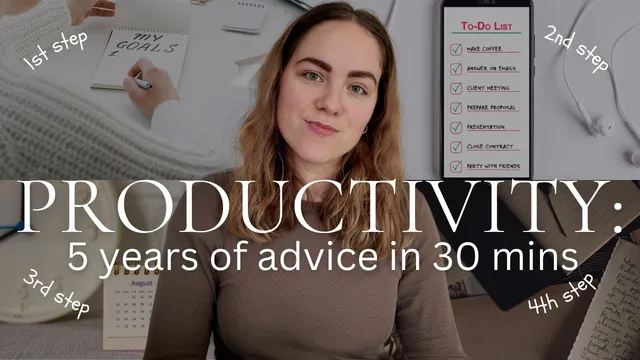
The 4 Part System That Made Me More Productive
Based on Ciara Feely's video on YouTube. If you like this content, support the original creators by watching, liking and subscribing to their content.
Productivity is presented as four connected systems: goal setting, task management, time management, and information management.
Briefing
Productivity, in this framework, isn’t treated as a single trick or motivation hack. It’s built from four interlocking systems—goal setting, task management, time management, and information management—so that planning, execution, scheduling, and reference material all reinforce each other. Missing any one piece leaves a gap: goals without tasks stall, tasks without time blocks create chaos, and doing work without organized knowledge slows everything down.
Goal setting comes first because it gives direction and measurable targets. The transcript cites 1960s research by Gary Latham and Edwin Locke showing that people who set goals are roughly 11% to 25% more effective at work than those who don’t. The practical takeaway is that goals should be written down (writing increases goal attainment odds), challenging rather than vague, and tied to something deeper—personal values, a life vision, or identity—so motivation and persistence hold up under pressure. Clarity is treated as a make-or-break factor: an example of “being consistent on YouTube” is criticized for being too fuzzy, with a better version offered as “post once a week on YouTube for 12 weeks,” then broken into steps.
To turn goals into action, the transcript recommends planning for obstacles using a “wish–outcome–obstacles–plan” style approach (a “WOOP” framework). It also emphasizes progress tracking, arguing that people can’t reliably tell whether they’re succeeding without measurement. The creator’s main implementation is the 12 Week Year system, which focuses on high-impact goals in a 12-week cycle—long enough to drive change, short enough to stay focused. Weekly scorecards and a daily “most important task” approach (echoing ideas from authors like Tim Ferriss and others) are used to ensure momentum: one key task per day, tackled early.
Task management is the second system, designed to stop the brain from acting as a storage device. The transcript argues that keeping “open loops” in your head causes reminders at the worst times and consumes mental space. It recommends capturing tasks externally, then processing them using the Getting Things Done method: collect everything, sort into actionable vs. someday vs. reference, define the next physical step, and use rules like the 2-minute guideline. Organization happens by context (what kind of work fits the current situation—email, phone, home, with another person), then by priority and time estimates. The transcript also highlights strategies for shrinking the workload: delete unimportant tasks, automate repetitive work, and delegate or outsource where possible.
Time management forms the third system, using a “trident” structure—yearly, weekly, and daily planning. Year planning is used to protect downtime and shape the calendar with meaningful events rather than letting time blur. Weekly planning centers deep work blocks for focused tasks, while shallow work fills the gaps. Daily planning is anchored by consistent morning and evening rituals, plus a flexible structure for different kinds of workdays.
Finally, information management—often overlooked—is presented as the speed boost for execution. The transcript frames knowledge management as externalizing reference material so projects don’t stall while searching for facts. It points to Thiago Forte’s “second brain” approach using PARA (Projects, Areas, Resources, Archives) and also mentions the Zettelkasten method attributed to Nicholas Luhmann, where ideas live as searchable index-card notes with sources. The core message: productivity improves when goals, tasks, time, and knowledge are managed as a connected system rather than separate efforts.
Cornell Notes
Productivity becomes more reliable when it’s treated as a system made of four parts: goal setting, task management, time management, and information management. Goals work best when they’re written down, challenging, aligned with values or identity, and defined clearly enough to act on. Task management reduces mental load by capturing open loops outside the head and using a next-action workflow (including the 2-minute rule) plus context-based organization. Time management then schedules deep work and personal commitments using yearly, weekly, and daily planning. Finally, information management speeds execution by organizing reference material through frameworks like PARA or Zettelkasten so projects don’t slow down searching for knowledge.
Why does goal setting get treated as the foundation of productivity, and what makes goals more effective?
How does the 12 Week Year system translate goals into weekly momentum?
What problem does task management solve, and how does Getting Things Done handle it?
How does context-based task organization reduce procrastination and context switching?
What does the transcript mean by trident time management, and how does it protect personal life?
Why is information management treated as a productivity system rather than a note-taking hobby?
Review Questions
- Which goal-setting practices in the transcript (writing down, challenge level, alignment with values, clarity) most directly address motivation and persistence—and which one do you currently neglect?
- Using the Getting Things Done workflow described, how would you convert a vague task into a project and then into a next action you can do today?
- What would your weekly deep work blocks look like if you had to schedule both work deliverables and personal commitments without relying on motivation alone?
Key Points
- 1
Productivity is presented as four connected systems: goal setting, task management, time management, and information management.
- 2
Goals are more effective when they’re written down, challenging, aligned with values/identity, and defined with enough clarity to break into steps.
- 3
The 12 Week Year system uses a 12-week cycle plus weekly scorecards to keep high-impact goals moving with regular review.
- 4
Task management should capture open loops outside the head, then sort items into actionable next steps using rules like the 2-minute guideline.
- 5
Context-based task organization reduces frustration by showing only tasks that fit the current situation and available mode of work.
- 6
Time management uses yearly, weekly, and daily planning to protect downtime and schedule deep work blocks for focused progress.
- 7
Information management speeds execution by organizing reference material through frameworks like PARA or Zettelkasten so projects don’t stall searching for knowledge.