The Biggest Misconception in Physics
Based on Veritasium's video on YouTube. If you like this content, support the original creators by watching, liking and subscribing to their content.
Energy conservation in physics is tied to continuous symmetries; when the relevant symmetry is absent, global energy conservation can fail.
Briefing
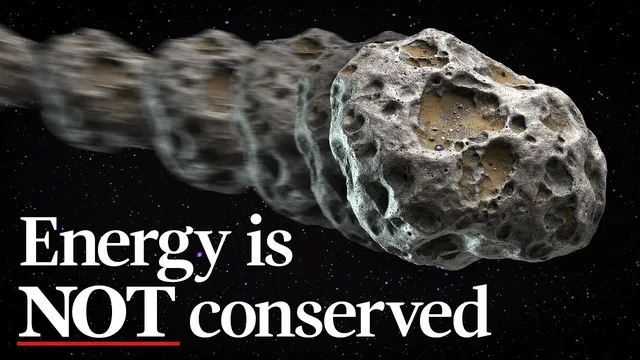
A rock thrown into deep space should keep moving at constant velocity—yet in an expanding universe it slows and loses energy. The central insight behind that mismatch is that energy conservation is not a universal law of nature in the way Newtonian mechanics suggests; it depends on symmetries, and cosmology breaks the key symmetry that would keep energy fixed.
In classical physics, conservation laws appear tied to how the universe looks under transformations. Emmy Noether’s work formalized this link: continuous symmetries generate corresponding conserved quantities. In the simplest “empty, static” universe, spatial translation symmetry implies conservation of momentum; rotational symmetry implies conservation of angular momentum; and time translation symmetry implies conservation of energy. Noether’s theorem turned what had long felt like a mysterious rule into a structural consequence of symmetry.
That framework also clarifies why energy seems to “disappear” for objects moving through the cosmos. Observations in the 1920s showed galaxies receding faster with distance, establishing that the universe is expanding. Later measurements of supernovae in the 1990s indicated that this expansion is accelerating, meaning the universe’s behavior changes over cosmic time. With no time symmetry across the lifetime of the universe, the usual form of energy conservation no longer applies. A photon emitted roughly 380,000 years after the Big Bang arrives today as microwave radiation rather than visible light—its energy has dropped by about 99.9%. The energy doesn’t travel to some hidden location; instead, the changing spacetime background alters what “energy” means globally.
The story also traces how Noether’s reasoning rescued energy conservation inside general relativity, where the geometry of spacetime itself can vary from point to point. Einstein’s early attempt to write a conservation equation for the combined energy of matter and the gravitational field ran into trouble because it relied on a quantity that behaves like a pseudotensor—frame-dependent in a way that conflicts with general covariance. Noether recognized that general relativity’s symmetry is local rather than global: in any small region, physics can be transformed without changing its form. Her second theorem showed that local symmetries yield continuity equations rather than global conservation laws. In this picture, energy can “leak” between spacetime patches through curvature terms, which can be reinterpreted as energy associated with the gravitational field.
Noether’s two theorems didn’t just settle a technical dispute between Einstein and Hilbert; they established the modern logic behind conservation laws. That symmetry-first mindset later became foundational in particle physics, where gauge and phase symmetries underpin conserved electric charge and help explain the emergence of fundamental particles such as quarks and the Higgs boson. Even when energy conservation fails globally in an evolving universe, Noether’s framework explains why it still holds approximately on short timescales—and why it breaks when the universe’s symmetries do.
Cornell Notes
Emmy Noether’s theorems connect conservation laws to continuous symmetries. In a static, empty universe, time translation symmetry implies energy conservation, while spatial and rotational symmetries imply momentum and angular momentum conservation. Cosmology breaks time symmetry: the universe’s expansion (and later acceleration) means energy is not conserved in the usual global sense, so photons redshift and rocks slow without energy “going” anywhere specific. In general relativity, Noether showed that local symmetries lead to continuity equations rather than strict global conservation, with spacetime curvature acting like a channel through which energy effectively transfers between regions. This symmetry-based framework later became central to particle physics and gauge theories.
Why does a thrown rock slow down in an expanding universe, even though Newton’s first law predicts constant velocity in empty space?
How does Noether’s first theorem explain the origin of conservation laws like momentum, angular momentum, and energy?
What role does time translation symmetry play in energy conservation, and how does cosmology break it?
Why doesn’t Einstein’s proposed energy conservation equation work cleanly in general relativity?
What does Noether’s second theorem change about conservation laws in general relativity?
How did Noether’s ideas influence particle physics beyond classical conservation laws?
Review Questions
- How does Noether’s first theorem connect time translation symmetry to energy conservation, and what observational evidence undermines that symmetry on cosmological timescales?
- In what way do local symmetries in general relativity lead to continuity equations instead of global conservation laws?
- Why is a pseudotensor problematic for defining gravitational energy in a generally covariant theory?
Key Points
- 1
Energy conservation in physics is tied to continuous symmetries; when the relevant symmetry is absent, global energy conservation can fail.
- 2
Time translation symmetry implies energy conservation; cosmological expansion and acceleration break time symmetry over large timescales.
- 3
Noether’s first theorem links spatial translations to momentum conservation and rotations to angular momentum conservation.
- 4
Einstein’s early gravitational energy conservation attempt ran into trouble because it relied on a pseudotensor that does not transform like a proper tensor under coordinate changes.
- 5
Noether’s second theorem shows that in general relativity, local symmetries yield continuity equations with curvature terms that allow energy to effectively transfer between spacetime regions.
- 6
On short timescales, approximate time symmetry makes energy appear conserved even in an expanding universe.
- 7
Noether’s symmetry-to-conservation logic became foundational in quantum and particle physics, including gauge symmetries and the conservation of electric charge.