The FUN and EFFICIENT note-taking system I use in my PhD
Based on morganeua's video on YouTube. If you like this content, support the original creators by watching, liking and subscribing to their content.
Zettelkasten is used as a knowledge-management system, not just a way to organize class notes by course.
Briefing
A PhD student in theater and performance studies describes a note-taking setup designed to turn scattered ideas into an interconnected “knowledge network,” so writing becomes less about hunting for sources and more about assembling already-linked thoughts. The core method is Zettelkasten, paired with Obsidian, and the central promise is practical: notes become easier to retrieve and remix because each idea is captured, rewritten in the author’s own words, and then linked to related ideas across readings and experiences.
The approach starts with a problem familiar to long-form researchers: undergrad-style note habits—highlighting quotes, writing in margins, and organizing by course—create stacks of notebooks that are hard to search later. When it’s time to draft a paper, the researcher can’t reliably remember where an insight came from or how it connects to other concepts. The missing piece is treated as knowledge management rather than simple organization: information needs to be stored in a way that mirrors how ideas relate in the mind.
Four principles guide the system. First, capture knowledge in your own words, ideally as short paragraphs; if something isn’t written or recorded, it fades. Second, treat everything encountered—memories, experiences, even “shower thoughts”—as potentially valuable knowledge, not just textbook content. Third, make each note a single, irreducible thought: complete enough to stand alone later, but focused enough to be meaningful. Fourth, build a network by continually asking how a new note connects to existing notes, since the system’s power comes from the quantity and quality of those links.
In practice, the workflow runs in two stages. Fleeting notes capture ideas quickly—on a notepad, via audio memo, or, for reading, through sticky notes placed in the margins of a book. The student uses sticky notes to preserve the reading experience while still recording where an insight appeared and why it mattered. Permanent notes come next: each sticky note is converted into a paragraph written in the student’s own words, with the original quote’s meaning translated into an irreducible idea and tagged with bibliographic context like page numbers. Library books can’t be annotated directly, so the system supports transcription into Obsidian after the fact.
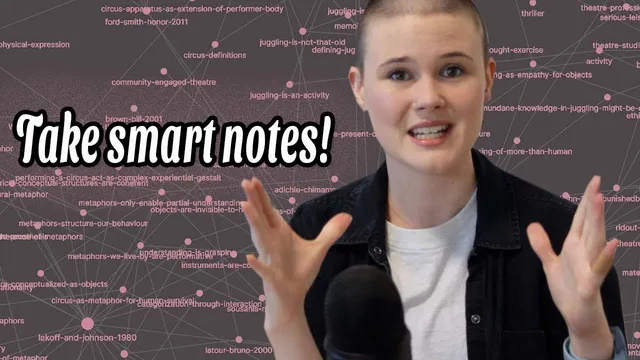
Inside Obsidian, the student organizes materials through linked Markdown notes. A bibliographic note is created for each book, named by the author’s last name and publication date, with an MLA citation at the top. From there, individual idea notes are created using unique identifiers (the student often names them after the note’s thesis). Each idea note links back to its source book and page, then links outward to other idea notes—such as connecting a claim about grades discouraging independent thinking to a separate note about students as “actors in the world.” Over time, the graph view reveals a dense web of connections that would be nearly impossible to reconstruct from notebooks.
The payoff is writing efficiency: when drafting an essay, the researcher can pull in already-written, already-linked notes and focus on ordering and flow rather than redoing the thinking. The final guidance is to trust the system—no single note triggers magic, but the growing network makes future writing easier and reduces the chaos of managing many separate notebooks.
Cornell Notes
Zettelkasten, implemented in Obsidian, is presented as a knowledge-management system for turning fleeting ideas into permanent, interconnected notes. The method relies on four principles: write in your own words, treat all encounters as knowledge, make each note a single irreducible thought, and link every new note to related ideas. The workflow captures quick insights as fleeting notes (including sticky notes while reading) and then converts them into permanent paragraph notes with bibliographic details like page numbers. In Obsidian, bibliographic notes link to idea notes, and idea notes link to other idea notes, building a network that makes later writing faster because the thinking has already been done and connections are already mapped.
Why does the system treat “knowledge management” as more important than organizing by course or keeping stacks of notebooks?
What does “write in your own words” change about how notes function in Zettelkasten?
How does the method decide what becomes a permanent note?
What role do bibliographic notes and page numbers play in the workflow?
How do links and backlinks make writing easier later?
What does “trust the system” mean in practical terms?
Review Questions
- How do fleeting notes and permanent notes differ in purpose and format within this Zettelkasten workflow?
- What are the four core principles, and which one most directly supports long-term retrieval and writing efficiency?
- In Obsidian, how does a bibliographic note connect to an idea note, and why are page numbers included?
Key Points
- 1
Zettelkasten is used as a knowledge-management system, not just a way to organize class notes by course.
- 2
Notes are converted into your own words as focused, irreducible paragraphs so they can be reused later as original thinking.
- 3
Fleeting notes capture ideas quickly (including sticky notes while reading), then permanent notes are created only for ideas worth keeping.
- 4
Each permanent note links back to its source book and page number, with bibliographic notes storing MLA citations.
- 5
The system’s strength comes from building a network of links between idea notes, so writing can draw from already-connected thoughts.
- 6
Obsidian’s backlinks and graph view help reveal and navigate the growing idea network.
- 7
The system improves over time: value increases with the number and quality of connections, not with any single note.