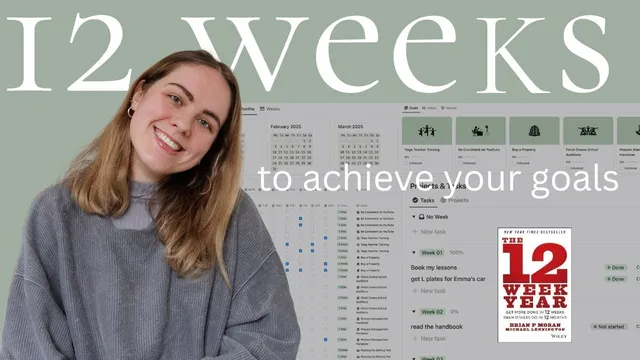
the Ultimate 12 Week Year Goals Set Up in Notion
Based on Ciara Feely's video on YouTube. If you like this content, support the original creators by watching, liking and subscribing to their content.
Use a single Notion hub page as the “current 12we goals” dashboard, with real upcoming events listed to avoid unrealistic scheduling.
Briefing
A Notion template built around the 12 Week Year is being set up to merge long-range goal setting with day-to-day task planning—so progress, habits, and deadlines all live in one system. The core move is turning each 12-week goal into a “weekly scorecard” with linked tasks, projects, and habits, then rolling those scorecards into a single dashboard for weekly planning. The result is a workflow designed to prevent unrealistic planning by forcing goals to be translated into concrete weekly behaviors.
Planning starts from a homepage that functions as the “current 12we goals” hub, with an events section used to avoid scheduling too much around real life. The setup uses a quarter-like structure for overview, but the creator emphasizes that the 12 Week Year can start any time in the year; quarters are optional scaffolding rather than a requirement. Progress tracking is handled through a database view that can be filtered across time (including pulling past-year examples into a new quarter view).
The heart of the system is a goal-planning table organized by “areas of life,” each with sub-areas and a target “goal state” describing where the person wants to land after 12 weeks. Goals are also tied to identity—following a productivity tip attributed to Ali Abdal—so the plan aligns with who the person wants to become (e.g., “content creator,” “drama teacher,” “creative director”). From brainstorming, five major goals are initially selected for the February-to-end-of-April cycle, then expanded to six when yoga teacher training is added.
The goals chosen include: passing the driving test; preparing a management handover (including writing a manager handbook and planning the financial runway for hiring); finishing drama school auditions (with round timing mapped to specific 12-week weeks); buying a property (tracked through viewings, offers, savings, and unplanned spending); building consistency on YouTube (time spent, videos uploaded, views, subscribers, and ad revenue); and yoga teacher training (study and homework across multiple weekends and weeks through May).
Each goal gets its own project/task/habit structure. For the driving test goal, the weekly scorecard auto-fills week starting dates and metrics, while the creator manually defines tasks (book lessons, book the test, get L plates, read the handbook) and projects (practice main driving tasks) with deadlines spread across weeks. Habits are set as recurring frequencies—one driving lesson per week and three practice sessions per week—while optional metrics like “time in car” can be added or removed.
After building the individual goal scorecards, the system links them into a progress dashboard by creating linked database views for each goal. Those dashboards then feed into a general weekly schedule that shows habits by day and surfaces upcoming projects and tasks. The weekly plan is designed around realistic capacity: the creator targets roughly 25 hours of planned work (often closer to 35 with spillover), schedules content creation on specific days, reserves Sunday blocks for yoga study, and fits driving and acting-related practice around teaching and business commitments.
The setup also includes a manual progress-tracking step: weekly goal progress is entered into the linked “goal weekly scorecards” section, then reviewed alongside the general schedule to spot overload before it becomes a problem. By the end, the creator is still deciding which goals to demote or remove—because six active 12-week goals feels misaligned with the system’s intended focus of three to four—while keeping the structure ready to adjust as weeks unfold.
Cornell Notes
A Notion system is built to run a 12 Week Year by converting each goal into a weekly scorecard with linked tasks, projects, and habits. Goals are planned using “areas of life” plus an identity-based target (“I am…”), then translated into week-by-week actions with specific frequencies and deadlines. Separate goal dashboards (driving, management handover, drama auditions, property purchase, YouTube consistency, yoga teacher training) are linked into one progress view, which feeds a general weekly schedule showing habits by day and upcoming work. The practical payoff is tighter planning: real dates and events are checked first, then weekly capacity is used to decide whether goals are realistic or should be demoted.
How does the template turn a broad 12-week goal into something actionable each week?
Why does identity-based goal setting matter in this setup?
What’s the role of linked dashboards in the workflow?
How are real-life constraints used to prevent overloading the 12-week plan?
How does the system handle goals with long timelines that extend beyond 12 weeks?
What metrics and habits are used for the property goal, and why those?
Review Questions
- If you had to add a new 12-week goal to this system, what three elements would you define first (habits, tasks, projects), and how would you decide the weekly frequency?
- How would you use the linked dashboards to detect overload before it derails a week?
- Which parts of the plan are designed to be manual, and which are designed to auto-fill (e.g., week starting dates)?
Key Points
- 1
Use a single Notion hub page as the “current 12we goals” dashboard, with real upcoming events listed to avoid unrealistic scheduling.
- 2
Translate each goal into a weekly scorecard with linked tasks, projects, and recurring habits so weekly planning becomes repeatable.
- 3
Set goals using both “areas of life” (broad + sub-areas) and an identity-based framing (“I am…”), then choose goals that align with that identity.
- 4
Link each goal’s weekly scorecard database into a combined progress dashboard so weekly scoring and review happen in one place.
- 5
Assign deadlines and frequencies at the task/habit level (e.g., one lesson per week, three practice sessions per week) rather than relying on vague intentions.
- 6
Plan weekly capacity explicitly (around 25 hours planned work, often more with spillover) and demote goals when habit load becomes misaligned.
- 7
For goals that extend beyond 12 weeks (like yoga training), split homework into 12-week phases while keeping core habits recurring.