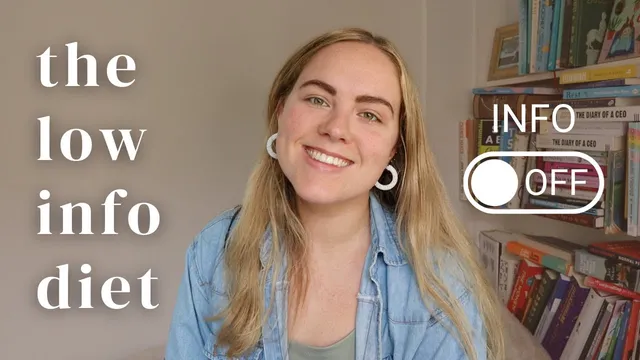
This ONE habit saves me 20+ hours a week
Based on Ciara Feely's video on YouTube. If you like this content, support the original creators by watching, liking and subscribing to their content.
Treat the information diet as a detox: remove most inputs temporarily, then reintroduce selectively with more awareness.
Briefing
A week-long “low information diet” freed up roughly 20+ hours per week by cutting back on the streams of news, notifications, and mindless searching that quietly drain attention and worsen mood. The core claim is that information isn’t just time-consuming—it creates an emotional tax. Negative or unresolved inputs (like breaking news, election updates, and inbox anxiety) leave people in a persistent state of discomfort, which then fuels the need for more distractions. Once that cycle is interrupted, spare time feels uncomfortable at first, but it quickly turns into more intentional evenings, better mood, and more follow-through on real priorities.
The approach is framed as a “detox” rather than a permanent lifestyle. It draws from Tim Ferriss’ “4-Hour Work Week,” where “elimination” includes an information diet, and from “The Artist’s Way,” which recommends “reading deprivation” as part of a broader deprivation practice. The logic is simple: after fully stepping away, people can decide what to reintroduce with more awareness. Many who try it, the transcript says, end up not wanting to bring most inputs back because the benefits—especially mood—outweigh the sense of “being informed.”
The biggest cut is informative media. That includes traditional news, election coverage, and social media feeds that constantly deliver other people’s lives. The transcript argues that most of this content is negative, and even when it’s not, it often creates “information without action”—knowledge that can’t be acted on immediately, leaving dissatisfaction instead of motivation. A practical workaround is to rely on others for updates: if something truly matters, people around you will share it, and we can ask a politically engaged friend for context when needed.
Notifications are treated as another major lever. Instead of checking email and messages first thing in the morning to reduce anxiety, the transcript describes delaying inbox access until 11:00 a.m. The result: mornings became more enjoyable because the person learned to tolerate uncertainty. That change is credited with saving several hours weekly—not by reducing screen time alone, but by reducing the time spent in worry.
Email and messaging also get tied to productivity through context switching. Constant responses interrupt deep work, and the transcript points to productivity frameworks like “Getting Things Done” and “Deep Work” to justify protected focus blocks. The recommendation: emails don’t require instant replies; if urgent responses are truly necessary, that’s a staffing or process issue.
Other cuts include limiting “googling time,” which the transcript estimates at 20+ minutes daily for an anxious, obsession-prone habit. The fix is to track a small list of two “google items” to research later, often discovering they aren’t urgent. Finally, “pleasure media” (TV, fiction reading) is also capped—using the “4-Hour Work Week” guideline of about one hour of TV in the evening and one hour of fiction before bed. TV can be reintroduced in a controlled way (e.g., one episode per night), and reading deprivation is positioned as a temporary reset that makes “dead time” feel less threatening.
The transcript ends with a practical warning: the hardest part is the emptiness after removing distractions. Rather than filling every gap immediately, it recommends leaving pockets of time open to experience control and discover what naturally fits—cleaning, creative work, or other activities that previously got postponed.
Cornell Notes
A “low information diet” is presented as a time- and mood-saving detox from news, social feeds, notifications, constant email checks, and habitual googling. The central mechanism isn’t only fewer inputs—it’s less “information without action,” which the transcript links to dissatisfaction and anxiety. Delaying inbox checks until 11:00 a.m. is described as a major mood improvement, while reducing email responsiveness protects deep work by limiting context switching. The practice also caps pleasure media (TV and fiction) and encourages leaving “dead time” open at first so people can learn what they actually want to do with regained hours. The approach is meant to be temporary, then selectively reintroduced with more intentionality.
What does “information without action” mean, and why does it matter for productivity and mood?
Why does delaying email and notifications improve mornings, according to the transcript?
How does the transcript connect email habits to deep work and context switching?
What’s the proposed method for controlling compulsive googling?
How should “pleasure media” be handled during the diet?
What should someone do with the “spare time” that appears after cutting information?
Review Questions
- Which types of content in the transcript are most likely to create “information without action,” and what alternative strategy is suggested for each?
- How does delaying inbox checks change both mood and productivity, and what time boundary is used as the example?
- What practices are recommended to prevent context switching from emails and messages during deep work?
Key Points
- 1
Treat the information diet as a detox: remove most inputs temporarily, then reintroduce selectively with more awareness.
- 2
Cut “informative media” (news, election updates, and social feeds) because it often delivers negative or un-actionable information that worsens mood.
- 3
Delay inbox and notification checks to reduce anxiety and the emotional cost of uncertainty; the transcript uses 11:00 a.m. as a concrete target.
- 4
Protect deep work by limiting email and message responsiveness; constant replies create context switching that reduces focus.
- 5
Use a short “googling list” (two items) to prevent habitual searching from consuming hours.
- 6
Cap pleasure media (TV and fiction) to avoid replacing information overload with another distraction loop.
- 7
When spare time appears, don’t immediately fill it with rigid plans; leaving pockets open helps people discover what they truly want to do.