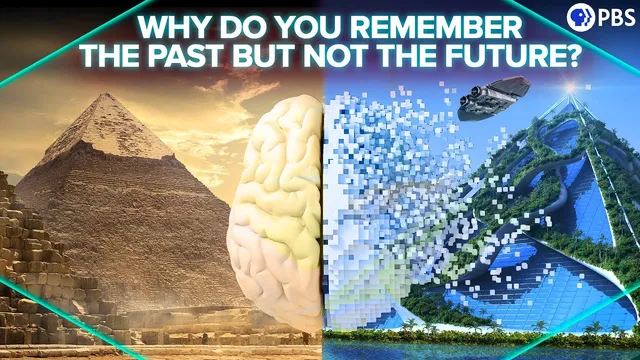
Why Do You Remember The Past But Not The Future?
Based on PBS Space Time's video on YouTube. If you like this content, support the original creators by watching, liking and subscribing to their content.
Time-reversal symmetry in physics means the equations of motion don’t inherently distinguish past from future; the arrow must come from initial conditions and correlation structure.
Briefing
Physics treats time as directionless: the equations governing motion run just as well backward as forward. Yet human experience is sharply directional—memories accumulate from past to present, not from future to present. The core insight is that this mismatch comes from how low-entropy beginnings of the universe enable correlations (and thus records) to build up in one time direction.
The discussion starts with memory as the bridge between thermodynamics and consciousness. At any moment, the brain’s experience is anchored to what came just before, with older events fading into the past. Over longer spans, recall depends on time-ordered records—memories that preserve a sequence from earlier to later. If the universe’s “arrow of time” is tied to the second law of thermodynamics, then the question becomes: why do memory-like records form in the same direction as increasing entropy?
To make that concrete, the transcript uses a simplified “memory” model. An object “remembers” when its current state is correlated with past events in a way that lets those events be reconstructed. An asteroid offers an intuitive example: collisions leave dents and embedded material; cosmic rays carve melt tracks; crystal structures preserve ancient heat. Those correlations let geologists and physicists infer formation history. But the asteroid’s present state does not naturally encode the future. Its future—more impacts, eventual decay into subatomic particles—doesn’t appear written into its current scars.
Time-reversal symmetry in fundamental laws can be illustrated with a proton forming from a positron and a neutral pion, then (in an idealized reversible scenario) decaying back into them after an enormous timescale. In a perfectly deterministic world, the proton’s internal state would allow reconstruction of both its formation and its decay, making the sequence look arrowless. The asymmetry only becomes visible when considering correlations with the environment.
The key move is to compare a normal forward evolution with a time-reversed one. In the reversed asteroid scenario, the rock would look “pre-loaded” with improbable features—like cosmic-ray tracks that are mysteriously erased by a future strike. That implies the asteroid was already correlated with an incoming event that hasn’t happened yet. Such a state is not forbidden by physics; it is extraordinarily unlikely. The same kind of improbability underlies entropy decrease.
So the arrow of time is linked to entropy through correlation. Increasing entropy corresponds to increasing effective correlations among parts of a system—sharing energy, entangling with surroundings, and leaving records. A low-entropy early universe provides a special starting point: correlations are initially scarce, then grow as the universe evolves. Local systems, including brains, inherit that “correlation-lite” beginning. Memory formation is described as the creation of correlations through interactions with the environment; because correlations tend to build in the direction of increasing entropy, memories accumulate in that same direction.
The transcript ends by addressing audience questions about apparent paradoxes: why the early universe seems both random and low entropy, how gravity’s degrees of freedom may account for low entropy (as emphasized by Roger Penrose), and whether quantum randomness or wavefunction collapse would break time symmetry. The takeaway remains that time’s directionality traces back to the universe’s unusually low-entropy beginning and the one-way growth of correlations—sometimes summarized with a thermodynamics pun and capped with a time joke.
Cornell Notes
Time-reversal symmetry in physics doesn’t automatically produce a “past-to-future” experience. The transcript argues that the brain’s directional memories arise because records are correlations: an object “remembers” when its present state is correlated with past events in a way that lets those events be reconstructed. In a time-reversed universe, a system would need improbable, pre-existing correlations with future interactions—like an asteroid already bearing features that a later cosmic ray will erase. Such states are allowed by the equations but are fantastically unlikely, mirroring the improbability of decreasing entropy. Since increasing entropy corresponds to increasing correlations (including via entanglement), the low-entropy beginning of the universe enables correlations—and therefore memories—to build in one time direction.
Why doesn’t the fundamental physics of motion pick a direction for time?
What does the transcript mean by “memory” in physical terms?
How does the proton example show that time symmetry can look perfect in an idealized setting?
What breaks the apparent time symmetry for the asteroid?
How does entropy connect to correlation, and why does that matter for memory?
What do the audience questions add about low entropy and quantum mechanics?
Review Questions
- In the transcript’s correlation-based definition of memory, what specific kind of relationship must exist between an object’s present state and past events?
- Why does the time-reversed asteroid require extraordinarily unlikely pre-existing correlations with future environmental interactions?
- How does increasing entropy translate into increasing correlations, and how does that link to why memories form from past to present?
Key Points
- 1
Time-reversal symmetry in physics means the equations of motion don’t inherently distinguish past from future; the arrow must come from initial conditions and correlation structure.
- 2
Memory is treated as a physical correlation: a system “remembers” when its present state can be used to reconstruct past events.
- 3
A deterministic, isolated system (like an idealized proton) can appear time-symmetric because its internal state could, in principle, encode both formation and decay histories.
- 4
For macroscopic objects, the arrow emerges because normal evolution builds correlations with past interactions, while time-reversed evolution would require improbable correlations with future interactions.
- 5
Increasing entropy is reframed as increasing effective correlations among system components and between a system and its environment.
- 6
The early universe’s unusually low-entropy starting point supplies “correlation-lite” conditions, letting correlations—and thus memory—accumulate in one time direction.
- 7
Questions about low entropy and quantum mechanics focus on gravity’s constrained degrees of freedom and whether randomness/collapse would break time-reversal symmetry.