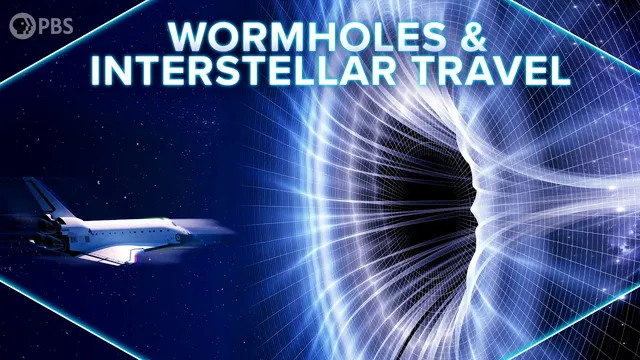
Will Wormholes Allow Fast Interstellar Travel?
Based on PBS Space Time's video on YouTube. If you like this content, support the original creators by watching, liking and subscribing to their content.
Schwarzschild-based wormhole geometries are not traversable once spacetime evolution is accounted for; the throat pinches off too fast for light to pass.
Briefing
Wormholes remain a staple of science fiction, but the physics trail from Einstein’s earliest ideas to modern constraints points to one bottom line: the most famous wormhole solutions pinch off too fast to traverse, and the traversable versions require “exotic matter” that likely can’t exist in the needed form. That combination—no stable, traversable geometry plus severe causality safeguards—explains why interstellar shortcuts are still firmly in the realm of imagination.
The story begins with solutions to general relativity that hinted at wormhole-like structures long before anyone had a workable travel mechanism. In 1915, Karl Schwarzschild found a solution to Einstein’s new field equations that later became understood as describing a black hole. In 1916, Ludwig Flamm recognized that, in certain coordinate descriptions, the geometry isn’t a one-way dead end but a two-sided funnel connecting regions of spacetime. In 1935, Albert Einstein and Nathan Rosen extended this into what became known as the Einstein–Rosen bridge, imagining two regions as overlapping layers of the same universe. Early interpretations even made the bridge seem like a particle analog when electromagnetic field lines threaded the funnels—an idea that didn’t survive contact with what real particles are.
The causality problem is where wormholes start to look dangerous. John Archibald Wheeler and his student Bob Fuller realized that the bridge could connect distant regions of the same universe rather than separate layers, potentially allowing near-instant travel if the wormhole throat stayed short. But that same setup invites time travel: if one mouth is accelerated and its clock “freezes” relative to the other, traversing the non-moving end could send a traveler back to the moment the other end was first accelerated. To prevent such paradoxes, Fuller and Wheeler dug into the Schwarzschild wormhole’s full spacetime evolution using Kruskal–Szekeres-type diagrams, where the wormhole throat effectively collapses. Their result: even light can’t get through—so the Schwarzschild wormhole is not traversable.
Traversable wormholes require a different engineering problem. Kip Thorne and Michael Morris showed that general relativity allows wormhole geometries with a stable throat, but the required stress-energy must violate the usual energy conditions—often described as “exotic matter,” such as negative energy density or outward pressure without the enormous mass-energy that would normally accompany it. The Casimir effect can produce negative energy density between closely spaced conducting plates, yet it’s far too weak, and any traveler would still have to pass through regions of extreme negative energy. Matt Visser proposed alternative geometries that keep exotic matter away from the traveler’s path, but the broader issue remains: exotic matter is not known to exist.
Even if exotic matter were found, deeper theoretical safeguards loom. Many physicists lean on Stephen Hawking’s chronology protection conjecture to prevent closed timelike curves, alongside Roger Penrose’s cosmic censorship conjecture that hides singularities behind event horizons. Some speculative loopholes exist—such as wormholes associated with rotating or charged black holes—but they’re expected to be unstable and, crucially, there’s no reliable way to know where such a shortcut would lead.
The episode closes with two pragmatic conclusions. First, creating a traversable wormhole from scratch is far beyond current capability, and perhaps fundamentally blocked by exotic-matter and stability constraints. Second, wormholes still matter scientifically: the Einstein–Rosen bridge has inspired ideas linking spacetime geometry to quantum entanglement, including the ER=EPR conjecture associated with Leonard Susskind and Juan Maldacena. In other words, wormholes may not deliver faster-than-light travel—but they could help explain how reality stays connected at the quantum level.
Cornell Notes
General relativity contains wormhole-like solutions, but the best-known Schwarzschild-based wormholes collapse too quickly for anything—including light—to pass through. Fuller and Wheeler showed that when spacetime evolution is included, the wormhole throat pinches off, eliminating traversability and blocking the time-travel scenarios that would otherwise follow. To build a traversable wormhole, Thorne and Morris found that the geometry needs a stable throat supported by “exotic matter,” typically tied to violations of general relativity’s energy conditions. Mechanisms like the Casimir effect generate negative energy density, but the effect is too weak and would likely endanger travelers. Even if exotic matter existed, chronology protection and cosmic censorship conjectures suggest nature resists the paradoxes traversable wormholes could cause.
Why did early wormhole ideas fail as travel routes even though they appeared in Einstein’s equations?
How do Kruskal–Szekeres-style spacetime diagrams change the wormhole story?
What makes a wormhole traversable in principle, and what blocks it in practice?
Why is “exotic matter” more than just negative mass?
What theoretical safeguards make traversable wormholes look paradox-prone?
How do wormholes still matter even if travel is unlikely?
Review Questions
- What specific result did Fuller and Wheeler obtain that ruled out traversing the Schwarzschild wormhole?
- What role do energy conditions play in determining whether a wormhole can remain open, and how does exotic matter relate to that?
- Which conjectures are invoked to prevent time-travel paradoxes and expose singularities, and how do they constrain wormhole scenarios?
Key Points
- 1
Schwarzschild-based wormhole geometries are not traversable once spacetime evolution is accounted for; the throat pinches off too fast for light to pass.
- 2
Einstein–Rosen bridges and later wormhole interpretations can suggest two-sided connectivity, but causality and full spacetime dynamics eliminate the travel possibility.
- 3
Traversable wormholes require a stable throat supported by exotic matter that violates general relativity’s energy conditions.
- 4
The Casimir effect can produce negative energy density, but it is far too weak and would likely expose travelers to harmful negative-energy regions.
- 5
Chronology protection and cosmic censorship conjectures are widely used to argue that nature blocks the paradoxes traversable wormholes could enable.
- 6
Even without faster-than-light travel, wormholes influence modern physics by motivating ideas like ER=EPR and connections between spacetime geometry and quantum entanglement.