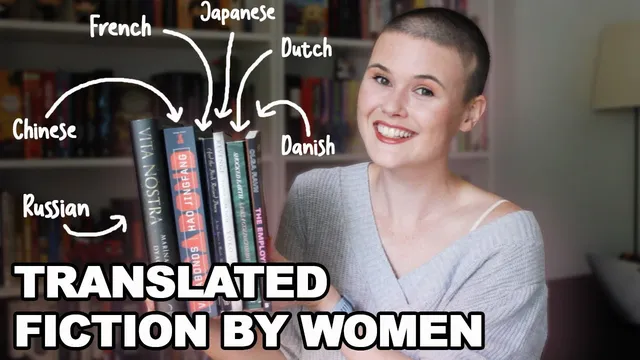
women's writing translated from TEN languages
Based on morganeua's video on YouTube. If you like this content, support the original creators by watching, liking and subscribing to their content.
Women in Translation Month is tied to a measurable imbalance: only about 30% of translated fiction and poetry into English in the U.S. is by women.
Briefing
Translated fiction by women is presented as more than a way to “travel” through stories—it’s a route into how different cultures build genres, tropes, and definitions of good writing. The month-long push behind Women in Translation Month (organized by the Women in Translation Movement, founded in 2013) frames the stakes: only about 30% of fiction and poetry translated into English in the United States is by women. Morgan’s personal shift is the real throughline—after realizing she loves translated fiction, she commits to reading exclusively women’s books translated into English from other languages, assembling ten recommendations from ten different countries and languages.
The list begins with a French-Canadian entry that doubles as quiet escapism: Jocelyn Saucier’s And the Birds Rained Down, translated by Rhonda Mullins. Set in northern Ontario, it follows two elderly men living in isolation in the forest, protected by misdirection from a hotel friend. Their solitude is disrupted by a relentless photographer hunting survivors of the Great Fires nearly a century earlier. At roughly 150 pages, it’s pitched as a short, absorbing retreat into the woods—while still carrying the emotional weight of memory and survival.
From there, the recommendations pivot sharply into dystopia, place-based politics, and formal experimentation. Agustina Basterraika’s Tender as the Flesh (Spanish; translated by Sarah Moses) imagines a future where animals develop a disease poisonous to humans, forcing society into veganism or cannibalism. The book’s most unsettling mechanism is linguistic: humans are sanitized through euphemisms (“special meat” and “heads”), while a meat-packaging middleman becomes morally unmoored when he’s gifted a female head. The story is tied to the author’s own shift away from meat, but it’s also framed as an indictment of capitalist consumerism’s habit of objectifying people.
Saskia Goldschmidt’s Shocked Earth (Dutch; translated by Antoinette Fawcett) grounds fiction in environmental catastrophe. Inspired by gas extraction in Groningen/Hroninen and decades of earthquakes, it follows a farming family whose attempt to go organic collides with relentless tremors and political denial. Goldschmidt’s reported method—living in the region for a full year to learn the land firsthand—feeds the book’s vivid sense of place.
Science fiction and literary form take center stage next with Olga Ravn’s The Employees (Danish; translated by Martin Aitken). Built from statements to ship administration, it centers on humanoid and human workers investigating mysterious objects brought aboard—objects that evoke scent, emotion, and nostalgia, blurring what counts as “human.” The inspiration is partly artistic (a Copenhagen sculpture program) and partly philosophical, including interest in writing where identity belongs to a group rather than a single protagonist.
The remaining titles deepen the range: Olga Tokarczuk’s Drive Your Plow Over the Bones of the Dead (Polish; translated by Antonia Lloyd Jones) pits an elderly woman’s animal-vs-hunter theory against indifferent police; Oksana Zabushko’s Fieldwork in Ukrainian Sex (Ukrainian; translated by Helena Hren) reads like a shifting, lecture-like stream of consciousness on nationhood, gender, and sexuality; Marina and Sergey Dyachenko’s Veda Nostra (Russian; translated by Julia Hersey) follows a girl’s strange, abusive school acceptance through a philosophical lens; Yangsze’s The Strange Beasts of China (Chinese; translated by Jeremy Cheung) uses framed magical realism and romance-like episodes to explore love and humanity.
Han Kang’s The Vegetarian (Korean; translated by Deborah Smith) turns vegetarianism into a social interrogation of norms and the right to want death, while Yoko Ogawa’s The Memory Police (Japanese; translated by Steven Snyder) treats disappearance and forgetting as a system enforced by a Memory Police—more dystopian-mystical than hard sci-fi. Across all ten, the core message is consistent: translated women’s writing doesn’t just broaden subject matter; it reshapes how stories are structured, morally framed, and emotionally experienced.
Cornell Notes
Morgan’s month of reading women’s translated fiction builds a case that translation is a gateway to different storytelling systems—genres, tropes, and even ideas of “good writing” shaped by place and culture. The Women in Translation Movement’s goal (founded in 2013) matters because only about 30% of translated fiction and poetry into English in the U.S. is by women. The recommendations range from French-Canadian escapism (Jocelyn Saucier’s And the Birds Rained Down) to dystopian moral language (Agustina Basterraika’s Tender as the Flesh) and place-based environmental politics (Saskia Goldschmidt’s Shocked Earth). Other picks experiment with form and perspective, including Olga Ravn’s The Employees and Yoko Ogawa’s The Memory Police, while still tackling big questions about humanity, memory, and social norms.
Why does the list treat translated fiction as more than “international travel” through books?
What makes And the Birds Rained Down (French-Canadian) stand out among the recommendations?
How does Tender as the Flesh (Spanish) use language to intensify its dystopia?
What real-world event anchors Shocked Earth (Dutch) and why does that matter for reading it?
What formal choice defines The Employees (Danish) and what themes does it serve?
How do The Vegetarian (Korean) and The Memory Police (Japanese) differ in what they’re “about,” despite both being unsettling?
Review Questions
- Which recommendation most directly links storytelling style to cultural training, and what evidence from the descriptions supports that?
- Pick one book from the list that uses euphemism or forgetting as a mechanism of control. How does that mechanism shape the reader’s moral response?
- Across the ten titles, which ones rely on a framing device (documents, lectures, nested stories), and what does that framing let each book do?
Key Points
- 1
Women in Translation Month is tied to a measurable imbalance: only about 30% of translated fiction and poetry into English in the U.S. is by women.
- 2
Reading translated fiction is framed as a way to learn different storytelling conventions—genres, tropes, and standards of “good writing”—not just new settings.
- 3
And the Birds Rained Down pairs short-form escapism with themes of survival and historical memory through a photographer’s relentless search.
- 4
Tender as the Flesh uses euphemistic language (“special meat,” “heads”) to sanitize cannibalism and expose how moral discomfort can be managed socially.
- 5
Shocked Earth grounds fiction in environmental politics by drawing on decades of earthquake activity linked to gas extraction and denial by authorities.
- 6
The Employees experiments with form by building the story from employee statements, turning “human” into a question negotiated through objects and group testimony.
- 7
The Memory Police treats disappearance and forgetting as an enforced system, making the book feel more like dystopian magical realism than conventional sci-fi.