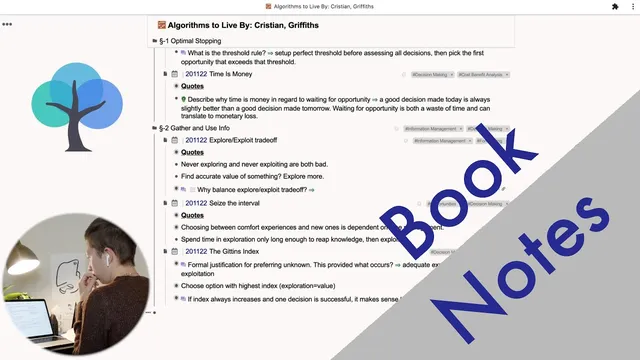
Write Book Notes In RemNote With Me (30 min)
Based on Red Gregory's video on YouTube. If you like this content, support the original creators by watching, liking and subscribing to their content.
Use note titles that accurately reflect the content inside each note, not just the book’s subsection heading.
Briefing
The core takeaway is a practical workflow for turning a nonfiction book into a usable, searchable knowledge base—using RemNote to both store notes and convert them into flashcards—while avoiding two common pitfalls: mismatched note titles and “collector’s fallacy” note-taking. The approach matters because notes only become valuable when they can be retrieved later, and when their organization reflects the actual content they contain.
The process starts with how notes are titled. When a book’s chapter and subsection headings are used as note titles, the titles should match the material inside the note. The workflow flags a specific failure mode: grabbing a quote from one topic while keeping the subsection title from another. For example, if a subsection title suggests “clinical trials on trial” but the captured quote is about “decision making,” the title becomes misleading. The fix is to rename the note so the title reflects what’s actually being stored. If the physical book’s navigation depends on the original subsection numbering, the method keeps that structure by using the chapter/subsection number (e.g., “3”) while adjusting the wording so the note’s context stays accurate.
The second principle is retrieval-first note-taking. Instead of writing simply to accumulate information, the workflow explicitly aims to avoid the collector’s fallacy—collecting notes without a clear reason to retrieve them. Every note is treated as something the author expects to use again, not as a permanent archive of everything read. That retrieval mindset is positioned as the difference between a knowledge base that supports learning and one that becomes clutter.
From a tooling standpoint, the workflow frames knowledge bases as a combination of dumping notes from multiple sources and connecting them through tags or links. Many programs can do that, but RemNote is singled out for combining linking/tagging with built-in flashcard creation “pretty seamlessly.” The motivation is to get a more robust system without splitting responsibilities across multiple tools—specifically for students building a serious knowledge base who want flashcards but don’t want to rely on Anki alongside another note app.
The session is also presented as an experiment: notes are written in real time while studying Brian Christian and Tom Griffiths’ Algorithms to Live By: The Computer Science of Human Decisions. The book is described as an accessible introduction for readers who aren’t already steeped in computer science, with ideas tied to everyday decision-making. The practical goal is to apply the workflow while taking notes from this text, testing whether the retrieval-first, context-correct method produces a knowledge base that is both navigable and study-ready through RemNote’s flashcard layer.
Cornell Notes
A retrieval-first system for book notes keeps organization accurate and prevents clutter. Notes are titled to match the actual content inside each note; if a quote comes from a different topic than the subsection heading, the title is adjusted (often keeping the numbering for physical-book navigation). The workflow also avoids the collector’s fallacy by writing only notes that are meant to be retrieved later. RemNote is used because it supports linking/tagging and can turn notes into flashcards without needing a separate flashcard tool. The method is applied live to Algorithms to Live By: The Computer Science of Human Decisions by Brian Christian and Tom Griffiths.
Why does matching a note’s title to its content matter, and what’s the concrete fix when it doesn’t?
What is the collector’s fallacy in the context of note-taking, and how does the workflow counter it?
How does the workflow define a knowledge base, and what functions are considered essential?
Why is RemNote positioned as a better fit than splitting tools, according to the workflow?
What makes Algorithms to Live By a suitable test case for this note workflow?
Review Questions
- When would you change a book note’s title, and what numbering strategy helps keep navigation consistent?
- How does retrieval-first note-taking reduce the risk of collector’s fallacy?
- What two RemNote capabilities are emphasized as making it a one-stop system for knowledge bases?
Key Points
- 1
Use note titles that accurately reflect the content inside each note, not just the book’s subsection heading.
- 2
If a quote belongs to a different topic than the subsection title, rename the note while keeping numbering for physical-book navigation.
- 3
Avoid collector’s fallacy by writing only notes intended for later retrieval and use.
- 4
Treat knowledge bases as connected systems: dump notes, then link or tag them for retrieval.
- 5
Choose tools based on whether they combine linking/tagging with flashcards, not just storage.
- 6
RemNote is presented as a single workflow that supports both knowledge-base linking and flashcard creation.
- 7
Apply the method to a real book while testing whether the notes remain navigable and study-ready.