You need a connection to your notes
Based on morganeua's video on YouTube. If you like this content, support the original creators by watching, liking and subscribing to their content.
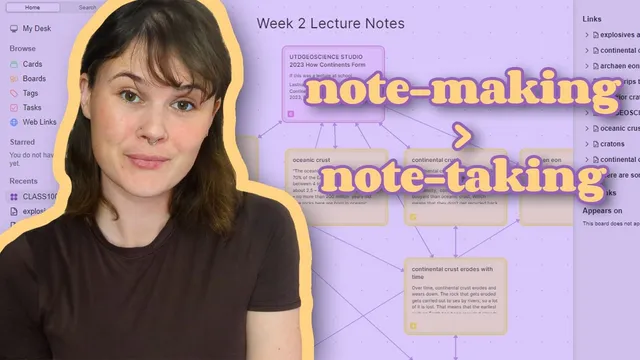
Permanent notes require connections: a literal link inside the note system and ideally an emotional link that makes the idea personally relevant.
Briefing
Making lecture notes “stick” in coursework-heavy natural sciences comes down to building personal, emotional connections—not just copying facts. Permanent notes in a Tiddly/“Zettelkasten”-style workflow form only after a learner links new information to existing knowledge and lived experience, turning outside material into personal knowledge that can be remembered and recombined creatively.
The core distinction is between fleeting notes and permanent notes. Fleeting notes are temporary captures made before something earns a place in the system. Permanent notes arrive only after the learner creates a literal connection inside their notes (through linking) and, ideally, an emotional connection that makes the idea feel part of their own thinking. That relationship-building mindset is framed as similar to getting to know a person: find common ground, then deepen it. For someone who doesn’t naturally care about rocks or physical concepts, the strategy is to look for overlap—such as shared interests, personal memories, or broader questions—so the subject becomes integrated rather than merely memorized.
To demonstrate the method, the creator uses Obsidian in earlier context but performs the walkthrough in Scrl (spelled “scrl” in the transcript), a visual note-taking tool that combines an infinite canvas with documents and bidirectional linking. The example board is organized around a class (“Natural Science lectures”), with one main lecture note and separate cards for individual pieces of information. After importing a lecture transcript (from a YouTube example titled “how continents form”), the learner extracts key facts into linked sub-notes—such as continental crust eroding over time and the implication that Earth’s earliest continental rock has already been recycled and is inaccessible.
The “deeper connection” step is where creativity enters. Instead of treating erosion as just geology, the learner connects it to a pre-existing theme: knowing is never finished. A new note (“there are some things we will never know”) is created and explicitly linked back to the erosion idea. Then the learner searches for a craton near home—finding the Superior Craton spanning central Canada and parts of Quebec and Ontario—and ties it to childhood drives to Sudbury, where massive roadside rocks and drill holes sparked curiosity. Even details not mentioned in the original lecture become part of the learning story: drill holes are interpreted as evidence of explosives used for highway construction, leading to reflections on how human “mastery” can be destructive and on whether highway builders treated humans as separate from the environment.
This process is mapped to a learning taxonomy: “ICE” (Ideas, Connections, Extensions). The lecture provides Ideas; linking creates Connections; and the final Extensions are original questions and creative writing that emerge from the integrated understanding. The result isn’t just better recall of geology terms like cratons—it’s a pathway to writing creative nonfiction about the human-environment relationship, grounded by scientific context.
The takeaway for students in natural science coursework is direct: expect the work to take more time, but treat it as learning through challenge. If the content feels boring, the fix is to build personal links and then use those links to generate new questions, reading, and creative nonfiction that connect niche science to philosophical and lived experience. The creator also recommends popular creative nonfiction examples such as Robin Wall Kimmerer’s Braiding Sweet Grass and Elizabeth Tova Bailey’s A Snail’s Pace / Sounds of a Wild Snail Eating as models for turning scientific knowledge into personal meaning.
Cornell Notes
Permanent notes in a Zettelkasten-style system form only after a learner builds connections—both inside the notes (via linking) and in their own mind (via emotional relevance). The transcript contrasts fleeting notes (temporary captures) with permanent notes that become part of personal knowledge. Using Scrl, the creator organizes a class board, imports a lecture transcript, extracts key facts into linked cards, and then goes further by connecting those facts to existing themes and lived experience. The Superior Craton example shows how a geology term becomes memorable through personal geography (Sudbury drives) and reflective meaning (highway explosives and human impact). This linking process can reach “Extensions,” where new ideas and creative nonfiction emerge from the integrated understanding.
What separates fleeting notes from permanent notes in a Zettelkasten workflow?
How does bidirectional linking change the way lecture information becomes usable later?
Why does the creator treat “knowing is never finished” as a connection worth building?
How does the Superior Craton example turn a technical term into a memory and a story?
What is the role of “ICE” (Ideas, Connections, Extensions) in the learning process described?
What practical advice is given for making natural science coursework feel less dry?
Review Questions
- How would you decide whether a lecture fact should become a permanent note rather than a fleeting note?
- Describe a personal connection you could build to a natural science topic you currently find boring. What existing theme or memory could you link it to?
- In the ICE framework, what would count as an “Extension” for your own notes, and how would you know you reached that stage?
Key Points
- 1
Permanent notes require connections: a literal link inside the note system and ideally an emotional link that makes the idea personally relevant.
- 2
Treat note-making as relationship-building—find common ground between the subject matter and your own interests, memories, or questions.
- 3
Use a structured board (class → lecture → fact cards) so extracted facts become navigable nodes rather than isolated summaries.
- 4
Let scientific details trigger broader reflections; for example, continental crust erosion can connect to themes about what humans can never fully know.
- 5
Search for real-world, local, or lived examples (like a nearby craton) to turn terminology into something you can picture and remember.
- 6
Use the ICE progression—Ideas → Connections → Extensions—to move from recall to original questions and creative nonfiction.
- 7
Expect the process to take more time, but treat that challenge as part of learning rather than a sign the material is wrong for you.