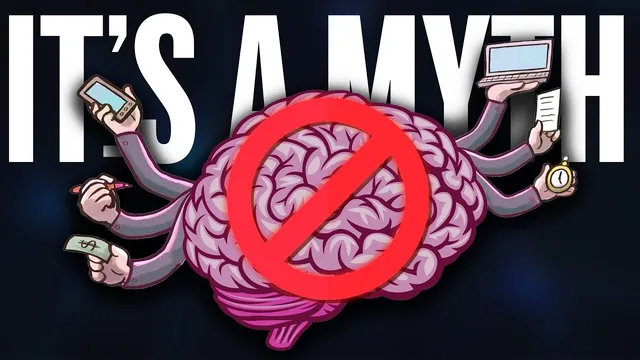
Your brain CAN'T Multitask - Here's why
Based on Artem Kirsanov's video on YouTube. If you like this content, support the original creators by watching, liking and subscribing to their content.
Attention is a limited resource that selects which information gets processed deeply enough to support learning.
Briefing
Multitasking fails not because the brain lacks willpower, but because attention is a limited, costly resource—and every switch leaves behind “attention residue” that drags down working memory. The core claim is that the brain can’t instantly reorient from one task to another without paying a cognitive price, so rapid glances at messages or frequent context changes quietly reduce the quality of learning and thinking.
Attention is framed as the brain’s priority-setting mechanism. With constant sensory input from sight, sound, touch, pain, temperature, and internal bodily signals—plus self-generated thoughts—the cortex faces far more information than it can process at once. To manage this bottleneck, the thalamus acts like both a filter and a relay station. It converges signals from across the body and then either blocks irrelevant information from reaching the cortex or amplifies what matters, effectively deciding what gets “green light” for deeper processing. The thalamus is portrayed as a lighthouse: its beam eliminates what isn’t attended while boosting what is.
What counts as “relevant” isn’t purely bottom-up. The thalamus receives feedback from the cortex, with the basal ganglia mentioned as a neurobiological middleman in that loop. In everyday terms, when someone listens in class, the cortex biases the system toward the lecture—amplifying the teacher’s voice and pointing gestures—while suppressing distractions like tight pants or a pen clicking in the background. A similar filtering process is suggested within higher cortical systems, where attention can be captured either by the lecture or by internal distractions such as daydreaming about lunch or someone in the room.
This attentional gating matters because learning depends on information reaching the right stages of processing. When attention is absent, information can stall at lower levels and may never become consciously available. With attention, sensory information can move upward toward the prefrontal cortex, where it can trigger reverberating activity linked to long-term plasticity—the strengthening of neural connections. Dopamine is introduced as a neuromodulator tied to both motivation/novelty and attention, and it is linked to boosting neuronal plasticity, making attended and novel information more likely to be learned.
The productivity punchline comes from the “attention residue” concept. Even brief task switching—like checking social media messages and returning to the original task—doesn’t fully reset the mind. A shadow of the previous task persists in working memory, consuming cognitive resources and creating “mental friction.” The result is lower clarity and reduced capacity to think effectively, which is why multitasking is so unreliable in practice. The takeaway is straightforward: attention is limited, switching it has a measurable cost, and minimizing distractions and context changes is essential for better learning and work performance.
Cornell Notes
Attention is presented as the brain’s priority filter that decides which information reaches the cortex for processing and learning. The thalamus is described as a relay-and-filter system that blocks irrelevant inputs and amplifies what matters, guided partly by feedback from the cortex. Learning is said to require attention because unattended information can get stuck at lower processing stages and may never reach areas involved in long-term plasticity. A key productivity concept is “attention residue”: after switching from task A to task B, a lingering trace of task A remains in working memory, creating cognitive friction. This residue helps explain why multitasking and frequent distraction reduce thinking quality even when the switch seems brief.
Why does the brain need attention in the first place?
How does the thalamus function in attention?
What does attention look like in a classroom example?
Why is attention essential for learning and long-term memory changes?
What is “attention residue,” and how does it undermine multitasking?
Why do quick distractions still matter even if they take only milliseconds?
Review Questions
- How do the thalamus and cortical feedback work together to determine what information gets amplified versus blocked?
- Explain attention residue and describe why it makes multitasking less effective even when task switching is brief.
- What mechanisms link attention to long-term plasticity, and where does dopamine fit in that relationship?
Key Points
- 1
Attention is a limited resource that selects which information gets processed deeply enough to support learning.
- 2
The thalamus functions as both a filter and a relay, blocking irrelevant signals and amplifying attended ones before they reach the cortex.
- 3
Attention can be guided by cortical feedback, with the basal ganglia mentioned as part of the neurobiological pathway.
- 4
Learning depends on attended information reaching higher processing stages; unattended inputs can stall at lower levels.
- 5
Dopamine is tied to attention, novelty, motivation, and neuronal plasticity, strengthening the link between focus and learning.
- 6
Task switching carries a hidden cost called attention residue, where a trace of the previous task persists in working memory.
- 7
Frequent context changes reduce clarity by creating mental friction, making multitasking unreliable for high-quality thinking.