How I Use Deep Work as a Computer Science PhD Student | Bullet Journal Spreads for Productivity
Based on Ciara Feely's video on YouTube. If you like this content, support the original creators by watching, liking and subscribing to their content.
Deep work is defined as distraction-free, cognitively demanding work that improves skills and creates new value; shallow work is logistical, often distracted, and usually produces little new value.
Briefing
Deep work is presented as the core survival skill for PhD students in an attention-scarce world: long stretches of distraction-free concentration that enable both rapid mastery of hard problems and high-quality, high-output knowledge creation. Drawing on Cal Newport’s framework, the transcript argues that modern academic work increasingly gets swallowed by “shallow work”—logistical, low-cognitive tasks done while distracted—that rarely produces new value. The practical takeaway is blunt: if a PhD is meant to generate new findings and technology, then protecting deep-work time is no longer optional; it’s the mechanism that turns effort into elite output.
Newport’s “deep work hypothesis” is used to connect the dots between demand and scarcity. The need for deep work rises because research requires sustained cognitive effort to produce novel work, yet distraction makes that effort harder to complete. Deep work, in contrast, is defined as professional activity carried out in distraction-free concentration that pushes cognitive capabilities to their limit, improves skills, and is difficult to replicate. Shallow work is defined as non-cognitively demanding tasks—often logistical—performed while distracted and easily copied, typically yielding little new value.
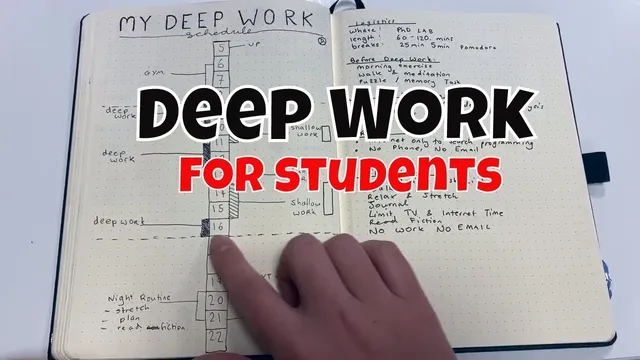
To make deep work workable, the transcript lays out multiple scheduling philosophies from Newport: monastic (isolate from shallow work entirely, even for extended periods), bimodal (alternate blocks of fully deep time with periods for shallow tasks), rhythmic (repeat a daily deep-work window, often the same hours each day), and journalistic (alternate deep and shallow tasks within the same day). The author’s own approach blends rhythmic and journalistic: about 90 minutes of deep work, then 60 minutes of shallow work, then another 90 minutes of deep work, followed by additional shallow blocks and a final deep block—typically landing around four hours of deep work per day.
The routine begins before the first deep-work block. Mornings include gym time, walking, mindful meditation, and a puzzle to “get into the zone.” During breaks, walking is used again—ideally without audio—to help reset attention and support problem-solving after hours of focus. To train focus, the transcript mentions memory competitions and uses Sudoku as a daily pre-deep-work ritual. Location and friction matter too: deep work happens in a lab desk setup, with headphones used as a “do not disturb” signal, notifications disabled, and email treated as a shallow-work activity rather than an interruption.
Internet access is allowed when needed for programming, but social media and email are kept out of deep blocks. The transcript also recommends scheduling internet access across the day so shallow periods can absorb it, while evenings shift toward internet-free recovery.
For goal-setting and accountability, the transcript applies the 4DX framework (from The Four Disciplines of Execution): focus on what’s “wildly important,” track lead measures (like deep-work time) alongside lag measures (outputs such as writing progress and working models), keep a compelling scoreboard by marking days with hours and notable insights, and maintain weekly evaluation and planning. Finally, it emphasizes rest as part of the system—ending work cleanly, assigning unfinished tasks to future time, and avoiding late-night email loops—so the brain can consolidate learning and generate new insights. The overall message is that deep work improves with practice: early sessions may feel limited, but consistent scheduling and habit-building can expand focus capacity over time.
Cornell Notes
Deep work is framed as the key practice that lets PhD students master hard material quickly and produce high-quality research output despite rising distraction. Newport’s definitions separate distraction-free, cognitively demanding deep work from shallow, logistical tasks that are easy to replicate and rarely create new value. The transcript turns the idea into a system: choose a deep-work scheduling style (monastic, bimodal, rhythmic, or journalistic), then protect those blocks with calendar scheduling, clear break rules, and strict boundaries for email and social media. It also adds focus training (meditation and Sudoku), uses the 4DX framework to track lead and lag measures, and treats rest as essential by ending work and avoiding after-hours email. Consistent practice is presented as what builds the ability to sustain longer deep-work sessions.
What distinguishes deep work from shallow work, and why does that distinction matter for a PhD?
How does the transcript translate Newport’s scheduling philosophies into a workable daily plan?
What practical tactics are used to protect deep-work focus from interruptions?
How does the transcript use 4DX to measure progress in deep work?
Why is rest treated as part of the deep-work system rather than downtime after it?
What focus-training rituals are mentioned, and how are they positioned in the workflow?
Review Questions
- How would you classify common PhD tasks (e.g., email, literature reading, coding/debugging, meetings) as deep or shallow based on the transcript’s definitions?
- Design a weekly deep-work plan using one of the four scheduling styles (monastic, bimodal, rhythmic, journalistic). What lead and lag measures would you track?
- What end-of-work routine would you implement to prevent after-hours worry and protect next-day deep focus?
Key Points
- 1
Deep work is defined as distraction-free, cognitively demanding work that improves skills and creates new value; shallow work is logistical, often distracted, and usually produces little new value.
- 2
Deep work becomes scarce as distraction rises, even though research demands sustained concentration to generate new findings—making focus protection essential for PhD progress.
- 3
Choose a scheduling philosophy (monastic, bimodal, rhythmic, or journalistic) and then commit deep-work blocks to the calendar to reduce decision fatigue.
- 4
Protect deep-work sessions by isolating email/social media/internet to shallow blocks, disabling notifications, and using friction signals (like headphones) to prevent interruptions.
- 5
Use focus-entry rituals (walking, meditation, Sudoku) and mindful breaks to reset attention and support problem-solving after long focus stretches.
- 6
Track progress with 4DX: set wildly important priorities, measure lead inputs (deep-work hours) alongside lag outputs (writing progress and working models), and review weekly.
- 7
End the workday cleanly with an off-ramp routine so rest supports insight generation rather than late-night work draining next-day performance.