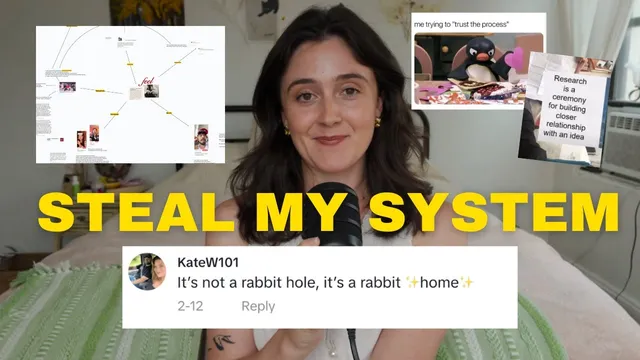
How to Manage Multiple Interests & Actually CREATE Something
Based on Anna Howard's video on YouTube. If you like this content, support the original creators by watching, liking and subscribing to their content.
Use Sublime “cards” to capture interesting items during passive scrolling so they don’t scatter across platforms and become unrecoverable.
Briefing
The core breakthrough here is a practical workflow for turning scattered curiosity into finished creative work—without fighting distraction head-on. Instead of treating research and creation as separate phases, the process uses a single system to (1) capture interests while scrolling, (2) “garden” ideas without pressure, and then (3) convert the best threads into a visual mind map that naturally leads toward an outline or project. The payoff is less mental overhead and fewer dead ends caused by algorithm-driven recommendations.
A key problem is attention fragmentation. The creator describes how the attention economy encourages passive scrolling—saving interesting items as bookmarks or random folders—until months of vague interests sit across multiple platforms and can’t be found again. To fix that, she saves everything as “cards” inside Sublime during the passive stage. Cards are individual pieces of media (quotes, posts, links, videos), and each card is assigned to a “collection” plus a privacy setting.
Collections become the organizing backbone. Some collections are thematic (agency, sensuality, resistance, desire, love and romance, grief), while others serve specific emotional or practical purposes—like a “self-trust bank” where supportive messages and proof of reliability are kept private for later reassurance. Public cards aren’t treated like social media; they don’t show up as related recommendations for other people when they’re private, but public cards can still generate “related cards” suggestions that keep ideas moving.
That related-cards feature is the engine for escaping algorithm dependence. Rather than combing through search results, ads, and SEO noise, a single quote can pull a web of connected sources. An example centers on Elizabeth Gilbert’s Big Magic, where ideas are framed as independent, energetic entities that seek manifestation through human collaboration. Starting from that one quote, Sublime surfaces related quotes from other authors (including Rick Rubin and a line from “Ideas are alive and you are dead”), letting curiosity follow a coherent scent instead of a platform’s feed.
When it’s time to create, the workflow shifts from collecting to mapping. The “canvas” feature is used to build a mind map from a central seed—often a quote from one’s notes or a visual reference (like an image of Kurt Vonnegut). From there, branches grow into themes such as stoicism, pain and war, or other sub-threads. The system supports both internal search (only within one’s own library) and broader search (across Sublime), including tangential references that help ideas collide.
Mind mapping isn’t treated as rigid planning; it’s treated as a way to let the project morph. A behind-the-scenes example from an earlier episode shows how a branch that was expected to be minor (presence) expanded into a more central theme after Andrea Gibson’s passing, changing the episode’s direction without forcing a linear rewrite. The creator credits mind mapping with better memory and creativity, citing guidance like using images in the center, connecting branches in curved layouts, and keeping one keyword per line.
The final message is motivational but grounded: honoring creativity means stepping outside algorithmic autopilot and paying attention to what curiosity keeps returning to. The workflow—cards for capture, collections for meaning, related cards for navigation, and canvas for transformation—turns distraction into a structured path toward actual output.
Cornell Notes
The workflow presented turns curiosity into creation by using one system to capture interests, connect them, and then visualize them as a mind map. During passive scrolling, items are saved as “cards” in Sublime so they don’t scatter across platforms and get lost. During “digital gardening,” cards are organized into collections and explored without a fixed end goal, allowing ideas to evolve. When a project is ready, a Sublime canvas converts a central seed (a quote, idea, or image) into branching themes, using related cards to follow a coherent “scent” of curiosity. This matters because it reduces algorithm dependence and lowers the mental load of turning research into an outline.
Why does saving ideas during passive scrolling often fail, and what does the “cards” approach change?
How do collections and privacy settings support both creative work and emotional resilience?
What’s the practical advantage of Sublime’s “related cards” compared with traditional search?
How does the canvas feature convert research into a creation-ready plan without locking the creator into a linear outline?
What mind-mapping guidelines are used to make the process effective?
How does the workflow address the fear of being distracted or overwhelmed by too many interests?
Review Questions
- How does saving items as Sublime cards during passive scrolling prevent the “lost source” problem described in the transcript?
- What role do collections and privacy settings play in keeping exploration both organized and emotionally supportive?
- Describe how a canvas mind map can change direction midstream without derailing the project.
Key Points
- 1
Use Sublime “cards” to capture interesting items during passive scrolling so they don’t scatter across platforms and become unrecoverable.
- 2
Organize cards into collections (thematic or purpose-based) to create structure for later exploration and retrieval.
- 3
Treat “digital gardening” as a no-pressure phase that allows curiosity to branch, rather than forcing immediate project outcomes.
- 4
Use related cards to follow a coherent chain of ideas from a single starting quote, reducing dependence on algorithmic feeds and noisy search results.
- 5
Convert research into creation by building a canvas mind map from a central seed (quote, idea, or image) and letting branches evolve.
- 6
Mind mapping supports flexible planning: branches can grow or shift in importance as new context emerges, avoiding stressful linear rewrites.
- 7
Honor creativity by stepping outside algorithmic autopilot and paying attention to what curiosity keeps returning to.