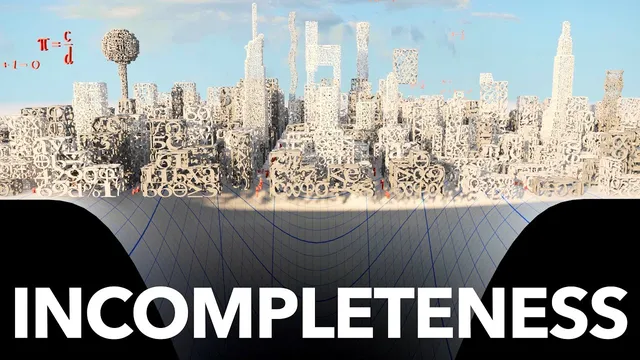
Math's Fundamental Flaw
Based on Veritasium's video on YouTube. If you like this content, support the original creators by watching, liking and subscribing to their content.
Any formal system capable of basic arithmetic contains true statements that cannot be proven within that system.
Briefing
Math has a built-in limit: for any sufficiently powerful system that can do basic arithmetic, there will always be true statements that no proof can ever derive. That “hole” matters because it turns questions that sound like pure logic—like whether twin primes are infinite—into problems that may be unanswerable in principle, not just difficult in practice.
The transcript connects this inevitability to a chain of ideas starting with John Conway’s Game of Life. The game uses a simple rule set on an infinite grid: dead cells with exactly three live neighbors become alive, while live cells with fewer than two or more than three neighbors die. Even with those minimal rules, patterns can stabilize, oscillate, travel (like a glider), or grow without bound. The key question—whether a given starting pattern eventually settles down or grows forever—turns out to be undecidable. There is no algorithm guaranteed to determine the “ultimate fate” of every possible pattern within finite time.
That same undecidability theme shows up across mathematics and beyond. The transcript traces it back to self-reference and the foundations of set theory. In 1874, Georg Cantor used diagonalization to show that infinities come in different sizes: the real numbers between 0 and 1 are uncountable, meaning no list can match them one-to-one with natural numbers. But Cantor’s work also triggered a broader crisis over what mathematics should accept as legitimate. Intuitionists rejected parts of set theory as human-made fiction; formalists—led by David Hilbert—wanted a rock-solid logical foundation.
Bertrand Russell then exposed a self-referential paradox in naive set theory: considering the set of all sets that do not contain themselves leads to a contradiction (“it contains itself if and only if it doesn’t”). The fix came by restricting what counts as a set, but self-reference kept resurfacing.
Hilbert’s program aimed to answer three questions: completeness (every true statement provable), consistency (no contradictions), and decidability (an algorithm to determine provability). Kurt Gödel shattered completeness with his incompleteness theorem: by encoding statements and proofs into numbers (Gödel numbers) and constructing a statement that effectively says “this statement has no proof,” Gödel showed that any system capable of arithmetic must contain true but unprovable statements. Gödel also proved that a consistent system cannot prove its own consistency.
Finally, Alan Turing addressed decidability through the halting problem. If there were a general method to predict whether any computation halts, it would also decide whether statements follow from axioms—by searching for a proof until the target theorem appears. But Turing’s diagonal-style construction shows that such a halting-decider cannot exist. The transcript then broadens the point: many systems are “Turing complete,” meaning they can simulate arbitrary computations, so they inherit undecidable properties. In quantum physics, for example, determining whether a system has a spectral gap is undecidable in general; in the Game of Life, the undecidable property is whether the pattern ever halts.
The upshot is not that math collapses, but that certainty has boundaries. The pursuit of those boundaries reshaped infinity, helped define modern computation, and even influenced real-world codebreaking and computer design—turning logical paradoxes into the engine behind the machines people use today.
Cornell Notes
The transcript argues that any mathematical system strong enough to do basic arithmetic will contain true statements that cannot be proven, and it will also lack a universal algorithm to decide provability. Conway’s Game of Life provides a vivid example: despite simple rules, no guaranteed method exists to determine the long-term fate of every starting pattern. This undecidability traces back to self-reference, which surfaced in set theory through Cantor’s diagonalization and later Russell’s paradox. Gödel formalized the limits of proof using Gödel numbering and an unprovable self-referential statement, while Turing proved that no general halting predictor exists—making decidability impossible in general. The result is a “hole” at the bottom of math that also appears in other Turing-complete systems, including aspects of quantum physics.
Why does Cantor’s diagonalization imply that some infinities are larger than others?
How does Russell’s paradox arise from self-reference, and why did it force changes to set theory?
What is the core mechanism behind Gödel’s incompleteness theorem?
How does Turing’s halting problem connect to undecidability in mathematics?
Why is the Game of Life’s “ultimate fate” undecidable even though its rules are simple?
What does “Turing completeness” buy you, and why does it imply undecidability in many domains?
Review Questions
- What specific self-referential construction does Gödel use (via Gödel numbering) to force the existence of true but unprovable statements?
- Explain how a hypothetical halting-decider would translate into an algorithm for deciding whether a statement is derivable from axioms, and why Turing’s contradiction blocks that possibility.
- In the Game of Life, why does the simplicity of local update rules not guarantee that global behavior is decidable?
Key Points
- 1
Any formal system capable of basic arithmetic contains true statements that cannot be proven within that system.
- 2
Conway’s Game of Life has an undecidable “ultimate fate” problem: no algorithm can always determine whether a pattern eventually halts or grows without bound.
- 3
Cantor’s diagonalization shows that infinities differ in size, establishing uncountable sets such as the real numbers between 0 and 1.
- 4
Russell’s paradox demonstrates how self-reference can break naive set theory, forcing restrictions on what counts as a set.
- 5
Gödel’s incompleteness theorem uses Gödel numbering to build a statement that effectively asserts its own unprovability, proving incompleteness for arithmetic-capable systems.
- 6
Turing’s halting problem shows there is no general algorithm to predict whether computations halt, which implies undecidability for provability from axioms.
- 7
Many Turing-complete systems inherit undecidable questions, including certain problems in quantum physics such as the spectral gap question.